Corporations far beyond Starbucks want to keep baristas out of unions.
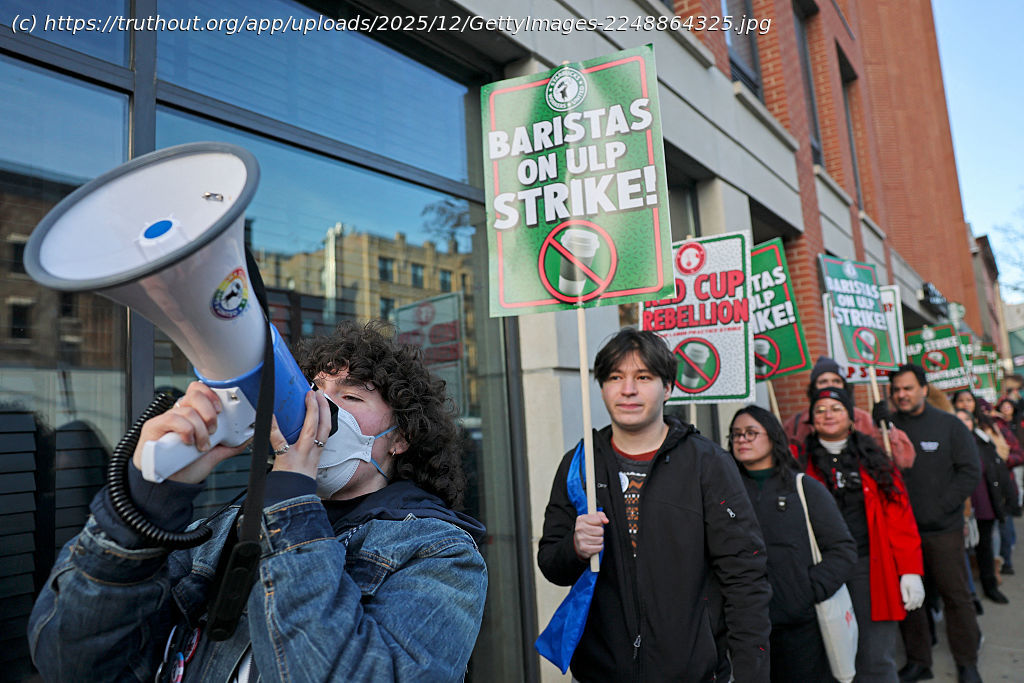
Thousands of Starbucks workers across a hundred cities are nearly one month into an expanding, nationwide unfair labor practice strike in protest of the coffee giant’s “historic union busting and failure to finalize a fair union contract,” according to Starbucks Workers United, the barista union that has spread to over 650 stores since its birth in Buffalo four years ago.
The strike comes after years of illegal anti-union antics by Starbucks and follows a historic $39 million settlement announced on December 1 for more than 500,000 labor violations committed by Starbucks management in New York City since 2021.
The rise of Starbucks Workers United has energized the U.S. labor movement, as the struggle to unionize the mega-chain represents far more than baristas pitted against managers: Starbucks is a trend-setting global powerhouse and one of the top U.S. employers. Current fights at places like Starbucks and Amazon will shape the labor movement for decades to come.
This is well understood by industry leaders, in no small part because of Starbucks’s deep interlocks with major corporations across numerous sectors. At its highest levels of governance and management, Starbucks’s closest industry ally may be Walmart, the top U.S. corporate employer and a long-time anti-union stalwart. Starbucks and Walmart, along with other corporations represented on Starbucks’s board of directors, also support major industry groups that carry out the retail and service sectors’ wider agenda of weakening unions.
Moreover, while Starbucks positions itself as a leader on climate and sustainability, it recently brought a longtime board director of oil giant Chevron onto its board, a move that lends legitimacy to accusations of hypocrisy leveled by baristas against the company.
All told, striking baristas are not merely up against the executives of a coffee store behemoth, but a broader constellation of corporate power fully networked into Starbucks’s top leadership. The New Starbucks Regime
In September 2024, Starbucks hired Brian Niccol as its new CEO — its fourth since 2022. Starbucks sales were stagnant, and Niccol, who had been Chipotle’s CEO since 2018, had a reputation as a successful food service executive. Starbucks’s stock shot up a record 24 percent with the news of Niccol’s hiring.
Under his watch at Chipotle, the company paid $240,000 to workers who sought to unionize a shop in Augusta, Maine, that the company shuttered, and Chipotle was accused of withholding raises from unionizing workers in Lansing, Michigan.
Nearly 500 Starbucks stores had unionized by the time Niccol took over. The new Starbucks’s CEO emphasized boosting sales at stores and promised “high-quality handcrafted beverage[s] to our cafe customers in four minutes or less” — experienced by baristas as speed-ups and surveillance.
Niccol’s total compensation package last year as Starbucks CEO was an astounding $95.8 million. The AFL-CIO ranked Niccol as the fifth-highest paid CEO of 2024, and Starbucks’s 2024 CEO-to-worker pay ratio was an astronomical 6,666-to-1.
Niccol’s also garnered controversy — and the ire of baristas — for accepting a company-paid remote office in Newport Beach, California, and commuting 1,000 miles on Starbucks’s corporate jet to its Seattle headquarters.
The highest governing body over Starbucks — which hired Niccol and can fire him — is the company’s board of directors. Mirroring the CEO turnover, the majority of Starbucks’s board is today composed of new faces compared to just a few years ago.
For the prior 20 years, the Starbucks board had been anchored by Mellody Hobson, who also sits on the board of JPMorgan Chase, the U.S.’s top bank, and is married to billionaire filmmaker George Lucas.
Today, the major corporate ties represented on Starbucks’s board through current or recent past executive or director positions cut across industries, from telecoms (T-Mobile and AT&T) to tech (YouTube and Yahoo), agriculture (Land O’ Lakes) to apparel (Nike), hotels (Hilton) to finance (BlackRock), and much more.