A robot vacuum and mop with a detachable deep cleaner
The $999.99 Eufy Omni E28 is the first hybrid robot vacuum and mop we’ve tested with a detachable handheld deep cleaner. Its roller mop offers serious scrubbing power, its base station effectively keeps the robot clean between runs, and its handheld cleaner adds versatility, helping you remove stains from carpet and upholstery. That said, despite offering a lofty 20,000Pa of suction power, the robot delivered underwhelming vacuum performance in our tests. The Ecovacs Deebot X8 Pro Omni ($1,299.99) doesn’t have a handheld component like the Eufy, but it offers superior autonomous cleaning performance and obstacle avoidance, plus a more streamlined base design, so it remains our Editors’ Choice for high-end mop and vacuum hybrids. Features: 3-in-1 Versatility
The Eufy E28’s standout feature is its FlexiOne deep cleaner, a portable handheld device that is similar to the Bissell Little Green ($123.59) and Hoover CleanSlate (starting at $119.99). The FlexiOne is also the E28’s main upgrade compared with the $899.99 Eufy E25, which otherwise shares the same specs.
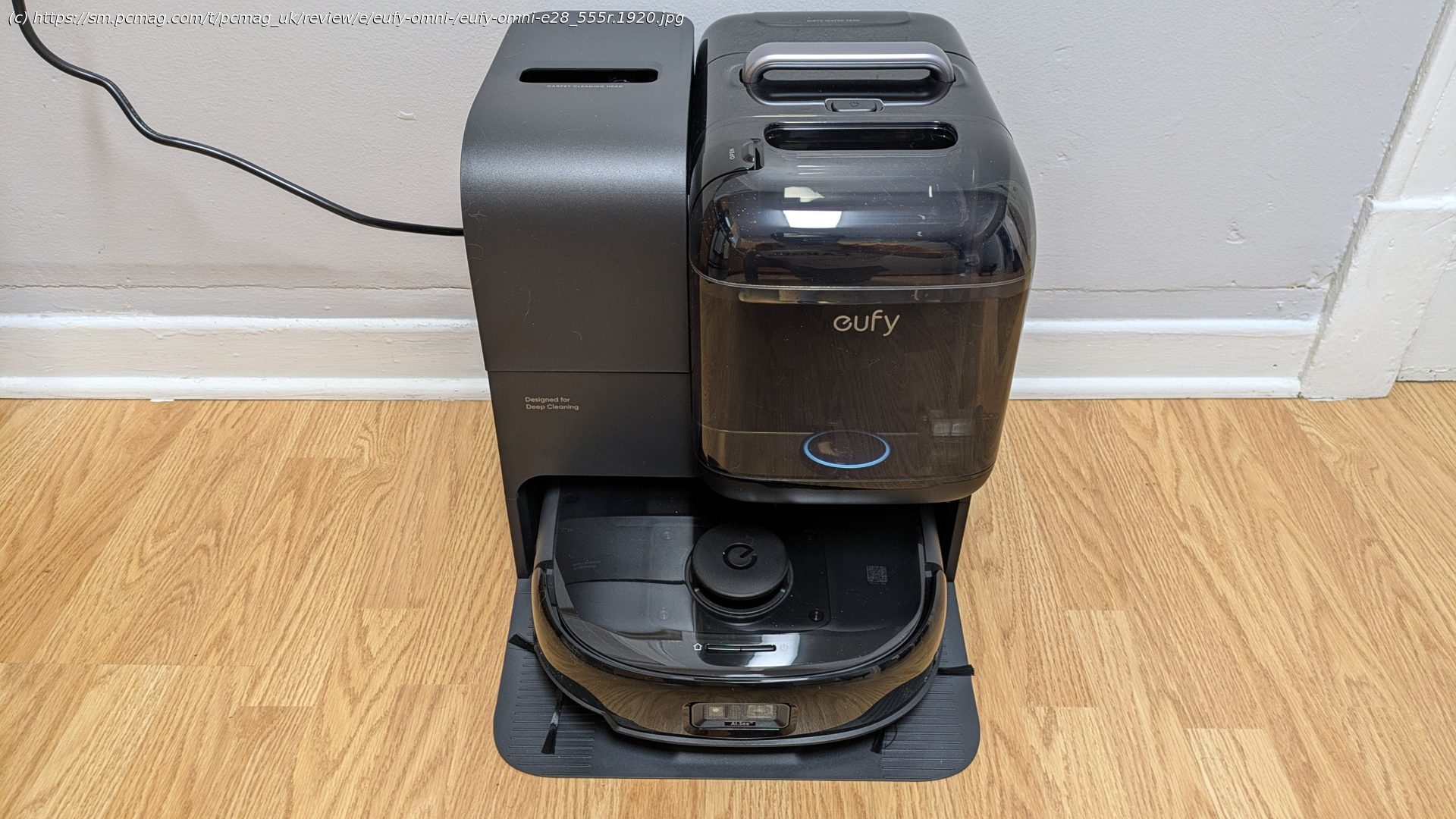
The modular FlexiOne lifts away from the lower portion of the robot’s base, bringing with it the plug and motor, the clean and dirty water tanks, and a nozzle attached to a hose. With that nozzle, you can spritz and scrape your furniture or carpet to tackle wet messes and set-in stains.
The E28 has an impressive list of features and specs beyond the handheld cleaner. The robot vacuum offers 20,000Pa of suction power, beating the Ecovacs Deebot X8 Omni’s 18,000Pa and falling just shy of the $1,599.99 Roborock Saros 10’s class-leading 22,000Pa. Instead of one brush roll on the bottom, it features DuoSpiral Brushes designed to prevent tangles and clogs. One of the brush rolls can shift to the side, creating a gap through which hair and fur are funneled into the robot.
Its HydroJet mop system resembles a paint roller and exerts 3.3 pounds of downward pressure to scrub your floors, as scrapers on either side keep it clean while it works. This is a relatively unique mop style for robot floor cleaners, though the Deebot X8 has a similar design. Most other high-end models use dual spinning mop pads, which have proven effective at wiping up stains, but ineffective at limiting cross-contamination as they work.
You can control the Eufy E28 with voice commands to Amazon Alexa or Google Assistant, and it navigates with a combination of LiDAR for mapping and an RGB camera to avoid obstacles. When done cleaning, the Eufy E28 navigates back to its base station to automatically empty its dustbin. The base station also washes and dries the mop with hot water and hot air, respectively, and then refills the robot’s tank with clean water and detergent from separate reservoirs in the base.
Other than the mop design and the deep cleaner, the E28’s features are common, but attractive for its price. It’s missing a few niceties of the Deebot X8 and the Saros 10, including the ability to wash the inside of its base station to combat grime buildup. Otherwise, it checks off all other boxes for a high-end robot hybrid.
The E28 succeeds the Eufy E20 ($649.99), which has 8,000Pa of suction power and a cordless vacuum attachment instead of a deep cleaner. The Eufy Omni S1 Pro ($1,499.99) is still the company’s highest-priced model, and though it only has 8,000Pa of suction and no deep cleaning attachment, its base station offers a unique Eco-Clean Ozone feature that sanitizes the tap water in its reservoir before putting it to use in the robot. Design: Modular, But Clunky
Thanks to its deep cleaner, the E28 looks unlike any other robot floor cleaner I’ve tested. The bottom part of the base station is typical, with a bay area acting as the robot vacuum’s charging dock. Hidden compartments for the dust bag and mopping detergent sit just above the robot’s bay on the left and right sides, respectively.
The FlexiOne unit takes up the entire top half of the base station and detaches via a handle. The motor, clean water tank, and dirty water tank all sit on the right side of the unit, below the handle. Near the handle is a power button to start deep cleaning and a flip-open notch for quickly filling the removable clean water tank. The see-through front plastic lets you check the water level in the clean tank at a glance. The dirty water tank sits opposite the clean tank, on the back of the unit. Both water tanks have recessed handles, allowing you to detach them from the rest of the unit for emptying or refilling.
The hose sits on the left side of the FlexiOne, with plastic slots to wind it tight to the body when not in use. The E28 comes with a plastic cover that slides over the top of the hose when it is wound in place for aesthetic purposes. That cover helps the overall style to an extent, but the E28 clearly puts function over form, and isn’t nearly as sleek as the Roborock Saros 10.
With the FlexiOne unit removed, the robot’s base has a visible power receptor where the deep cleaner rests. Lifting and returning the FlexiOne isn’t quite seamless. The back of the unit has a plastic protrusion for winding the power cord, and it causes the rest of the machine to not sit flush against the wall. Putting the FlexiOne back on the base without knocking this plastic piece into the wall, and moving the whole base as a result, requires precision. I found myself fidgeting with the position of the base every time I tried to return the deep cleaner to its resting place.
The robot vacuum itself is square with rounded edges, instead of the more customary circular shape. The top features a LiDAR tower and two physical buttons: One starts and pauses a run, and the other sends the robot home. A clear plastic cover with cutouts for the tower and the buttons lifts away from the robot to allow manual access to the dustbin and filter. A button behind the dustbin pops out the robot’s water tank. The front side has a bumper and an RGB camera for object detection.
On the bottom of the robot, side brushes sit at both front corners, with one capable of extending away from the body to reach into wall corners and edges. The robot has two main wheels flanking the centered DuoSpiral Brushes with a caster wheel at the front. Edge sensors circle the perimeter. The roller mop spans the width of the vacuum toward the rear, and unlike the brush rolls, it is not removable.