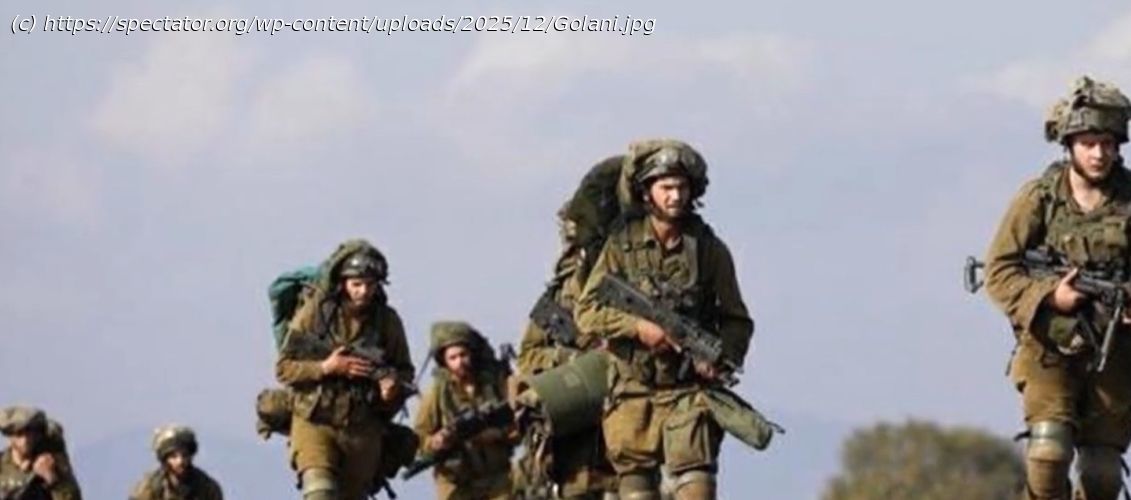
On December 17th I watched a broadcast by the Israel Defense and Security Forum of a Hannukah celebration by the.A Golani Brigade celebration illuminates a Jewish presence that long predates modern politics—and hints at what may come next.
On December 17th I watched a broadcast by the Israel Defense and Security Forum of a Hannukah celebration by the storied IDF Golani Brigade in Gaza. More specifically the celebration took place in Rafah, the area of Gaza where a year ago the Biden administration admonished Israel not to go with his famous, “Don’t.” It was a joyous celebration as have been all Hannukah celebrations that I have personally attended this year even after the horrific terror attack at a Jewish Hannukah celebration on Bondi beach in Sydney, Australia. There was the lighting of candles with the customary blessings along with singing and circle dancing. I didn’t see any latkes or sufganot (Jewish Hannukah donuts) being served but there were probably some on hand. was this the first Hannukah celebration in that now famous territory because Jewish on and off Jewish communities have existed in Gaza for hundreds of years, well before the founding of Islam.
As to Gaza, until Trump is willing to give Israel the go-ahead to disarm Hamas … Israel has declared the Yellow line to be the new border with Gaza.
Although it was not reported in the mainstream media, shortly after the IDF began operations in Gaza following the October 7th invasion by Hamas, Israeli soldiers were praying in an ancient synagogue in the territory dating back to 508 A.D., predating the founding of Islam by a century. Characteristically its floor used to contain a mosaic depicting a man playing the harp. (After the Six-Day War it was defaced by Arabs and consequently moved to the Israel Museum for protection.) The harpist’s name, David, is written on the floor in Hebrew, it Nor being a mosaic of King David.
Earlier on, in the 3rd century Gaza contained a Jewish town called Kfar Darom. That town was destroyed numerous times but at the end of the 19th century, its land was acquired by Tuvia Miller of the city of Rehovot who transformed its swamps into a blossoming orchard. And then, once again, Arabs destroyed the orchard and its well during the anti-Jewish riots of 1936 to 1939. Jews returned to Kfar Darom in October 1946 along with 10 other communities, but the town was once again evacuated during Israel’s War of Independence following the Egyptian siege of 1948 and 1949. Then history repeated itself when it became the first Jewish community to be rebuilt in Gaza following the 1967 Six-Day War.