There’s no other handheld offering what the Nintendo Switch 2 does at its price.
It’s been six months since the Nintendo Switch 2 finally stepped out into the light of day. The inevitable tragedy of any new product is that the novelty quickly dissipates. Despite having it in hand for half a year, fans, detractors, and even Nintendo itself seem to be underestimating just how this iterative handheld/console hybrid device may hold the secret to even better handhelds of tomorrow.
Nintendo would rather you focus on its first-party games. At the same time, the PC crowd is still too obsessed with getting their hands on the latest and greatest chips to recognize the benefit of handheld-specific game optimization. The result is only ever a small bump in frame rate that won’t truly impact the overall quality of titles. Even when the Switch 2’s on-paper specs don’t seem to hit the mark as handhelds that cost $200, $550, or $900 more, its console-based hardware has managed to keep pace in 2025. Time will tell whether it will stay that way into 2026 and beyond.
The Switch 2 is a model for how the old ways of making consoles may still win in the long run. The 5-year-old Xbox Series S and Series X, as well as the PlayStation 5, are PCs in everything but name. They’re both working on AMD APUs, or accelerated processing units, that make porting games between consoles and PCs relatively easy. The Switch 2 is the outlier. It’s using an Nvidia-made chip that is based on an entirely distinct ARM-based microarchitecture. Public statements from numerous developers show porting games to Switch 2 isn’t straightforward. Still, because of Nvidia’s hardware-specific DLSS (deep learning super sampling) upscaling, games on Nintendo’s handheld are just as playable.
The Switch 2 isn’t a replacement for a PC. It’s a device that also hides its share of hidden costs. I had to buy an extra 256GB microSD Express card for the sake of downloading all these games I’ve played throughout the year. And to that end, Nintendo seems to be emphasizing digital media with the proliferation of game key cards—rather than the collectible physical media you can actually claim to own. Nintendo also brought us the first $80 game, and it’s still trying to force consumers to accept a new pricing standard for a hobby that’s getting ever more expensive.
The Switch 2 may not stay $450 for long, either. Because of the RAM shortage, consoles and PCs alike will probably cost more in 2026. The best advice I can offer is that you should get the console you want now and enjoy it while it lasts.Switch 2 manages to hold its own
The original Switch was a secondary console for many players; only there to play Nintendo’s first-party titles not available elsewhere. The Switch 2 has the potential to be a primary device, especially for those who live a mobile gaming lifestyle. With its lower power draw, limited memory, slim design, and minimal battery, it can’t offer the same fidelity as more expensive machines. The thing is, you need to compare it to other available handhelds. In that regard, the Switch 2 makes games look just as good for a fraction of the cost.
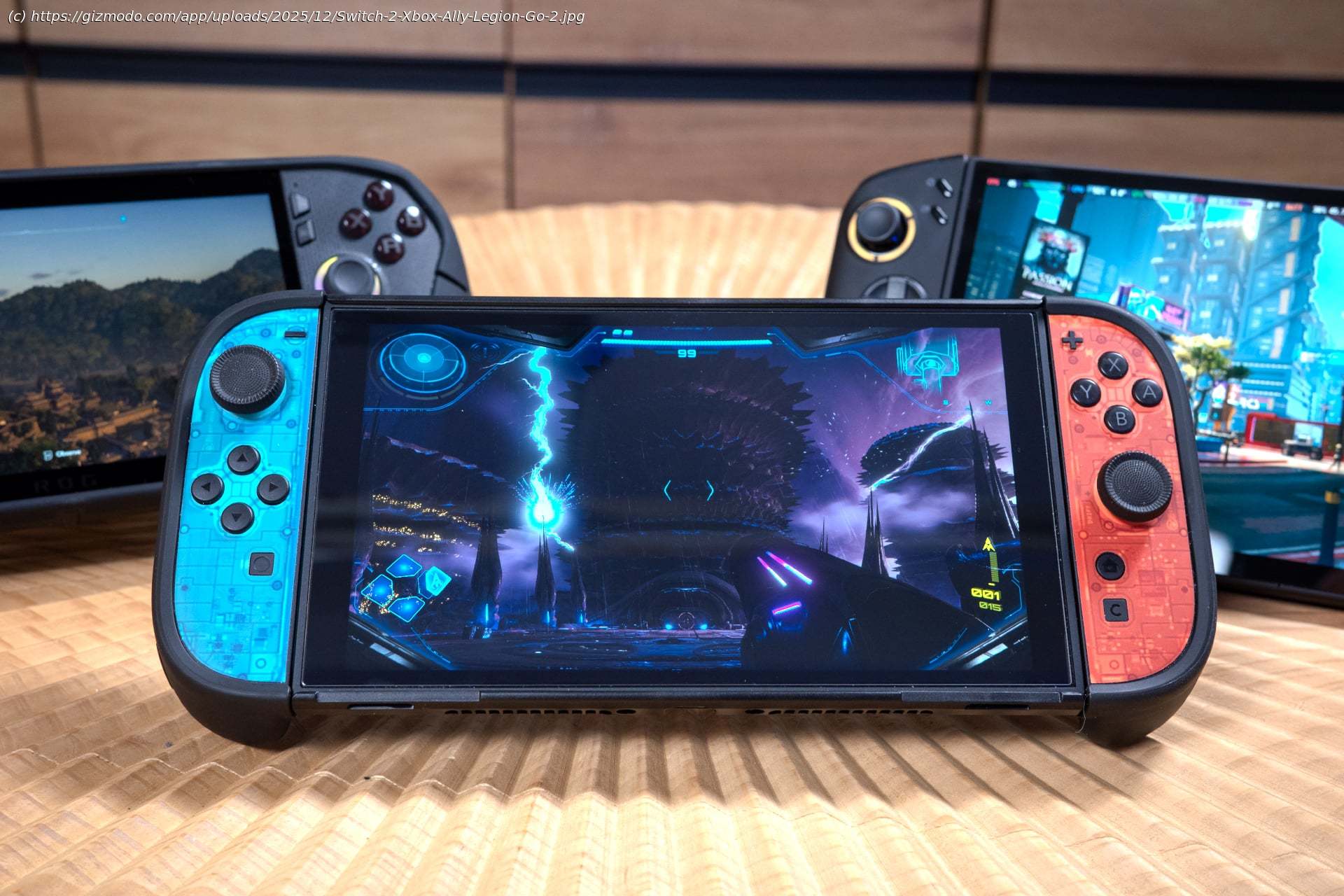
With all the 2025 handhelds at hand, I made an effort to compare performance between all available systems, in official and non-official configurations. This year, I tested the $650 Legion Go S with SteamOS, the $1,350 Legion Go 2, and—finally—the $1,000 Asus ROG Xbox Ally X. These are all handheld PCs. They are all running various operating systems, though they’re all powered by AMD chips built for this form factor. Some sport better screens, like the Legion Go 2’s beautiful OLED display, and they feature more console-like controls than the Switch 2. I tested each handheld at its maximum resolution, but PC gamers have the choice to reduce graphical quality for the sake of performance; the Switch has far fewer options.
I dual-booted the Legion Go 2 with Bazzite as well as Windows 11. Bazzite is a Linux-based operating system similar to SteamOS. The Asus ROG Xbox Ally X is running Windows, but with the full screen experience, a version of the OS that lets you navigate to your games with a controller. The new UI is still buggy. However, Microsoft has made strides with preset game profiles so that you don’t have to finagle graphics or mess with TDP (thermal design power). Both Linux-based handhelds offer better performance on the same specs compared to Windows 11, even to this day.