The Elegoo Mars 5 Ultra is one of the easiest resin printers to recommend, combining excellent 9K detail with thoughtful automation that removes much of the friction new users typically face—all at a remarkably accessible price.
Elegoo first made waves in consumer 3D printing with budget-friendly resin machines that delivered surprising detail for the price. Over the past decade, its lineup has expanded in resolution, mechanics, and usability. From the original Mars series that helped democratize high-quality resin printing to larger formats like the Saturn family, Elegoo’s portfolio now serves beginners and experienced makers alike. Into that progression comes the Mars 5 Ultra ($349.99), a compact resin printer that combines a 9K-resolution monochrome LCD, a latest-tech light source, and a tilting resin vat designed to reduce peel forces and improve print reliability. With automatic build-plate leveling, an onboard camera for live monitoring and time-lapse recording, and streamlined software, the Mars 5 Ultra targets first-time resin users and budget-conscious hobbyists who want modern features without stepping up to a larger or pricier system like the Saturn 4 Ultra 16K.
Until recently, many printers at this price required careful manual setup and trial-and-error to produce consistent results. The Mars 5 Ultra simplifies your early prints and reduces common failure points. Resin printing still has inherent messiness and a learning curve, but the Mars 5 Ultra represents one of today’s strongest value propositions in consumer resin 3D printing. It earns an Editors’ Choice award for budget resin models.Unboxing and Setup: Familiar Elegoo Care
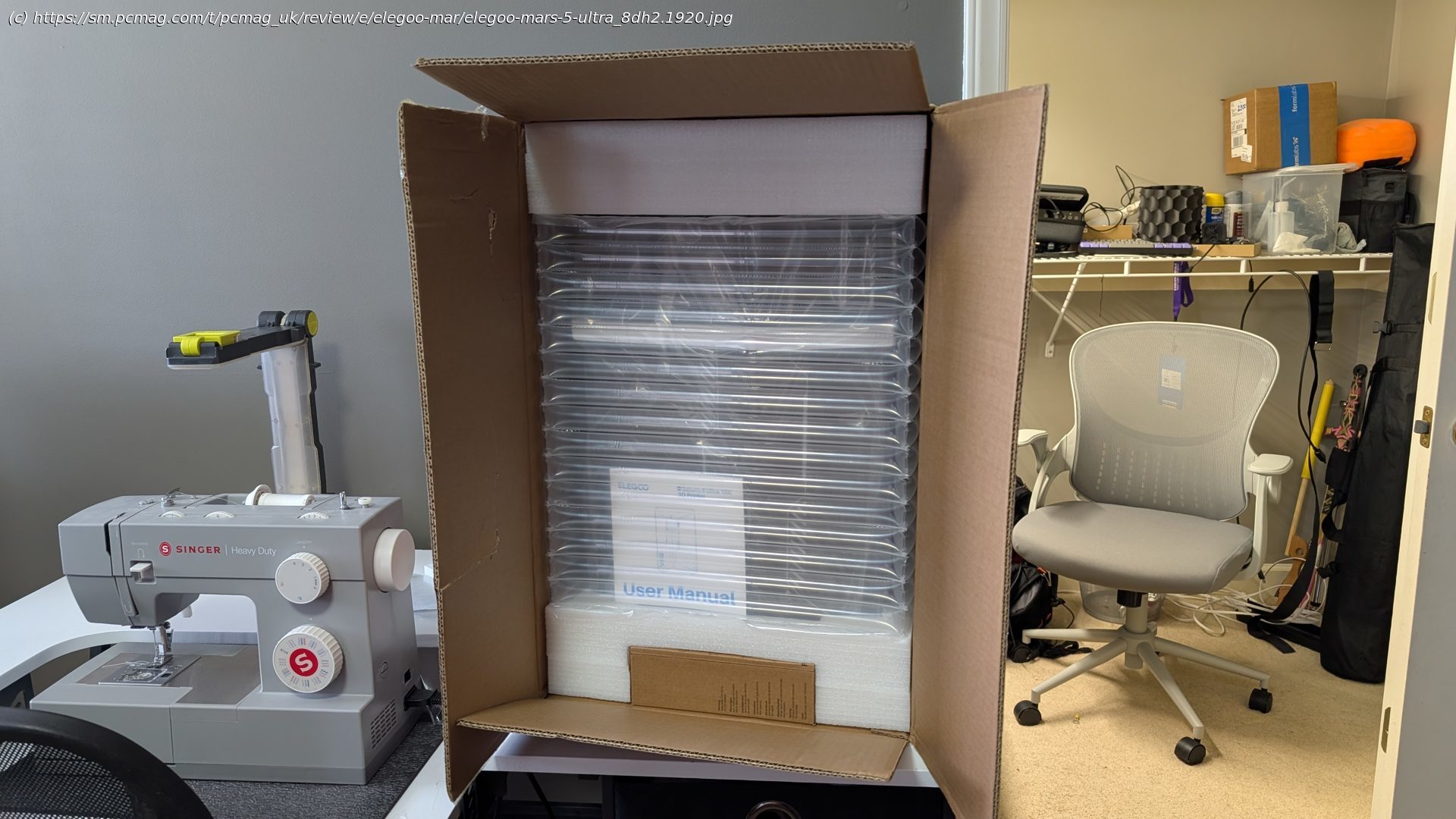
Elegoo continues to treat shipping a resin printer like a minor engineering discipline, and the Mars 5 Ultra arrives with the same reassuring attention to protection seen across the company’s recent releases. The printer ships securely packed in a sturdy outer carton, with thick internal cushioning designed to absorb the inevitable knocks of transit and my angry UPS driver.
Inside the machine, custom-cut foam braces the resin vat and build plate, preventing movement or stress during shipping. The overall presentation feels deliberate and practiced, suggesting Elegoo has refined this process over many generations of resin hardware. This “apocalypse packaging” has become fairly standard now across the major 3D-printing companies, and Elegoo doesn’t disappoint.
The accessory bundle is equally well-considered. Elegoo includes gloves, both plastic and metal scrapers, Allen keys for servicing, funnel filters for reclaiming resin, and a spare set of hardware for future FEP film-sheet replacements. A USB flash drive comes preloaded with the Elegoo SatelLite slicer and sample models, allowing users to get up and running quickly without hunting for software. A few disposable face masks are also included, alongside a resin drip tray and an external Wi-Fi antenna. The power adapter is separately packaged and surprisingly small, the size of a small laptop DC charger.
Once assembled, the Mars 5 Ultra makes a strong visual impression. Its compact proportions, clean lines, and tinted cover give it a modern, almost futuristic presence. Elegoo clearly understands that many resin printers live on desks, not in garages, and the Mars 5 Ultra reflects that shift. I like how it mirrors the Saturn 4 Ultra and Saturn 4 Ultra 16K, like the little brother of the lineup.
With my test sample, Elegoo included bottles of its 8K Space Grey Standard resin, which, after a thorough shaking, poured easily into the Mars 5 resin tray. I appreciated the tray’s design, and its opposite corners have molded-in pouring spouts for easy pouring of resin back into the bottles. I also appreciated the included funnel for pouring the resin back into the bottle when done. This funnel design screws onto Elegoo bottles easily and routes air behind the resin, allowing it to drain quickly.
The Mars 5 Ultra comes with an unconventional tilting resin tray, which is a hallmark design of the Elegoo resin-printer series. On most resin printers, each layer releases from the FEP by brute force. The build plate lifts straight up, the cured layer clings to the film, and suction breaks all at once. The Elegoo Mars 5 handles this differently by slightly tilting the resin tray from zero degrees to about -4 degrees before lifting. That small angle change allows the layer to separate progressively rather than snap free, reducing suction, lowering stress on the print, and putting less wear on the FEP over time. I had experienced the tilting tray while testing the Saturn 4 Ultra 16K.
The effect is easy to understand if you think about peeling a label. You don’t pull straight up from the middle; you lift a corner and peel it back smoothly. The Mars 5 releases each layer the same way, letting go from one edge rather than all at once. For new users, this means fewer sudden release forces, better success with fine details and larger cross sections, and a peel action that feels controlled and intentional rather than abrupt. Something like peeling the backing paper off the tape in the image below.
Once you have the resin tray filled and everything plugged in, the unit runs a pre-flight checklist to ensure all sensors are operating correctly. It’s nice to have the machine make sure I haven’t forgotten anything before a big print.
Using this machine through the eyes of a new user felt a lot like using the entry-level FDM-based Bambu Lab A1 mini. It’s simple and clean, with few stumbling blocks between you and the prints you’re trying to make.