Sony’s Hawk-Eye tech is an impressive feat of camera technology that changed the NFL this year, but there’s still one thing fans and football commentators are begging for.
When Super Bowl LX rolls around this year, all eyes will be on the NFL. That includes, on average, a gargantuan audience of 120 million human viewers from across the U.S. (around one-third of the country), but also more untraditional eyes—ones of a non-human variety.
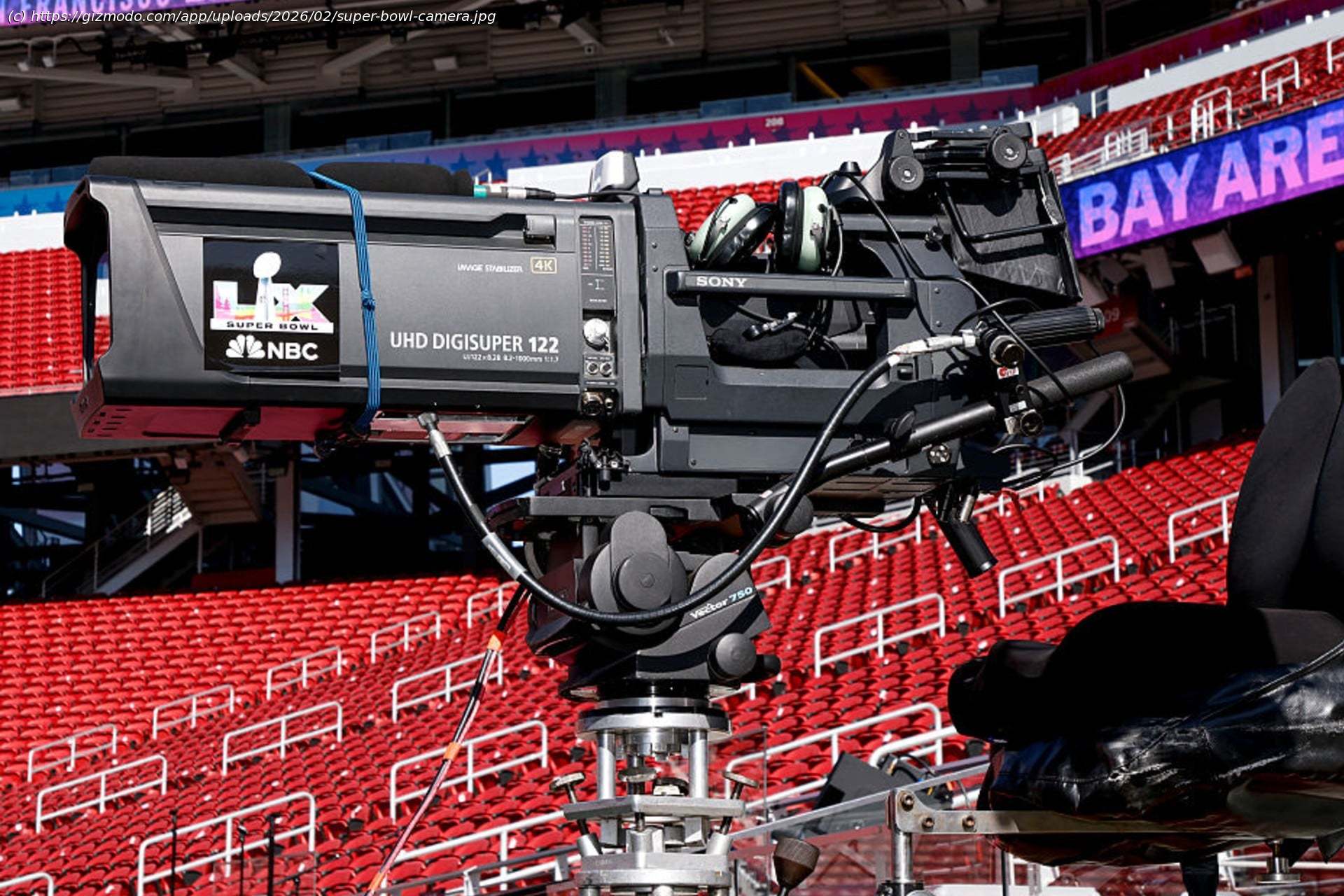
In addition to football fans and people who just want to mindlessly watch advertisements, there will be an armada of cameras fixing their gaze on Levi Stadium in San Francisco. Those “eyes” are dedicated to capturing each and every solitary moment of the sport’s most pivotal day—big plays, fan reactions, and any potential Janet Jackson-style “wardrobe malfunctions,” just to name a few. Some of those all-seeing eyes might even wind up tipping the scales of the game—especially the ones made by Sony.
This year’s impending Super Bowl will be just the first ever to feature Sony’s Hawk-Eye tech, a camera system that uses a half dozen 8K cameras installed in the catwalks of NFL stadiums to assist on-field officials with the critical task of determining the line to gain. For those not fluent in NFL lingo, that’s the line—the yellow one superimposed on TV broadcasts—that teams need to reach in order to keep their offense on the field. (The 2025 season, for context, is the first full season where Hawk-Eye was used ubiquitously across the league to provide virtual measurements, though it was tested initially in 2024.)
While the players themselves work as a team to win the NFL’s biggest game, Sony’s Hawk-Eye cameras and the NFL officiating apparatus work as their own kind of team. After footage is captured by the cameras, it’s then sent to the NFL’s Art McNally GameDay Central Officiating Center in New York. From there, on-field officials are informed of the distance, while virtual recreations of those measurements are made to be shown to the in-stadium audience and anyone watching on TV in real time.
It might not sound like a lot, but for diehard fans and the teams in the game, it’s a critical facet in determining whether, after 22 weeks of grueling televised violence, a team walks away with the Lombardi Trophy and some shiny new rings or with empty hands and a demoralizing start to the offseason.
Obviously, with those kinds of stakes, the pressure is on Sony for its systems to really get things right.
“As the biggest game and the most-watched show of the year, the Super Bowl production requires tools we can trust,” said Ken Goss, NBC Sports EVP of Studio and Remote Operations, in a statement leading up to Super Bowl LX. “Working with Sony allows us to flawlessly deliver every angle, replay, and on-field moment to viewers watching around the world.”
While this is the first year that Sony’s Hawk-Eye cameras were used frequently in the NFL for virtual measurements and in the Super Bowl, the technology has actually been implemented in other sports for similar purposes. In tennis, the tech is famously used for automated line-calling, determining whether the ball is in or out, and deciding which player gets awarded points. In this capacity, the tech is apparently accurate within an impressive 5mm. In soccer, Hawk-Eye can be of equal importance, since it’s used to determine whether the entire ball has crossed the line and whether a goal has been scored—not a minor task in a sport that is often decided by one score.