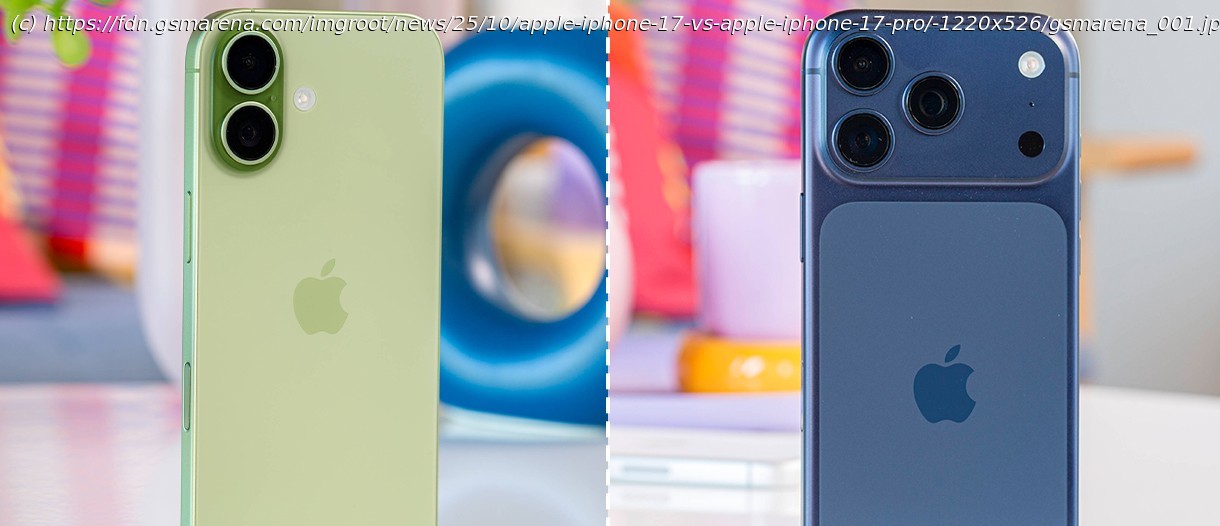
Is the Pro model worth the extra price, or has the vanilla bridged the feature gap to make the Pro obsolete? Apple’s 2025 iPhone lineup once again puts its.
Apple’s 2025 iPhone lineup once again puts its users in a familiar position – choosing between two very similar yet distinctly positioned models. The gap between the iPhone 17 and iPhone 17 Pro is as small as ever, but as they say, the devil is in the details – and those details might justify the Pro’s higher asking price for some, while others may find the standard model more than enough.
The iPhone 17 finally feels like a true flagship in its own right, matching the Pro’s 120 Hz refresh rate, OLED quality, and overall polish. This year, the basic model is lighter, slimmer, and still boasts the Apple A19 chipset with impressive performance and efficiency.
The iPhone 17 Pro, however, remains the ultimate iPhone experience – armed with the more capable A19 Pro SoC, 12GB RAM (up from 8GB), a triple-camera system with a new periscope telephoto, and faster USB 3.2 connectivity. There’s also the added novelty of the new design (if you are into it) and some exclusive pro-grade video features that content creators might appreciate.
So, are these features enough to justify the Pro’s price premium? Or is the regular iPhone 17 good enough to satisfy even power users? Let’s find out.Table of Contents:
For starters, you can compare the complete specs sheets or directly continue with our editor’s assessment in the following text.Size comparison
Despite sharing the same 6.3-inch display, the two iPhones differ slightly in their proportions and overall heft. The iPhone 17 is the slimmer and lighter of the two at 177 grams and 8 mm thickness, while the iPhone 17 Pro measures 8.8 mm and tips the scales at 206 grams. In hand, that 30-gram difference is noticeable, giving the vanilla model a touch more comfort and balance during prolonged use.
The regular 17 features the familiar glass-aluminum sandwich. In contrast, the Pro comes with Apple’s new design language, which has a standout camera island and combines an aluminum-alloy body with a patch of glass on the back. The two iPhone models are also offered in a set of distinctly different colors. Display comparison
There’s no real winner in the display department – the two iPhones use the same 6.3-inch LTPO Super Retina XDR OLED panel with a 120 Hz refresh rate, HDR10, and Dolby Vision support. Resolution, pixel density, and even max brightness are identical, with both models reaching around 1,000 nits typical and up to 3,000 nits peak in HDR mode. In short, the viewing experience is equally stunning whichever model you choose.
Color accuracy, contrast, and motion handling are virtually indistinguishable as well. Both feature an Always On Display and have an antireflective surface.
Apple continues to deliver one of the finest mobile displays on the market, now shared by the vanilla and Pro iPhones.Battery life
Both iPhones have excellent battery life. The iPhone 17 packs a 3,692 mAh cell, and in our tests, it achieved an Active Use Score of 14:59 hours. The iPhone 17 Pro houses a marginally larger battery of 3,998 mAh but got a very similar 15:23h Active Use Score.Charging speed
The two iPhone models are rated at the same max Watts of charging power; however, they don’t quite charge at the same rate, as we discovered.
The regular iPhone 17 tops out at about 29W and charges a bit slower – 31% in 15 minutes, 52% in 30 minutes, and a full charge in 1 hour and 42 minutes.
The iPhone 17 Pro, on the other hand, charges faster despite having a larger battery. In our charging test, it peaked at around 35W, and reached 40% of charge in 15 minutes, 70% in half an hour, and completed a full charge in 1 hour and 18 minutes. The difference to the iPhone 17 is not dramatic, but the Pro does enjoy a measurable advantage here.
Besides the cable charging, both phones also support wireless MagSafe and Qi2 charging up to 25W, and it’s equally fast, achieving roughly 50% in 30 minutes, as well as 4.5W reverse wired charging for accessories. Neither supports reverse wireless charging.