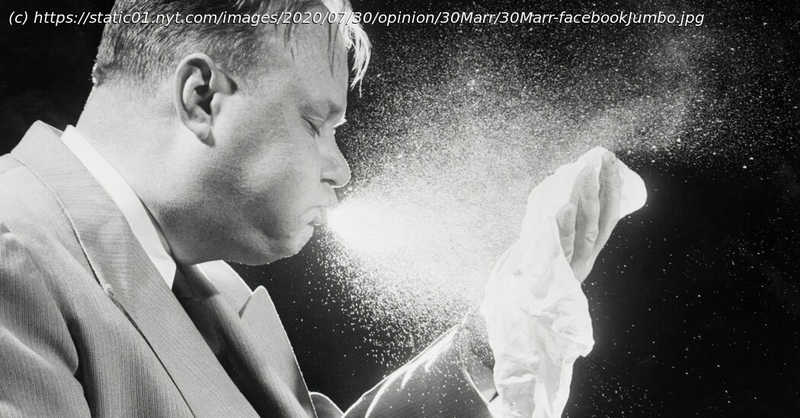
Transmission through aerosols matters — and probably a lot more than we’ve been able to prove yet.
Finally. The World Health Organization has now formally recognized that SARS-CoV-2, the virus that causes Covid-19, is airborne and that it can be carried by tiny aerosols.
As we cough and sneeze, talk or just breathe, we naturally release droplets (small particles of fluid) and aerosols (smaller particles of fluid) into the air. Yet until earlier this month, the W. H. O. — like the U. S. Centers for Disease Control and Prevention or Public Health England — had warned mostly about the transmission of the new coronavirus through direct contact and droplets released at close range.
The organization had cautioned against aerosols only in rare circumstances, such as after intubation and other medical procedures involving infected patients in hospitals.
After several months of pressure from scientists, on July 9, the W. H. O. changed its position — going from denial to grudging partial acceptance: “Further studies are needed to determine whether it is possible to detect viable SARS-CoV-2 in air samples from settings where no procedures that generate aerosols are performed and what role aerosols might play in transmission.”
I am a civil and environmental engineer who studies how viruses and bacteria spread through the air — as well as one of the 239 scientists who signed an open letter in late June pressing the W. H. O. to consider the risk of airborne transmission more seriously.
A month later, I believe that the transmission of SARS-CoV-2 via aerosols matters much more than has been officially acknowledged to date.
In a peer-reviewed study published in Nature on Wednesday, researchers at the University of Nebraska Medical Center found that aerosols collected in the hospital rooms of Covid-19 patients contained the coronavirus.
This confirms the results of a study from late May (not peer-reviewed) in which Covid-19 patients were found to release SARS-CoV-2 simply by exhaling — without coughing or even talking. The authors of that study said the finding implied that airborne transmission “plays a major role” in spreading the virus.
Accepting these conclusions wouldn’t much change what is currently being recommended as best behavior. The strongest protection against SARS-CoV-2, whether the virus is mostly contained in droplets or in aerosols, essentially remains the same: Keep your distance and wear masks.
Rather, the recent findings are an important reminder to also be vigilant about opening windows and improving airflow indoors. And they are further evidence that the quality of masks and their fit matter, too.
The W. H. O. defines as a “droplet” a particle larger than 5 microns and has said that droplets don’t travel farther than one meter.
In fact, there is no neat and no meaningful cutoff point — at 5 microns or any other size — between droplets and aerosols: All are tiny specks of liquid, their size ranging along a spectrum that goes from very small to really microscopic.
(I am working with medical historians to track down the scientific basis for the W. H. O.’s definition, and we have not found a sensible explanation yet.)
Yes, droplets tend to fly through the air like mini cannonballs and they fall to the ground rather quickly, while aerosols can float around for many hours.
But basic physics also says that a 5-micron droplet takes about a half-hour to drop to the floor from the mouth of an adult of average height — and during that time, the droplet can travel many meters on an air current.