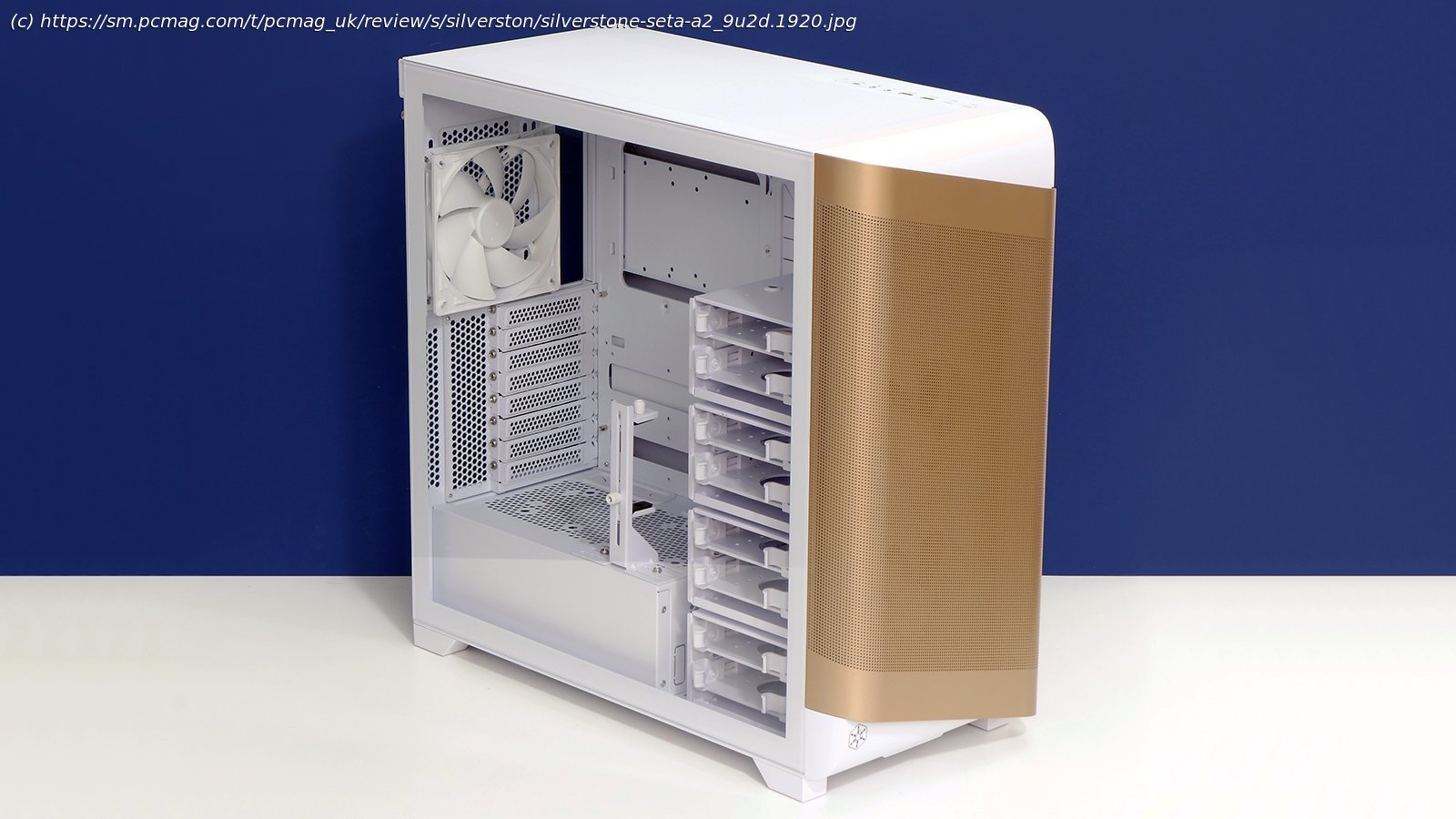
Extra sturdy and packed with bays
No, SilverStone’s Seta A2 is not your typical high-end PC case, though similar designs once ruled the high-end desktop (HEDT) market. Weighing in at 31.3 pounds and packed with a ton of fan and storage mounts, the $179.99-MSRP Seta A2 harkens back to a time when you might buy a case to carry through successive builds, keeping it not until it wore out, but until its actual ports were no longer relevant. (Anyone need a FireWire or an eSATA? Anyone?) For a special group of buyers interested in a long-term case for a high-powered workstation, that might still sound perfect. But know that some of the Seta’s premium features can be used only at the expense of certain others, so check carefully that your build emphasis and this case’s quirks align gracefully. Otherwise, in a big ATX tower, you might consider Fractal Design’s North XL or Asus‘ whopping (and admittedly even pricier) ProArt PA602.Design: A Real Endurance Chassis
Unless you drop it or have a habit of cross-threading screws, the Seta A2 will probably outlive your next build and the one after that. It’s big, sturdy, and well-vented enough that it should stick around at least until a future system demands some new must-have cable connector.
But it comes down to what you want from a case: massive liquid cooling potential? Lots of storage bays? Support for huge GPUs? All of that? This Seta can supply each of those, sometimes at the expense of one of the others. Here, buyers are paying for a removable stack of eight drive bays that hide a pair of 420mm-format radiator mounts in an age where many of us have moved on to cloud or networked storage. The rest of the case holds seven more 2.5-inch or three more 2.5-inch plus two more 3.5-inch drives, and the stack of racks covers up another 3.5-inch bay. (We’d love to hear in the comments section how you’d fill all those bays.)
Front-panel connectors include the old-fashioned pair of stereo jacks for a separate headphone and microphone, a pair of USB 3.x Type-A ports, and a Gen 2×2 Type-C port, all lined up with lighted power and reset buttons and an unlit mode button for the integrated LED controller. All this is along the front of the top panel’s right edge.
In the image above, the vented portions of the top and right-side panels are also visible, as is a light diffuser that sits between the plastic front-panel frame and its gold-painted metal accent.
Around back, we see an eighth expansion slot on a removable square that can be rotated to fit vertical card risers (not included). The eighth slot used to be popular for adding a third double-slot graphics card to the bottom slot of a motherboard, back in the days of SLI and CrossFireX. It could still potentially be used that way by anyone who wants the added power of an extra card for AI or other number-crunching tasks. But that’s an admittedly niche need in 2025.
Other rear-panel features include a power-supply mounting plate that’s held in place via two captured screws, and a vertically adjustable 140mm exhaust fan on 120mm/140mm screw slots.
A dust filter that covers the bottom panel all the way to the front panel slides out from beneath the power supply’s bay.
Snapping off the front panel provides access to the factory-installed trio of 140mm intake fans, but the panel cannot be set aside easily, due to its ARGB LED wires being firmly affixed at its edge.