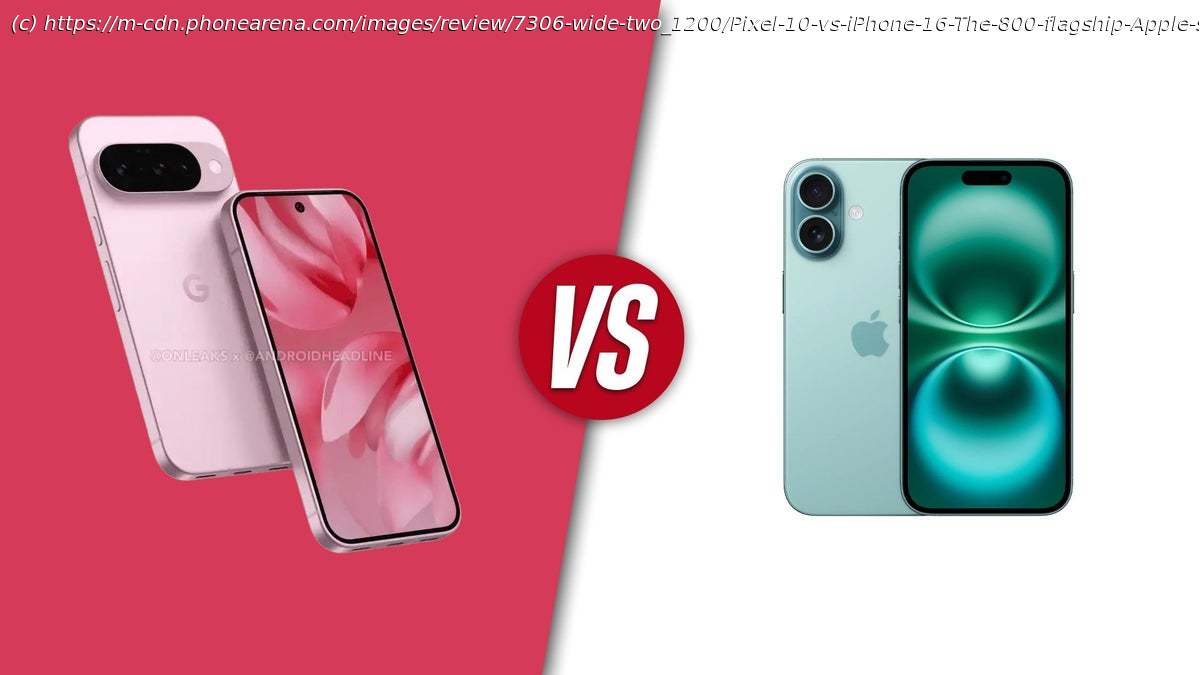
The Pixel 10 is said to have triple cameras, smarter AI, a better display—what exactly is the iPhone’s edge now?
Google’s upcoming Pixel 10 is about to challenge Apple’s iPhone 16 head-on. These are the standard, base flagship models in their respective lineups, each targeting the $800 price range, and it feels like the Pixel might have even more going for it than before this year.
While the iPhone 16 leans on raw power with the ultra-fast A18 chip, it is yet to impress with its AI features. Not to mention that it still comes with a severely outdated 60Hz display.
The Pixel 10, on the other hand, will debut Google’s first fully custom chip, the Tensor G5, and bring a new AI assistant called Pixel Sense. It’s expected to beat the iPhone on camera versatility for the first time thanks to a new triple-lens setup. The question is whether all that will be enough to make Pixel 10 the smarter buy over Apple’s already-available flagship.
Both phones are built to flagship standards, with aluminum frames and toughened glass front and back. The iPhone 16 uses Apple’s Ceramic Shield (second generation) for display protection, while the Pixel 10 is expected to continue with Gorilla Glass Victus 2.
Size-wise, the Pixel 10 is likely to be larger and heavier, matching the Pixel 9’s dimensions of 152.8 x 72 x 8.6 mm and a weight around 198 grams. The iPhone 16 remains one of the more compact flagship phones at 147.6 x 71.6 x 7.8 mm and 173 g.
Apple introduced a vertical dual-camera layout on the iPhone 16 to support Spatial Video capture for Vision Pro users, while the Pixel 10 is expected to keep the horizontal camera bar, now with three sensors for the first time.
The iPhone’s new Capture Control button and Action button add extra physical interaction options, but we were left with mixed feelings about them, as the placement awkward is rather awkward.
As for the color options, the Pixel will likely offer hues like Peony and Wintergreen, while the iPhone 16 comes in Pink, Teal, Ultramarine, White, and Black.
This is one of the biggest dividing points. The Pixel 10 is expected to use a 6.3-inch OLED display with a 120Hz refresh rate and a peak brightness over 2,700 nits—already seen on the Pixel 9. It also maintains a tall 20:9 aspect ratio and symmetrical bezels.
The iPhone 16, meanwhile, continues to use a 6.1-inch OLED panel with a 60Hz refresh rate. Its resolution (2556 x 1179) is slightly sharper on paper, but its real-world brightness falls short at just 1,012 nits in our lab tests, with worse outdoor visibility than the Pixel 9.