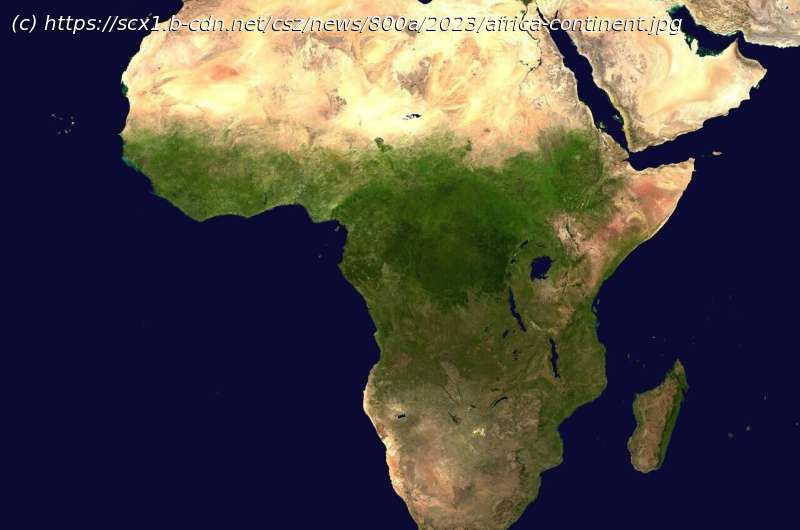
A study led by researchers from Brown University finds that rainfall patterns across northern Africa remained largely stable between 3.5 and 2.5 million years ago—a pivotal period in Earth’s climate history when the Northern Hemisphere cooled and places like Greenland became permanently glaciated.
A study led by researchers from Brown University finds that rainfall patterns across northern Africa remained largely stable between 3.5 and 2.5 million years ago—a pivotal period in Earth’s climate history when the Northern Hemisphere cooled and places like Greenland became permanently glaciated.
The new findings, published in Science Advances, challenge long-held interpretations of the climate history of northern Africa, which had suggested that the region dried out considerably during this period. The timing coincides with the appearance of the first known member of the genus Homo in the fossil record, leading to speculation that this drying may have played a significant evolutionary role near the dawn of the human lineage.
But compared to previous studies, this new study analyzed a more direct proxy for rainfall—leaf waxes produced by terrestrial vegetation—and came to a new conclusion.
“Plants produce these waxes during the summer growing season, so they provide a direct signal of summer rainfall over time”, said Bryce Mitsunaga, who led the research while completing his Ph.D. in Brown’s Department of Earth, Environmental and Planetary Sciences and is now a postdoctoral researcher at Harvard. “We found that precipitation cycles didn’t change much even as all these larger changes in temperature and glaciation were happening.