How does this war end?
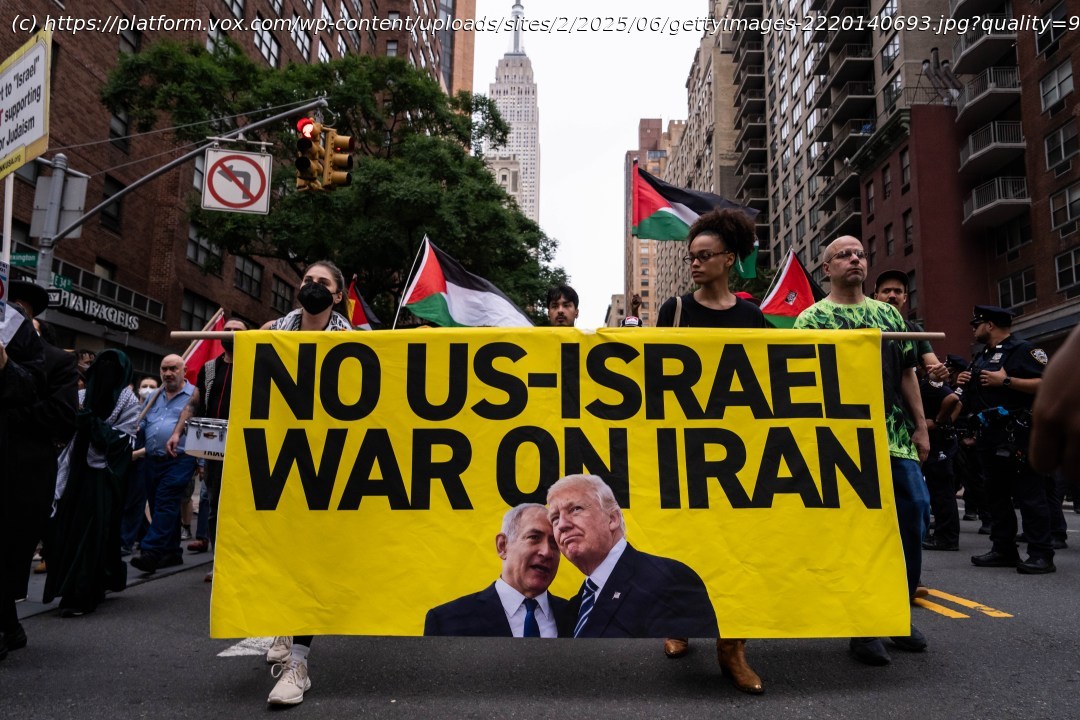
When Vice President JD Vance appeared on Meet the Press on Sunday morning, anchor Kristen Welker asked him a simple question: Is the United States now at war with Iran?
In response, Vance said, “We’re not at war with Iran; we’re at war with Iran’s nuclear program.”
This is akin to saying that, in attacking Pearl Harbor, Imperial Japan had merely declared war on America’s warship construction program. Yet it’s notable that Vance felt the need to engage in such contortions — and that President Donald Trump, in his address to the nation last night, went out of his way to emphasize that there were no additional strikes planned.
The Trump administration does not want to admit it has begun a war, because wars have a way of escalating beyond anyone’s control. What we should be worrying about now is not how the US-Iran fighting began, but how it ends.
It is all too easy to see how these initial strikes could escalate into something much bigger — if Iran’s nuclear program remains mostly intact, or if Iran retaliates in a way that forces American counter-escalation.
It’s possible neither occurs, and this stays as limited as currently advertised. Or factors beyond our knowledge — the “unknown unknowns” of the current conflict — could lead to an even greater escalation than anyone is currently predicting. The worst-case scenario, an outright regime change effort akin to the 2003 invasion of Iraq, cannot be entirely ruled out.
I don’t know how bad things will get, or even if things are likely to get worse. But when I watched Trump’s speech, and heard his obviously premature claims that “Iran’s key nuclear facilities have been completely and totally obliterated,” I couldn’t help thinking about another speech from over 20 years ago — when, after the toppling of Saddam Hussein in 2003, George W. Bush stood on an aircraft carrier and declared “Mission Accomplished.”
The mission hadn’t been accomplished then, as it almost certainly hasn’t been now. We can only hope that the resulting events this time are not a similar kind of catastrophe.
We do not know, at present, just how much damage American bombs have done to their targets — Iranian enrichment facilities at Fordow, Natanz, and Isfahan. Satellite imagery shows that there are above-ground buildings still standing, belying Trump’s claims of complete destruction, but many of the targets are underground. It’s possible these were dealt a severe blow, and it’s possible they weren’t.
Either scenario creates pathways to escalation.
If the damage is indeed relatively limited, and one round of American bombs was not able to shatter the heavily reinforced concrete Iran uses to protect its underground assets, the Trump administration will face two bad choices.
It can either let a clearly furious Iran retain operational nuclear facilities, raising the risk that they dash for a nuclear weapon, or it can keep bombing until the attacks have done sufficient damage to prevent Iran from getting a weapon in the immediate future. That commits the United States to, at minimum, an indefinite bombing campaign inside Iran.
But even if this attack did do real damage, that leaves the question of the program’s long-term future.
Iran could decide, after being attacked, that the only way to protect itself is to rebuild its nuclear program in a hurry and get a bomb.