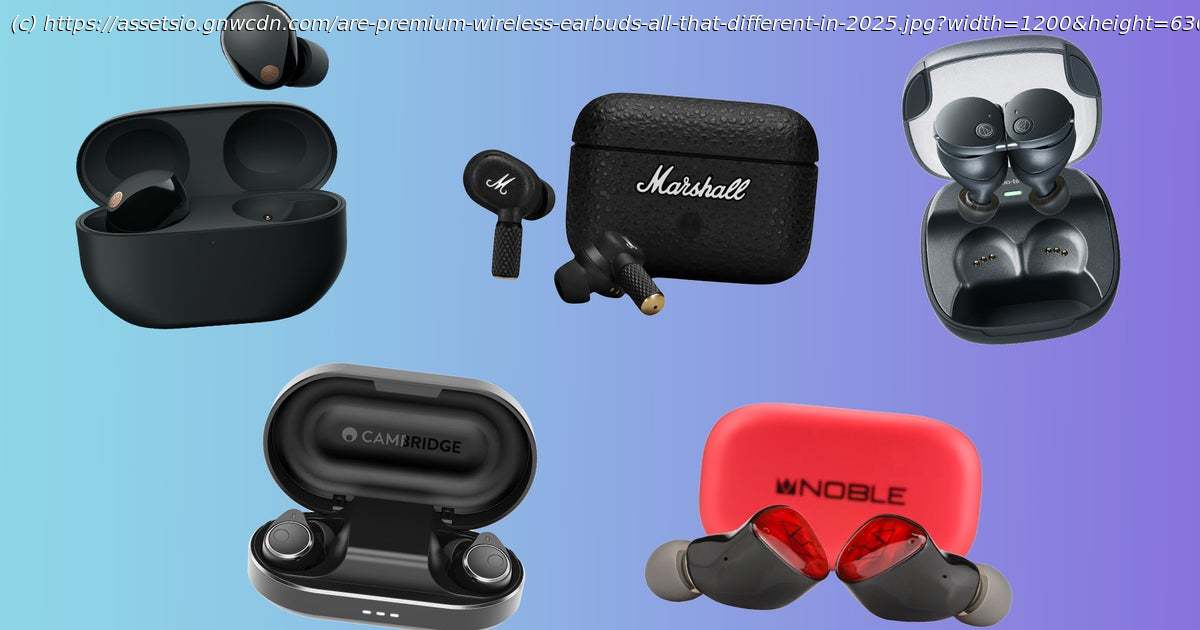
Reece takes a detailed look at five premium wireless earbuds to see how different the market segment is in 2025, with surprising results.
If there’s one area of tech that’s exploded in recent times. It’s wireless earbuds with noise-cancelling powers. We’ve seen all sorts of options emerge up and down the price ladder from both established audio players and newcomers, and here I thought I’d put a few premium pairs I’ve looked at to the test and come to a conclusion of whether any of them are much different and worth your time.
So, read on below to see my thoughts on key players from Sony, Cambridge Audio, Marshall, Audio-Technica and Noble Audio – you can go for the whole thing, or click on the relevant section for the item you’re really interested in.
Buy:
The Sony WF-1000XM5 has been around since July 2023, so they’re getting on for two years old at this point, With this in mind, they’ve carved out a place as the de-facto ‚best‘ option for folks from a lot of outlets who are a lot more in-tune with audio gubbins than me due to sublime noise cancelling, rich audio and a comfortable fit.
The first thing I noticed with the XM5s is how much smaller and lighter they are than their predecessors, whose units were much larger, as was the charging case they came with. By downsizing them, Sony has made these buds a lot more pocketable and portable to the point you may well lose them in a bag in a pinch, being 25 per cent smaller and 20 per cent lighter than their predecessor.
General build quality is excellent, with a smooth and glossy plastic finish to the case and buds, and a pleasant action to the hinge. The case is bereft of much in the way of additional branding or pizzazz, coming in black with a rose gold Sony logo, a small status LED, USB-C port and pairing button on the reverse.
The earbuds themselves fit into your earholes with a twist and push fit, which makes for a secure seal to help with noise cancellation performance. There are touch controls on the buds themselves for things like playback control and adjusting the level of noise-cancelling, although due to the rounded finish of the edge of the buds, it can feel a little finicky to get them to do what you want them to against earbuds with more dedicated controls.
Pairing is easy, while there is also support for Multipoint Bluetooth out of the box if you want to share your buds between friends on different devices, or keep them to yourself with a phone, laptop and something else. For workout fans, the XM5s are also IPX4 rated for sweat resistance.
Sony’s app control for the XM5s is quite advanced, coming with clever features such as spatial audio and head-tracking means for things such as accepting phone calls. It can also change listening profiles based on your routine if you want it to. Codec support is reasonable too, with the more common SBC and AAC here alongside Sony’s own, and the more advanced LDAC, if you want to engage in some more detailed listening.
The noise-cancellation is only on or off, which is a shame against Sony’s previous over-ear models that had more granular control if you wanted it. Nonetheless, the noise cancellation of these earbuds is excellent that does a rather good job of cancelling out most noises on busy train journeys, although they do miss out a little on some voices. The great performance is due to Sony’s new mic array with three on each earbud, including dual feedback ones for cancelling out lower-end frequencies, alongside a new integrated processor. The transparency mode is natural and doesn’t feel at all synthetic or ultra-processed when you want to hear the world around you.
The endurance of the XM5s is solid too, with eight hours from the buds with Bluetooth and active-noise-cancelling enabled, with the extra 16 hours from the charging case taking it to a total of 24 hours. Unlike a lot of things, this remains unchanged from the XM4 model, but is still decent for a premium set of earbuds.
The audio profile of Sony’s latest wireless earbuds has been changed somewhat from their previous models, with an exchange of richness in the low end for more clarity and detail in more of a Bose-style sound signature, I’d argue. This isn’t to say the low-end is devoid of any character or depth, as there’s plenty of both to make them a refined listen.
The gritty bass runs in Steven Wilson’s Meanwhile had an excellent sense of clarity and extension to it in among the busier elements of the track’s vocal and acoustic guitar interspersed throughout, while the strong synth bass in Earth Wind & Fire’s Let’s Groove carried weight and presence without going overboard.
The mid-range here is especially lovely, with crispness and sumptuous detail captured in Al Stewart’s Time Passages with his rich vocal and the inflexions of acoustic guitar and organ work. Jimmy Buffett’s Tonight I Just Need My Guitar was much the same story, with some excellent clarity and detail extracted on his vocal, the song’s prominent acoustic guitar work, and the distant percussion that felt off in the distance due to the excellent soundstage.
The XM5s also present a great sense of directionality to their sound as demonstrated also by the width of the signature bongos in Earth, Wind & Fire’s September and the choir and backing vocals way off to the sides in Paul McCartney’s Little Willow. This can also help the immersion factor for mobile gaming, too.
The top end isn’t too jarring, but is as precise and clear as the mid-range, as with the incessant cymbal hits on On The Other Side from The Strokes that can sometimes be quite painful to listen to in some other cans I’ve used. With that wide soundstage, it also allowed lots of room to breathe for the competing percussion introduction of Steely Dan’s Do It Again, where the tones of the track’s electric piano, congas and guiro were nicely distinguishable.
As you might expect from a set of earbuds that’ll run you £219/$311, the Sony WF-1000XM5 impresses with class-leading noise cancellation, a comfortable fit and audio that’s rich, clear and wonderfully detailed across the frequency range. They’re also a lot more compact than previous models, making them infinitely possible. As it turns out, the de facto ‚best‘ earbuds are genuinely excellent.
Buy:
The Cambridge Audio Melomania M100 might be more of the ‚wildcard‘ choice here, coming from a brand that epitomises the term ‚heritage brand‘ in my mind. I’d already been impressed by their sister product, the wireless over-ear noise-cancelling P100 headphones, so it’s fair to say I had quite high hopes for their first ANC-flavoured in-ear model.
The M100 feature a thinner and slimmer case than the XM5s, which is arguably easier to slot into a pocket, although the buds and case are a little more plasticky in build than Sony’s more premium-level finishing. As with Sony’s, though, the case doesn’t have much flair beyond a glossy Cambridge Audio logo and a USB-C port on the rear.
The earbuds fit with a convenient twist-and-push motion into your ears, and the default tips provided a secure fit and good seal for noise cancellation in my ears, although there are multiple other sizes in the box to suit different sizes. The touch controls on the M100 are fine, if a little fiddly given the smaller profile of the buds themselves. To pair them, you need to hold for nearly 10 seconds.
Clear voice prompts are at least provided to notify you when it’s done, and choosing ‚Southwark‘ in the Melomania Connect app will prompt Matt Berry to tell you when your headphones are connected. The app control is a bit more basic than Sony, but you do get more granular control for the noise-cancellation, plus a low-latency game mode. You don’t get the clever spatial audio or advanced routines, as Sony does, though.
The M100’s active noise cancellation surprised me with how solid it is, being able to block out most noises on a couple of busy train journeys into London and using the Underground.