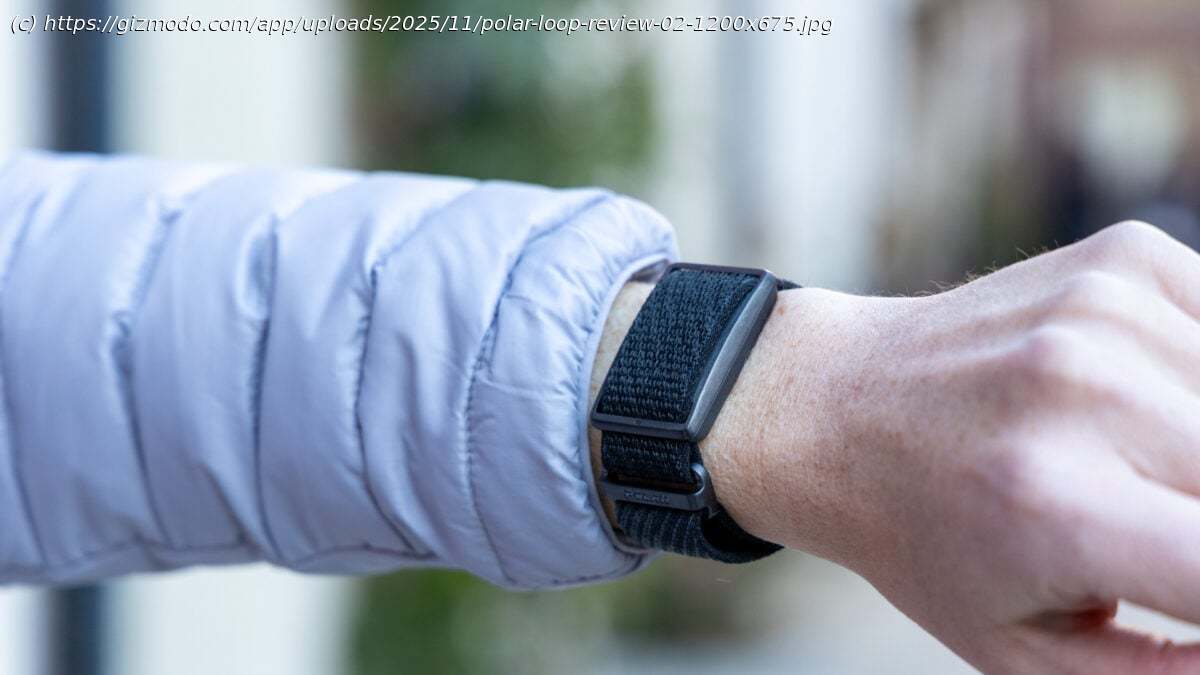
The new subscription-free fitness band is a solid competitor to Whoop, but with a big caveat.
Screenless fitness trackers can sometimes feel like they aren’t doing the job they set out to do. Sure, there’s no constant stream of data to obsess over every time you turn your wrist. But in the absence of that quick peek, I find myself opening a tracker’s companion app—constantly—to check on the data it’s collected. In the end, I find myself spending more time staring at those charts and figures than if I took a look at the tiny screen on my wrist every now and again.
So when I began testing the Polar Loop—a new screen-free wearable health and fitness band—I wasn’t all that excited. After all, the new product from Polar (the company that introduced the first wireless heart rate monitor nearly 50 years ago in 1977), almost exactly resembles the Whoop 5.0. In fact, the device, which came out in early September, has been nicknamed the subscription-free competitor to Whoop. The Polar Loop costs $199 and all its features are free in the accompanying—again, free—app. Whoop on the other hand, includes its band in the membership, but that starts at $199 a year and goes up from there.
If you anticipate using your device for more than a year, the cost of a Whoop 5.0 really adds up whereas the Loop, literally, does not at all. I spent a few weeks training with the Loop, and in the end, what made me fall in love with it was less about the cost (which, obviously, is still crucial to making a decision about purchasing a wearable) and more about what the Loop does not do: dump tons of health and fitness data at you.
If this sounds counterproductive, that is almost the point. If the goal of creating a screenless fitness tracker is to make you spend less time looking at the thing, and more time living your life, then the accompanying app should match that same tone. And there are almost no screenless wearables on the market today that do just that. Here’s a deep dive into more.The goldilocks of fitness trackers?
Polar is a company that is no stranger to monitoring our health. In the late 1970s and early 1980s, the company introduced the first wireless heart rate monitor, the Sport Tester PE2000, which was initially designed for elite endurance athletes, particularly cross-country skiers. The design—a chest-strap transmitter connected to a wrist receiver watch—allowed for real-time monitoring without wires, which was revolutionary at the time.
But a chest strap worn 24/7 would annoy just about any regular person. These days, almost all heart rate tracking systems on the market use an optical heart rate monitor, which works by shining a light into the skin to detect changes in blood volume with each heartbeat.
There’s so much you can ascertain from your heart rate, and most wearables today use heart rate to track everything from sleep to step count to exercise and recovery. The Polar Loop is no different in this regard. The accompanying app, the Polar Flow, provides a detailed picture of your last night’s sleep and includes other basic metrics like step count and heart rate.
The step count and heart rate lined up with what my Apple Watch was telling me (I often wore both of them at the same time, though not always). The sleep tracking also seemed to match with the Oura 4 Ceramic, which I was also testing at the time.