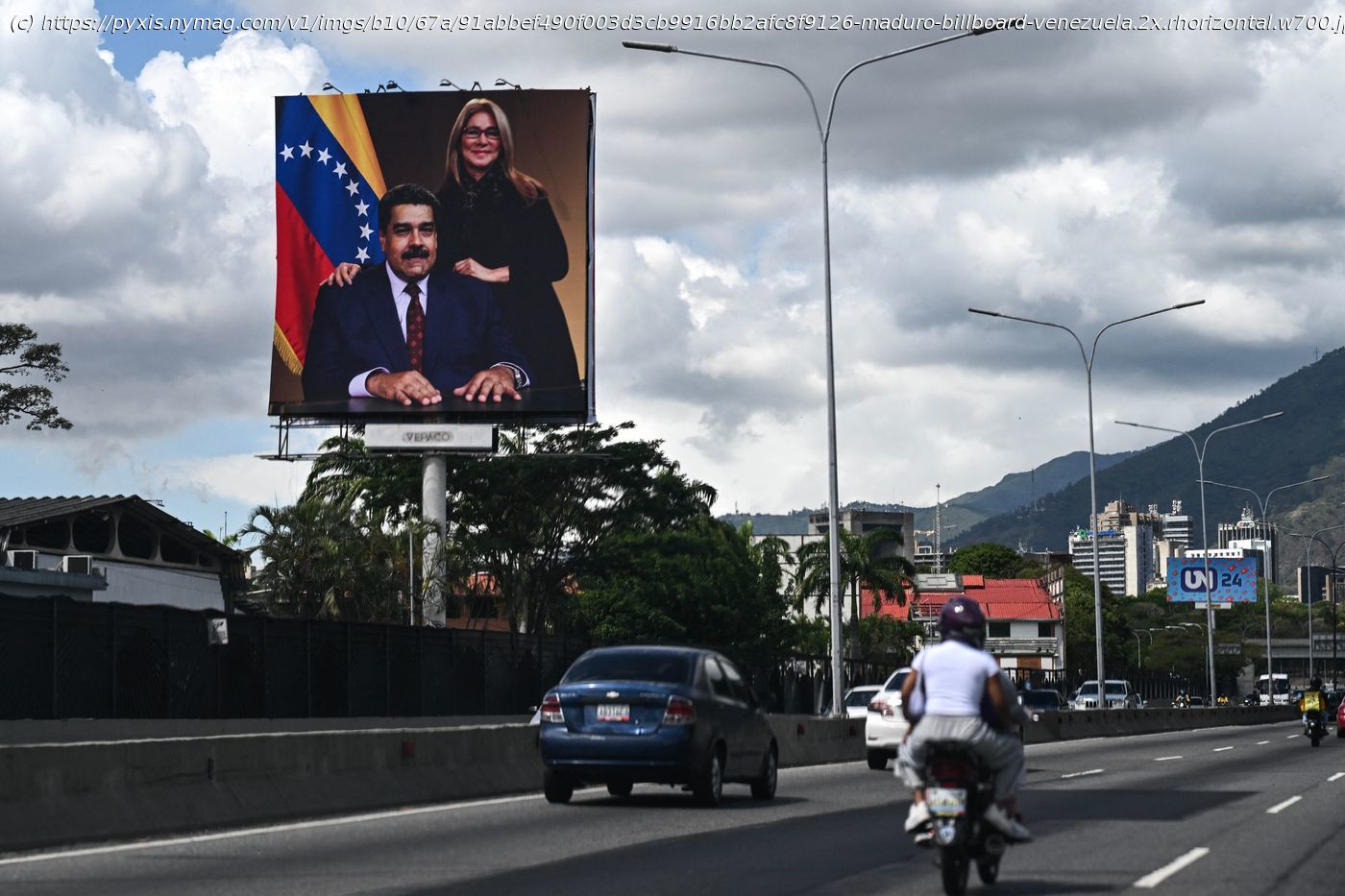
More than two weeks after the U.S. attacked Venezuela and kidnapped Nicolás Maduro, Trump isn’t running the country, but he seems to be getting much of what he wants.
Just over two weeks ago, the U.S. invaded Venezuela, abducted Nicolás Maduro and his wife and threw them in a Brooklyn jail, and then President Donald Trump said a bunch of wild stuff — including announcing that the U.S. was going to run the country and take its oil. A week ago, he shared a fake Wikipedia page on social media which said he was the “acting president of Venezuela.” He’s not; interim president Delcy Rodríguez is, but so far it seems Trump is getting much of what he said he wanted. Below is a look at how Trump’s big intervention is playing out thus far.
.
Is Trump running Venezuela?
No. But he’s clearly wielding a lot of leverage on its new leader.
.
Rodríguez appears to be playing along — and consolidating her power
Since the U.S. ousted Maduro, the former vice president has been working to meet the Trump administration’s demands — while at times publicly denouncing what the U.S. has done — and all the while working to consolidate her control over the regime and country. Per Bloomberg:
[Rodríguez] has seamlessly moved into the role of acting president. She has chaired meetings with senior officials, greeted international envoys, welcomed the press at Miraflores Palace and met privately with diplomats. But beneath the continuity, the bedrock of Chavismo — Venezuela’s brand of socialism — is beginning to shift as Rodríguez quickly moves to consolidate authority and unite the fractured ruling coalition. There are some subtle changes. Rodríguez’s days start earlier, her public remarks are far more concise and the marathon speeches that defined Maduro’s rule are gone. Public officials are now allowed back on X.
Other moves are far more consequential, including a reshaping of the cabinet and security apparatus and the release of dozens of political prisoners. Decisions on senior personnel are being received positively by the Trump administration, according to one person familiar with the matter who asked not to be named discussing sensitive deliberations.
Trump and Secretary of State Marco Rubio have repeatedly said that Rodríguez has been doing what the administration tells her. Trump has called her a “terrific person” and last week told Reuters that she “has been very good to deal with.” He also said that he thinks she’s “eventually” going to come to the White House, and that “I’ll go to their country too.”
In her state of the union speech Thursday, Rodríguez called for opening the country’s oil sector to foreign investment.
The regime has also moved to reopen the U.S. embassy in Caracas and has already hosted a U.S. delegation. At the same time, Rodríguez and other regime officials have been trying to have it all ways, signaling willing partnership and shared opportunity with Trump and the U.S., while also insisting they are just as anti-imperialist as they ever were.
On Thursday, Rodríguez met in Caracas with CIA director John Ratcliffe, the most senior Trump administration official to visit the country since the invasion. His high-profile visit was reportedly intended to further signal the administration’s support for Rodríguez as the country’s interim leader. (Ahead of the Maduro operation, a CIA assessment indicated that Rodríguez would be the best choice to take over and maintain stability in the country.)
Here’s what Freddy Guevara, the former vice president of the Venezuelan National Assembly, who has been living in exile for the past four years, recently told Reveal about Rodríguez and her grip on power:
I know her and I know her brother. I was involved, as I said, in negotiation processes and they were both in there. And I have to tell you that they are not moderate at all, they are super radical, and they believe they are smarter than everyone. I am sure that what they’re trying to do is to convince Trump or the Trump administration to allow them to have kind of a Saudi Arabia or China in Latin America. Which means international investments, but no political freedom for example. I think that’s her plan A.
I think their plan B is to outsmart Trump and figure it out, how to survive and buy time, make small concessions enough to not get them out of power.
.
Is the U.S. taking Venezuela’s oil?
It’s definitely already taking some of it.
The U.S. has tracked down and seized six “dark-fleet” oil tankers carrying Venezuelan crude and has redirected at least a few of them to U.S. ports. The blockade is working, the Wall Street Journal reports:
The oil-tanker crackdown has had a significant impact on Venezuela’s oil exports. In the month of January, crude loadings have fallen to about half of normal levels, according to shipping-analytics provider Kpler. The only ships that are loading crude at Venezuela’s ports are tankers bound for the U.S. and those transporting oil to Venezuelan refineries, the company said.
U.S. officials have said that they are working with the Venezuelan government, and that the U.S. would receive Venezuelan crude that is backed up in onshore facilities and floating tankers that serve as oil storage and then sell it. Many of those barrels have been blocked from going to China or other markets because of the U.S. blockade of dark-fleet oil tankers.
Trump has announced that Venezuela is going to handing over some 30 to 50 million barrels of sanctioned oil — which could be worth nearly $3 billion — and that the U.S. will then sell the oil and split the money with Venezuela. He also suggested the U.S. military would be sent in to secure the oil, though there are currently no American servicemembers on the ground there, and Trump officials are reportedly looking into using private military contractors instead.
Last week, the Department of Energy announced that the U.S. had completed its first sale of Venezuelan oil, for $500 million. According to the Financial Times, Vitol trader John Addison, a Trump campaign megadonor, bought $250 million worth. The other $250 million sale was to the trading house Trafigura.
Trump also announced that U.S. oil companies were going to sink at least $100 billion into rebuilding Venezuela’s oil sector, but that hasn’t happened yet. He hosted a White House summit with oil executives on January 9 and the response was lukewarm. Exxon CEO Darren Woods told Trump that Venezuela was currently “uninvestable” and ConocoPhillips CEO Ryan Lance expressed some strong reservations, as well. Trump later attacked Woods for “playing too cute” and said he was “inclined to keep Exxon out” of the country as a result. Only the CEO of Chevron, which is the only American oil company already operating in Venezuela, indicated that the company was ready, willing, and able to quickly ramp up its production.
As for the others, Trump can’t force private companies to invest.
Nonetheless, as the reports, there are several companies, individuals, and industries who seem likely to cash in, including smaller firms.
.
Venezuela has released political and foreign prisoners
On January 8, the Venezuelan regime announced that would free a “significant number” of political prisoners — which is something it has been pressured to do by Trump in the aftermath of the invasion. The regime says it has since released more than 400 people, but according to the Venezuelan human rights group Foro Penal, as of Saturday it had only released 139 of the at least 863 political prisoners it was holding at time of the invasion.
The regime also released several U.S. citizens who were imprisoned in the country, as well as a number of other foreign citizens.
.
But it has not closed its notorious El Helicoide prison
El Helicoide in Caracas is considered one of Latin America’s worst prisons, where countless Venezuelans, including thousands of political prisoners, have been held and subject to extreme overcrowding, systemic torture, and other documented human rights abuses.
On January 6, President Trump said that “they have a torture chamber in the middle of Caracas that they’re closing up.” But there are so far no signs that the Venezuelan regime is moving to do that.
.
Democracy doesn’t seem to be a big priority, and the Venezuelan opposition is still on the outside
Though people like Marco Rubio have indicated that Venezuela making a transition to real democracy remains a U.S. goal, nobody is putting forward an actual timeline for that. Trump has said he’s a “big fan” of democracy, but he has also made it more than clear that what he most cares about is pliant leadership and unfettered access to Venezuela’s oil. He has also basically endorsed interim president Delcy Rodríguez.
Venezuelan opposition figures like María Corina Machado don’t appear to be included in any concrete U.S. plans thus far, though Rubio has said that the administration expects Venezuela to grant amnesty for all opposition members, which would mean Machado and others would be able to freely return to the country.
Machado continues to warn against allowing Rodríguez and other Maduro regime officials to remain in power, while also insisting that she believes there will be a democratic transition and that’s she’s ready to lead the country if given the opportunity. At this point, it’s not clear if she or other opposition figures will get that chance.
.
Trump finally got a Nobel Peace Prize … medal
He’s always wanted a Peace Prize and surely believes invading a sovereign country and snatching its head of state is the kind of thing that makes him deserve one. The Nobel committee might never agree with that, but the last Peace Prize winner sort of does. María Corina Machado, who Trump has repeatedly indicated he doesn’t support to lead the country, met the president at the White House on Thursday and presented him with her medal in “recognition for his unique commitment with our freedom.”
All Machado apparently got in return was a Trump-branded swag bag.
.
Americans have very mixed feelings about Trump’s intervention
As our own Ed Kilgore explained last week:
A Reuters-Ipsos poll immediately after the strike on Caracas showed a third of Americans supported it, a third opposed it, and a third had no opinion. A CBS poll a day later that forced yes-or-no reactions showed 48 percent approval and 52 percent disapproval of the action. An Economist-YouGov survey a week after the attack showed 40 percent of Americans supporting and 45 percent opposing the use of “military force to remove” Maduro. And most recently, Quinnipiac showed 47 percent supported Trump’s “decision to remove” Maduro and 45 percent opposed it. In every case, polls predictably showed high Republican and low Democratic support for the incursion, with independents in the middle but leaning toward opposition.
Prospects for more aggressive and enduring U.S. intervention in Venezuela were a lot less popular. CBS showed 62 percent of Americans wanted little or no U.S. “control over Venezuela” going forward, with only 11 percent favoring “a lot” of control. Economist-YouGov showed 56 percent of Americans (and 62 percent of independents) opposed an “invasion” of Venezuela. And Quinnipiac showed 73 percent of respondents opposed the deployment of U.S. ground troops in Venezuela.
.
Cuba may soon be plunged into darkness, by U.S. design
The New York Times’ Frances Robles reports Cuba needs 100,000 barrels of oil per day to keep the country’s power on, and has long been reliant on Venezuela for oil and trade. The country is already in the midst of one of its worst economic crises in decades, and with Trump vowing that Cuba will no longer receive any Venezuelan oil or money, the country faces a potentially devastating crisis. Per Robles:
From diesel to operate buses to gasoline for cars to jet fuel to power airplanes, oil is in short supply in Cuba. A nation already enduring prolonged blackouts could come to a grinding halt as reserves run out, the country plunges into darkness and its economy craters, according to energy experts and economists who follow Cuba closely. …
At its peak, Venezuela sent its ally some 100,000 barrels a day. More recently, that number had dropped to about 35,000 barrels a day, experts say. “If Cuba loses that, the impact is basically going to be catastrophic,” said Jorge R. Piñon, a former oil executive who is now a researcher for the energy institute at the University of Texas. “The chain of events is that the Cuban economy literally collapses, there is no food in the markets, the trains are not moving, the buses are not moving,” he said.
Cuba also gets some of its oil from Mexico, and so far the Trump administration isn’t trying to block those shipments, but it may not be enough. Trump has also repeatedly threatened Cuba’s government, warning them to “make a deal, before it’s too late.”
.
Trump’s ‘Donroe Doctrine’ has otherwise shifted to Greenland
Trump is now apparently all in on his plan to reassert U.S. dominance over the Western Hemisphere, and he has renewed and expanded his threats of seizing Greenland, prompting sharp pushback from Denmark, European leaders, Greenlanders, and American poll respondents.More Politics