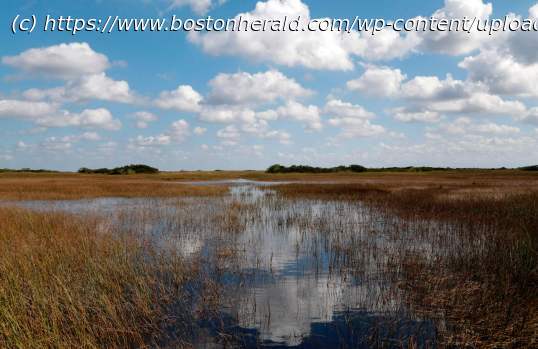
It’s been 25 years since America decided to save the Everglades. The restoration is over budget and behind schedule, but experts see improvements, and a light at the end of the tunnel.
The 20th century was horrible for the Everglades. The broad shallow river, one of the most unique ecosystems on the planet, was labeled wasteland and ruthlessly dammed, carved into parcels, dried out and diverted into near oblivion.
But at the end of the century, 25 years ago this month, Democrats and Republicans from Florida and Washington, D.C., joined forces and signed the Comprehensive Everglades Restoration Plan into law.
The ambitious 68-project plan was supposed to cost $7.8 billion, it was supposed to take 30 years to complete and it was supposed to save what was left of the Everglades.
That’s not how things have played out, at least not yet. Two of those three expectations have been vastly overshot — costs have tripled to $23 billion and it could take another 20 years to complete.
Experts say restoration success hinges on two things: The engineering has to work and the people of Florida have to be willing to pay for the job to be finished.
But where do we stand 25 years in? After decades of funding delays, after heated controversies over reservoir size, after “lost summers” due to toxic blue-green algae, the pace of construction has finally quickened. The “crown jewel” of restoration — the Everglades Agricultural Area Reservoir — is finally under construction. More water is flowing under Tamiami Trail and into Everglades National Park.
Shannon Estenoz is the chief policy officer of The Everglades Foundation, a nonprofit focused on science and policy around the restoration plan. To use a sports metaphor about the restoration, she said, “I would say we are in the fourth quarter of the restoration program, and we’re ahead, we’re winning. But the game is still losable, we could still blow it. … We, the people, could get this wrong. So we’ve got to keep our heads in the game and stay focused.”
In a nutshell, the restoration plan looks to reverse the mistakes of the 20th century.
The Everglades once flowed 220 miles from south of Orlando to Lake Okeechobee, down through what is now the Everglades Agricultural Area, the Miccosukee Reservation and into Everglades National Park. The river terminated through vast mangrove-lined estuaries in Florida Bay and the Gulf.
But the modern world envisioned a dry farmable Everglades.
During the 20th century, the river was dammed and cut into boxes. Some became suburbia, some became farmland. Remaining wild areas were often parched, or in some cases, such as along Tamiami Trail, where the Miccosukee Reservation sits, flooded.
Florida Bay grew too salty without enough fresh water, and during wet years, as of 2025, half of the original Everglades has been destroyed.
The restoration plan has moved at a maddeningly slow pace for some, especially during weather extremes.
During dry years, Florida Bay has become so salty and hot that seagrass die-offs fuel algae blooms that in turn fueled more seagrass die-offs. Recovery takes decades. During wet years, such as 2016, canals shunted highly polluted Lake Okeechobee water east and west to estuaries near Stuart and Fort Myers, decimating those ecosystems and prompting “lost summers” of economic damage.
“You know, we were slow in getting out of the box,” said Steve Davis, The Everglades Foundation’s chief science officer, referencing the cumbersome process of planning and navigating funding cycles in Congress. “But now we’re kind of hitting all of those key metrics in terms of having projects planned, having them authorized, having the money to now construct and even accelerate something like the (Everglades Agricultural Area) Reservoir.”
The pace of groundbreaking, construction and completion of pivotal projects has undeniably accelerated in the last few years.
In July of this year, the U.S. Army Corps of Engineers, the agency overseeing the restoration, agreed to allow the state to take the lead in construction on key projects, including the reservoir, which is now projected to be done by 2029 instead of 2034.
Since 2023, the Army Corps and South Florida Water Management District, which also oversees the plan, have made many gains, including:
When will it all be done? Col. Brandon Bowman of the Army Corps said it will be “a couple decades” before every last one of the 68 infrastructure projects is finished.