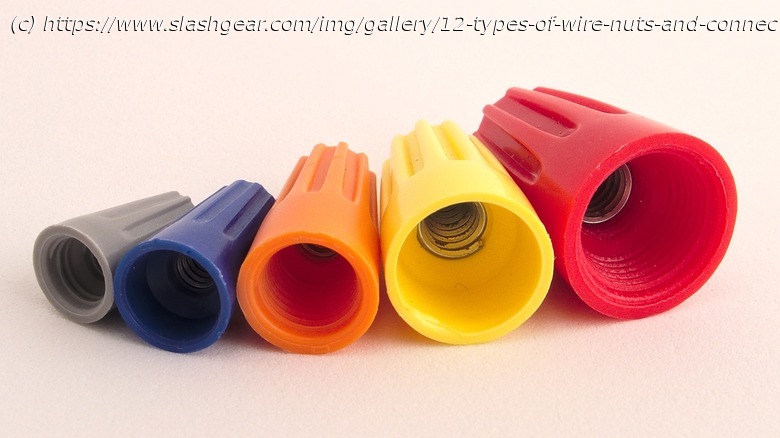
There are many wire connectors out there but these are some of the most common ones you’ll encounter.
Connecting wires have become a facet of everyday life, and humans have developed tons of ways to do it. Many of today’s cables have connectors, like the humble USB-C cable, to make it incredibly easy for the end user to handle. For other applications, there are myriad wire connectors to get the job done. In your day to day life, you probably walk past a dozen of them every day, as most buildings have wire splicing and connecting in the walls where you can’t even see them.
These wire connectors have dozens of applications depending on what you want to do, and they come with their own set of rules, an assortment of wire-specific tools, and other devices to help you connect one wire to another properly without starting a fire or shorting out whatever you’re connecting. Most people have probably seen wire connectors in garages or junk drawers and may wonder what they are, what they do, and how they work. If you are one of those people, this is the article for you.
Below is a list of common wire connectors and their intended purposes. There are far more than 12 types of wire connectors out there, and some are so niche that they’re only used for one thing, so we stuck to the most common ones. So, grab a nice pair of wire strippers and let’s get started. Twist-On Wire Connectors
By far the most common type of wire connector is the twist-on wire connector. These little guys are pretty simple to use and, as a homeowner who does their own repairs, I can tell you that the ease of use is a boon. These are also commonly referred to as wire nuts. Some believe it’s because they look like a nut or because you can „screw in“ wires like a nut. However, the wire nut is actually a trademarked name by Ideal Industries, sort of like how adhesive strips are often called Band-Aids.
In any case, these work pretty simply. You twist a couple of wires together and then stick them in the connector and then screw them in until they are hand-tight, just like a screw into a nut. The connector holds the two wires together and keeps the connection secured. You don’t need to use any electrical tape, although some people do as a backup measure just in case.
These are used for general electrical applications all over. I’ve used a dozen of these working on my house’s electrical wiring, but they’re also used in commercial environments, and you’ll even peep a few if you look at your automobile’s wiring. The color and size also matter as well, denoting the amount of voltage and wire gauge size each one can handle.Winged Twist-On Wire Connectors
The winged twist-on wire connector is an extremely close relative of the standard twist-on connector, and the two are often used interchangeably. In fact, they work almost identically, with the winged version having the extra plastic wings on the sides to grant the user additional leverage when connecting wire nuts. This can be helpful in some environments, especially in tighter spaces. However, the tradeoff is that winged wire nuts are physically larger, which means less can fit into their enclosed space.
In terms of pure mechanics, winged twist-on connectors work just like their non-winged brethren. You stick a couple of wires in there and „screw“ them in. The mechanism inside of the nut twists the cables and holds them in place, allowing an uninterrupted flow of electricity. These connections are insulated from the space around them, minimizing the risk of damage. Theoretically, you don’t need to pre-twist the wires before shoving them in a wire nut, but some people suggest that you do so anyway.
Much like regular twist-on connectors, the color and size denote how much capacity they have. Unfortunately, these aren’t standardized across brands, but if you look at the packaging, you can usually tell what kinds of connectors you need for which applications. They are also used in the same spaces as traditional wire nuts, so they truly are interchangeable. Crimp-on Wire Connectors
For more permanent applications, a crimp-on wire connector may be the way to go. These can be made out of metal or plastic, although even plastic ones have metal components, so they’re all metal to some extent. For these, you’ll need additional tools, including a wire stripper and a crimper tool, which are used to tighten the connector once the wires have been inserted. Some crimp-on connector kits come with one, which is good because most people probably don’t buy those tools often.
The mechanism for crimp-on connectors is deceptively simple. The wires are inserted into the connector, and the crimper tool will crush the connector onto the wires. This creates a cold solder situation where the metal is functionally fused together. Whether or not crimp-on is superior to actual soldering is the subject of some debate, but in general, it’s an easy way to make a near-permanent connection without breaking out the soldering iron and flux. In general, many agree that crimp-on works best for smaller wire where soldering would be pointlessly difficult.
Crimp-on connectors are mostly used in environments where the connection needs to be as close to permanent as possible. They’re also useful in environments where standard wire nuts may not hold up, like industrial buildings with a lot of vibration. It is also a popular style in boats and automobiles.Push-In Wire Connectors
Push-in connectors are some of the easiest wire connectors to use. They are fairly common, especially in countries like Japan, and they compete in mostly the same space as standard wire nuts. They offer an inexpensive, non-permanent way to connect wires together with an added bonus of having built-in support for more than two or three wires, with some having six, seven, or even eight slots in varying configurations.