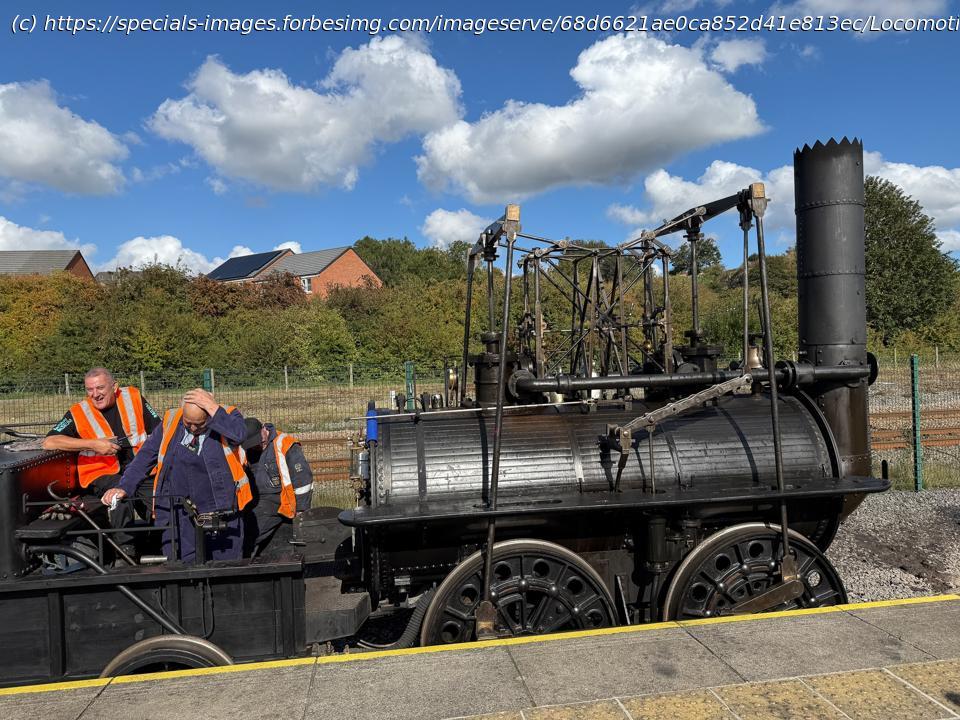
Born in the age of coal, the rail industry helped ignite the climate crisis. Today, rail — celebrating its 200-year anniversary — is reinventing itself as the greenest mode of mass transport.
Two hundred years ago tomorrow, on 27 September 1825, Locomotion No. 1 pulled passengers in a carriage, starting modern rail travel. And, as coal-powered locomotives played a key part in the industrial revolution, it can be argued that rail travel also played a pivotal role in starting the climate crisis.
“Yes, the climate crisis was partly caused by railways,” agrees Rob Scargill, lead curator of Railway Futures: the Porterbrook Gallery at the National Railway Museum in York, „but the climate crisis could, in part, be alleviated by railways,” he added.
“It’s a legal obligation that by 2050 we have to decarbonize the whole economy. And transport is the biggest emitting sector. Nearly a quarter of all greenhouse gas emissions in the U.K. are transport related. Unlike in the past, rail is the now greenest mode of mass transport, and getting greener. One of the big ways of decarbonizing rail is through electrification powered by renewable sources.”
Scargill was speaking at Locomotion museum in Shildon, County Durham, where tomorrow a replica of Locomotion No. 1, built in 1975, will recreate—over three days—the first journey on the Stockton & Darlington Railway, a coal line which also carried fare-paying passengers. The 26-mile journey between Witton Park Colliery and Stockton via Shildon and Darlington on 27 September 1825 is today celebrated as a history-changing event transforming how the world traded, travelled, and communicated.
The three day reenactment is the focal point of the nine-month S&DR200 festival celebrating the region’s pioneering past, and has incorporated a series of large-scale outdoor events, exhibitions and new art commissions in its public spaces, libraries, and world-class museums.
Today, the newly restored replica of Locomotion No.1 started from the Locomotion museum in Shildon—part of the national Science Museum group—which houses the original locomotive, and which is adjacent to the Stockton & Darlington Railway line, which is still a live line.Tourism
Since soul-crushing job losses in the 1960s through to the 1980s, rural County Durham has been one of the most deprived parts of the country. It’s likely cold comfort to those who lost their jobs, but the area is now evolving into a tourism hotspot, with Locomotion alone predicted to attract 250,000 visitors this year.Locomotion
The first steam engine on the S&DR—known as Locomotion No. 1 for 170 years or so—pulled 27 waggons along this first “Permanent Way” on its opening day in 1825. This linear event was said to have been witnessed by 40,000 or so spectators entertained by a band in the final waggon “playing cheering and appropriate airs.”
The pivotal early locomotive—a travelling steam engine rather than one fixed to the ground—puffed through the Stockton & Darlington Railway’s Georgian landscape. The 26-mile line was mainly used to transport coal to market, but as it also carried fare-paying folk it was an important stepping stone in the development of passenger railways, pre-dating the better-known Liverpool to Machester railway of 1830, which is world famous for the Rocket locomotive and was designed from the get-go to be a city-to-city line. (George Stephenson was involved with both railways, and his Newcastle locomotive factory also supplied the first steam engines that worked them.)
Locomotion Museum houses 47 engines and carriages from the early Stockton and Darlington Railway. Why, in 2004, did the Science Museum group open such an impressive—and free entry—attraction in a small, tucked-away town some 62 miles from the National Rail Museum in York? Because Shildon was the world’s first “railway town,” created from scratch to house a wagon works operational from 1833 through to 1984 when the plant still employed more than 2,500 people.
While the Stockton & Darlington Railway’s inaugural journey was pivotal in the history of transport, the development of rail technology goes back much further than 200 years and the North East of England has a long history of rail transport before steam locomotives.
The Stockton & Darlington Railway has been billed as the world’s first passenger-carrying rail line since 1875 thanks to the forgotten Victorian figure James Stephen Jeans. Jeans wasn’t a rail financier, a locomotive engineer, or a wayleave-granting landowner; he was a jobbing journalist. It was 29-year-old Jeans, an eager young wordsmith for hire, who was most responsible for shaping the story of the opening of the Stockton and Darlington Railway as the “greatest idea of modern times.”
In April 1875, Jeans was commissioned by the directors of the North Eastern Railway, owners of the Stockton and Darlington Railway, to write a book celebrating the line’s jubilee in September of the same year. His swiftly-written 315-page history of the first 50 years of the railway—a giveway book created for cash and based on a biased brief from a company with an aggrandising agenda—propagated several myths about the Stockton & Darlington Railway. Myths that are still current.
Historic England claims the Stockton & Darlington line was the “birthplace of the modern railway system,” used “innovative technology to carry both passengers and freight” and “began the railway age which was to change the world.” A BBC news report on 25 September repeated that the Stockton & Darlington line was the “birthplace of railways.”
Archival research by an eminent North East historian reveals a far more complex picture, showcasing that railways have a far longer history than most people realise. Les Turnbull, a former university lecturer, has concluded that, contrary to common claims, the Stockton and Darlington Railway did not introduce any ground-breaking technologies—malleable iron rails, cuttings, embankments, large railway bridges, signals, and locomotives existed long before 1825—nor was it the first public railway, and the line wasn’t even the first railway to take paying passengers.
The Surrey Iron Railway of 1801, the Swansea and Mumbles line of 1804, and the Kilmarnock and Troon line of 1812 predated the Stockton and Darlington line as public railways, with the last two lines carrying passengers as well as freight. The Middleton Railway to Leeds was established in 1758 and, in 1812, was the first to use locomotives.
Yet railways are even older than this. Rutways have existed since antiquity, and in 1604, colliery owners built Nottingham’s Wollaton Wagonway in Nottingham. In the 1720s the horse-powered Tanfield Wagonway on Tyneside was constructed with deep cuttings, huge embankments and the world’s first large masonry railway bridge, the Causey Arch.
While the Stockton and Darlington’s inaugural journey on featured an experimental VIP passenger coach—named, appropriately enough, Experiment and with Latin text that, according to Scargill meant “private risk, public service” and which was part of of the rail company’s first logo (which showed carriages pulled not by a locomotive but by a horse)—and 26 other coal wagons, many with passengers sitting on top, the everyday line was worked for several years not by locomotives but by horses. In truth, says Turnbull, the Stockton and Darlington Railway was an obscure coal line for most of its early history. Eight years after opening, only one percent of the company’s revenue was generated from passenger traffic.
There are many other myths surrounding the Stockton and Darlington Railway. A locomotive called Locomotion No. 1 did not puff along the line on the opening day—that was a later name for the engine. The locomotive was originally called “Active.”
The Locomotion No. 1 on display in the Locomotion museum is not 1820s vintage or even from the 1830s—it’s an amalgam of parts, with the long working engine frozen in the configuration it had in about 1857 after several key parts had been replaced, Trigger’s Broom style.
Nor is it the Stockton to Darlington Railway as is sometimes written. The mineral line started not in Darlington but at the Witton Park Colliery, close to St. Helen Auckland, a southern satellite of Bishop Auckland. Five miles of this part of the line quickly fell out of use and are today part of the S&DR Discovery Trail, a walking and cycling route.
Visitors can follow the line’s route and climb to the top of the Brusselton incline, where a stationary steam engine once pulled carriages along the line. The engine is long gone, but the buildings remain, and they are now converted into houses.
Later stone sleepers left in situ in several sections give a good approximation of what the original route might have looked like in this still rural landscape. (There are also original stone sleepers from the line embedded in the sea wall at Saltburn, on the Co.D Durham coast.)
In Darlington, the Skerne railway bridge, built by George Stephenson for the opening of the Stockton and Darlington Railway, is billed as the world’s oldest railway bridge still in use for its original purpose. A painting commissioned in 1875 for the line’s big-budget jubilee portrays spectators watching the September 1825 opening day but features later retaining walls on Skerne bridge—John Dobbin painted the bridge as it was in 1875, not in its original state.
Many of the foundation myths largely started by Jeans have been repeated by the media covering the S&DR200 Festival, mainly for story-arc simplicity—in reality the history of rail travel, like all history, is complex and often disputed.
What’s not in dispute is, as Scargill stated, that rail travel is more climate friendly than car travel. Indeed, one of the key selling points of the S&DR bicententary celebration events is that a great many of them are easily accessible by rail. LNER—one of the S&DR200 Festival’s partners—runs the East Coast mainline service between London and Scotland, with stations in York, Darlington and Durham all hosting celebratory events next year.
And much of the route of the original Stockton & Darlington railway line—minus the short stretch from Witton Park to Shildon—is still in use as a passenger line.
Locomotion No. 1 departed Locomotion Museum at 11:45 today and made its way to Hopetown Museum in Darlington, where it will spend the night.
Tomorrow, 27 September, Locomotion will depart Hopetown Museum at around 11:30am and will pass over Skerne Bridge in Darlington, the world’s oldest railway bridge still in continuous use.
On Sunday, the replica locomotive will head to Stockton Station at 10:55am and also visit Rochester Road at 11:31. A mural will be unveiled at Stockton Station, and Rochester Road will be the final public viewing point of the weekend.
Guy Martin, the former motorcycle racer turned TV presenter, is part of the driving team for Locomotion No 1. A production company has been making a documentary for more than a year about the replica locomotive and the part it is playing in the 200 year anniversary celebrations.