A new investigation shows how chemicals used for decades to make carpets stain resistant have contaminated swaths of the South.
Bob Shaw glared at the executives from the chemical giant 3M across the table from him. He held up a carpet sample and pointed at the logo for Scotchgard on the back.
“That’s not a logo,” fumed Shaw, CEO of the world’s largest carpet company, one attendee later recalled. “That’s a target.”
Weeks earlier, 3M Company announced it would reformulate its signature stain-resistance brand under pressure from the Environmental Protection Agency because of human health and environmental concerns.
Mills like Shaw’s had been using Scotchgard in carpet production, releasing its chemical ingredients into the environment for decades. And on a massive scale: The shrewd CEO built Shaw Industries from a family firm in Dalton, Georgia, into a globally dominant carpet maker worth billions.
“I got 15 million of these out in the marketplace,” Shaw told his 3M visitors. “What am I supposed to do about that?”
A 3M executive replied that he didn’t know. Shaw threw the sample at him and left the room.
The answer to Shaw’s Scotchgard question from that moment in 2000 would be the same as that of the broader industry. Carpet makers kept using closely related chemical alternatives for years, even after scientific studies and regulators warned of their accumulation in human blood and possible health effects. Customers expected stain resistance; nothing worked better than the family of chemicals known as PFAS.
A lack of state and federal regulations allowed carpet companies and their suppliers to legally switch among different versions of these stain-and-soil resistant products. Meanwhile, the local public utility in Dalton responsible for ensuring safe drinking water coordinated with carpet executives in private meetings that would effectively shield their companies from oversight.
Year after year, the chemicals traveled in water discarded during manufacturing from mills across northwest Georgia, eventually reaching a river system that provides drinking water to hundreds of thousands of people in Georgia and eastern Alabama.
The pollution is so bad some researchers have identified the region as one of the nation’s PFAS hot spots. Today, the consequences can be found everywhere. PFAS, often called forever chemicals because they can take decades or more to break down, are in the water and the soil.
They’re in the dust on floors where children crawl, the local fish and wildlife, and as ongoing research has shown, the people.
Doctors have few answers for those like Dolly Baker who live downriver from Dalton’s carpet plants. She recently learned her blood has extraordinarily high PFAS levels.
“I feel like, I don’t know, almost like there’s a blanket over me, smothering me that I can’t get out from under,” she said. “It’s just, you’re trapped.”
An investigation by newsrooms including The Atlanta Journal-Constitution, The Associated Press and FRONTLINE (PBS) has revealed how the economic engine that sustained northwest Georgia contaminated the area and neighboring states, too. Downriver from Dalton, AL.com found cities in Alabama are struggling to remove PFAS from drinking water. And in South Carolina, The Post and Courier traced a local watchdog’s discovery of forever chemicals to a river by a Shaw factory.
The full story of Georgia’s power structures prioritizing a prized industry over public health is only now emerging through dozens of interviews and thousands of pages of court records from lawsuits against the industry and its chemical suppliers. Those records, including testimony from key executives, emails and other internal documents, detail how carpet companies benefited from chemistry and regulatory inaction to keep using forever chemicals.
All the while, the mills still hummed.Pointing fingers in a company town
A sign welcomes Dalton’s visitors to the “Carpet Capital of the World.”
Fleets of semitrucks stamped with company logos rumble out of behemoth warehouses. Textiles have employed generations here, propelling the city from 19th-century cotton mills into a manufacturing hub — and the region into a supplier of carpet to the globe.
The durability that makes PFAS so good at protecting carpets from spilled tomato sauce and muddy boots lets them survive in the environment. It also makes them dangerous for humans. Because they bind to a protein in human blood and absorb into some organs, PFAS linger.
The blood of nearly all Americans has some amount of the chemicals, which have been used in a variety of consumer products: nonstick cookware, waterproof sunscreen, dental floss, microwave popcorn bags.
Few industries used them as much as carpet did in northwest Georgia. While huge amounts were needed for stain resistance on an industrial scale, minuscule amounts — the equivalent of less than a drop in an Olympic-sized swimming pool — can make drinking water a health risk. For certain PFAS, U.S. regulators now say no level is safe to drink.
More than a year before the Scotchgard announcement in 2000, 3M informed Shaw Industries and its biggest competitor, Mohawk Industries Inc., that it was finding Scotchgard’s chemical in human blood and that it stayed in the environment, 3M records show.
Carpet executives have long insisted they are not to blame. They point out that 3M and fellow chemical manufacturer DuPont assured them their products were safe, for decades hiding internal studies that were finding harm to the environment, animals and people.
Shaw and Mohawk both said they relied on and complied with regulators and stopped using PFAS in U.S. carpet production in 2019.
In an interview, a Shaw executive said the company acted in good faith as it worked hard to exit PFAS as quickly as suitable substitutes could be found.
“Hindsight is 20/20,” said Kellie Ballew, Shaw’s vice president of environmental affairs. “I don’t think that we can call into question our intentions. I think Shaw had every good intention along the way.”
Shaw in a follow-up statement said it complied with its wastewater permits and took guidance from chemical companies, some of which “instructed Shaw to put spills of product into the public sewer system.”
Mohawk declined an interview request, instead referring to a 2024 filing in its lawsuit against chemical companies: “For decades, DuPont and 3M sold their carpet treatment products to Mohawk without disclosing the actual or potential presence of PFAS in their products.”
Later, in response to detailed questions, Mohawk attorney Jason Rottner wrote that, “Any PFAS contamination issues in northwest Georgia are a problem of the chemical manufacturers’ making.”
Now, uncertainty and feelings of betrayal are boiling across the region. Communities fear their drinking water is unsafe and local governments say the problem is too vast for them to fix alone.
In Washington, Republicans and Democrats alike have been slow to act. Under President Joe Biden, the Environmental Protection Agency in 2024 established the first PFAS drinking water protections. The Trump administration has announced plans to roll back some and delay enforcement of others.
The agency declined interview requests but in a statement said it is committed to combating PFAS contamination to protect human health and the environment, without causing undue burden to industry.
Georgia’s regulatory system has done little to scrutinize PFAS and depends mostly on industry to self-report chemical spills, imposing modest penalties when companies do. The Georgia Environmental Protection Division, which declined an interview request, said it “relies on the expertise of” the EPA.
Meanwhile, carpet makers still can’t seem to shake PFAS. Just last year, EPA concluded “PFAS have been and continue to be used” by the industry, based on wastewater testing. The agency did not name companies and said it’s unclear whether the chemicals were from current or prior use.
The mess in northwest Georgia has led to a series of lawsuits over the past decade with hundreds of millions of dollars at stake.
Buried in this avalanche of litigation, finger-pointing and politics are the people who live here. They have been forced to navigate a public health and economic crisis of a magnitude still not fully understood.
“They ought to have to clean this land up,” Faye Jackson said, referring to carpet companies. A former industry worker, she raised her family in a house next to a polluted river and has elevated PFAS levels in her blood. “They ought to have to pay for it.”The creek ran blood red
Lisa Martin watched the creek beside the Mohawk Industries mill run red with carpet dye.
It was one of her first days as a planning manager at Mohawk in 2005, and she tried to hide her unease as the dye runoff turned the water into what looked like blood.
The red she saw in Drowning Bear Creek had come from the nearby dyehouse, where carpets got their colors. There, machines whirred as workers sloshed around in rubber boots in ankle-deep dyewater, reminding Martin of fishermen. The acrid odor made her eyes tear up.
A recent California transplant at the time, Martin recalled her initial culture shock.
“At a gut level, you know it’s not right. And unfortunately, when you try to raise the flag and everybody’s like, ‘Well, that’s just the way it is,’” Martin said in an interview.
“I became complacent.”
Like Shaw, Mohawk is based in northwest Georgia and is among the largest carpet companies in the world. The industry supported the entire community, employing someone in what seems like every family. Martin realized carpet was in the region’s DNA.
Martin said the chemical runoff was routine during her 20 years at Mohawk, which ended with her 2024 retirement. Sometimes, when the company dyed carpets blue, the water in the creek would be blue, too. One spill that turned the creek purple for a mile downstream killed thousands of fish, records show.
Mohawk’s attorney called such spills “rare instances” that were promptly reported and said there is no evidence any spills directly discharged PFAS.
In the dyehouse, what neither Martin nor the workers could detect were the colorless, odorless compounds also included in the wastewater: forever chemicals. Machines bathed the carpets in these soil-and-stain blockers, and what didn’t stick washed away.
For decades, Mohawk’s and Shaw’s mills sent PFAS-polluted wastewater through sewer pipes to the local Dalton Utilities plants for treatment that did not remove the chemicals. Much of the tainted water ended up in the Conasauga River.
Both Shaw and Mohawk said they operated in accordance with permits issued by Dalton Utilities. The utility said it takes direction from federal and state regulators, who have not prohibited PFAS in industrial wastewater.
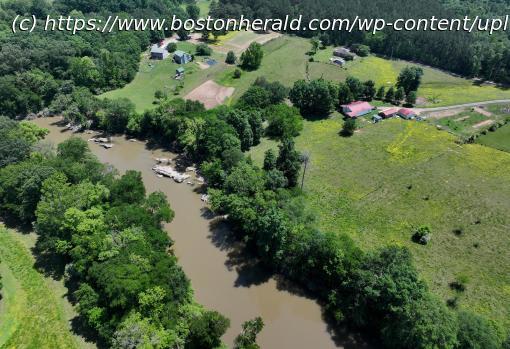
The Conasauga watershed is filled with lush green pastures, creeks and tributaries that help fuel the water-hungry industry. The river’s waters emerge out of Georgia’s Blue Ridge Mountains and eventually flow southwest, past Dalton, Calhoun and Rome, and then into Alabama.
Residents downriver from the mills didn’t know about the chemicals running through their towns. But the industry’s top leaders did.
PFAS is a catchall term for a group of thousands of related synthetic compounds also known as fluorochemicals. They have been fundamental to the carpet business since the 1970s, as market demand for stain resistance transformed the industry, and carpet makers began buying millions of pounds. In the mid-1980s, the introduction of DuPont’s Stainmaster, accompanied by a successful marketing blitz, further established these products as essential.
Neither DuPont nor its related chemical companies that supplied PFAS provided comment for this story.
The carpet industry used so much PFAS that Dalton’s mills became the largest combined emitters of the chemicals among 3M’s U.S. customers, according to a 1999 internal 3M study that looked at 38 industrial locations.
Before 3M had pulled Scotchgard, leading to Bob Shaw’s showdown in the spring of 2000, both Shaw Industries and Mohawk had been privy to inside information that PFAS were accumulating in human blood. Bob Shaw did not respond to requests for comment.
In late 1998 and early 1999, 3M held a series of meetings with carpet executives to disclose its blood-study research, according to 3M’s internal meeting notes from court records.
“When we started finding the chemical in everybody’s blood, one of the biggest worries was Dalton, because we knew how sloppy they were,” Rich Purdy, a 3M toxicologist who alerted the EPA to his company’s hiding of PFAS’ dangers, said in an interview.
Notes by a 3M employee from a January 1999 meeting said Mohawk executives did not express grave concerns about the revelations. “No real sense of Mohawk problem/responsibility,” 3M noted. “If it’s good enough for 3M, it’s good enough for Mohawk.” Mohawk’s attorney said of the meetings over two decades ago that 3M assured the company its chemicals were safe.
At another meeting that January, Shaw executives were “concerned but quiet,” with one executive expressing he “felt plaintiffs’ attorneys would be involved immediately,” according to 3M’s notes. Shaw Industries maintains it learned of the concerns about Scotchgard at the same time everyone else did.
In follow-up letters to top executives with Shaw and Mohawk later that month, 3M noted the company’s efforts were guided by the idea that reducing exposure “to a persistent chemical is the prudent and responsible thing to do” while emphasizing current evidence did not show human health effects.
“We trust that you appreciate the delicate nature of this information and its potential for misuse,” the letters said. “We ask that you treat it accordingly.”
3M then asked for access to Shaw and Mohawk mills to see if they were handling the chemicals safely, records show. Those internal reports, produced in 1999, would fault how carpet companies handled PFAS products, exposing workers and the environment, according to court records.
The next year, 3M and EPA announced concerns about Scotchgard.