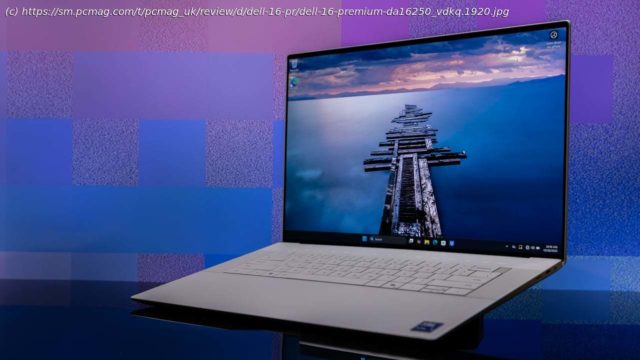
The Dell 16 Premium (DA16250) is a stunningly designed desktop replacement laptop with considerable power potential, paired with a gorgeous 4K OLED display. However, it’s super pricey and falls short in a few key areas of usability.
Shoppers looking to the Dell Premium (formerly XPS) line for a high-end laptop won’t be disappointed, but several worthy alternatives have landed since Dell’s major rebrand, crashing its party. The Dell 16 Premium (starting at $1,499.99; $3,199.99 as tested in model DA16250) is a masterclass in big-screen laptop design. It’s as elegant as they come, containing a roaring engine with its Intel Core Ultra 7 255H processor and Nvidia GeForce RTX 5070 graphics. Plus, with longer battery life than expected, considering its stunning 16.3-inch 4K OLED display, what’s not to like? For starters, the price for this silicon mix is steep for a mainstream-coded laptop, and its keyboard is less than amazing. The laptop comes up short on ports, too, for its size. While we’ve found plenty to enjoy with the Dell 16 Premium, it’s not quite enough to unseat the Editors’ Choice award-winning Framework Laptop 16 from the desktop replacement throne, and it’s not prepared to go toe-to-toe with the 16-inch MacBook Pro, either.Configurations: A Wide Range of ‘Premium’ Options
Dell wasn’t kidding when it labeled this line as “Premium.” As tested, the Dell 16 Premium costs $3,199.99 (though seen, at times, discounted to $2,799.99) for an Intel Core Ultra 7 255H CPU, an Nvidia GeForce RTX 5070 (8GB) GPU, 32GB of memory, a 1TB solid-state drive, and a 16.3-inch 4K (3,840-by-2,400-pixel) 120Hz OLED touch-screen display. This is expensive for these specs, but you’re paying for its premium build in addition to that powerful hardware.
If you like the design but want to spend the least, you can opt for the $1,499.99 starter model. This configuration features an Intel Arc 140T integrated GPU, 16GB of RAM, a 512GB SSD, and a non-touch 2K screen. Unfortunately, this configuration is also still not worth the parts list. The most decked-out model will cost you $3,749.99 for an Intel Core Ultra 9 CPU, 64GB of RAM, and a 4TB SSD.Design: Elegance Incarnate
This laptop really does scream premium. The Dell 16 Premium’s aluminum hood is painted a platinum color (also available in black), while its curved edges and hinge give off an elegance that says, “MacBook could never.” However, it’s a bit thicker, at 0.75 inch, than the 0.66-inch chassis on the 2024 Apple MacBook Pro 16-Inch. Dell could also provide more color options beyond Platinum and Graphite (black).
The lower deck is where the Dell 16 Premium truly shines, resembling a spaceship computer. Between the flat, uniform keyboard and touchpad surface, the LED-lit function bar, and compact, tight speakers, you could easily place this laptop in a sci-fi film, and I’d buy it as future tech. The bezels on the display are remarkably thin, as well.
Dell’s design isn’t for everybody, so be aware that you’re paying a significant amount of money for a unique look and experience. I love how it looks, but maybe not how it feels. (I’ll get into that later.)Display and Audio: Stunning (for Better and Worse)
You cannot get me to look away from a shiny OLED display.you just can’t. The Dell 16 Premium lives up to its name, providing a stunning 16.3-inch OLED display that bursts with color and produces sufficient brightness to combat pesky glare.
With its 3,840-by-2,400-pixel resolution, I could make out all the minute details in the background set of the latest Critical Role episode. Its 120Hz refresh rate makes it smooth enough for effective midrange gaming and an overall smoother desktop experience. Watching movies or playing my favorite games is so satisfying with a screen this vivid.
The Dell 16 Premium’s speakers are extremely loud, but that’s not necessarily a positive. I feel like I got punched when I play Mxmtoon’s “Just a Little.” The soundstage feels tight, as if all the notes don’t have enough room to breathe, so the audio comes off sharp and occasionally noisy or muddled.Keyboard, Touchpad, and Webcam: Looking Nicer Than It Feels
I love how the Dell 16 Premium’s keyboard looks—it just tickles my brain as a sci-fi nerd. But I’m not a big fan of how it feels. While the keys are surprisingly snappy, and they’re a fine size, their flat design makes them difficult to navigate. The keyboard quickly grows frustrating to type on, and the backspace key is also smaller than I’d like. The button-less LED-lit function bar may turn off some people as well; I like it, though I wish it gave some haptic feedback.
Speaking of haptic feedback, that’s what you’re getting with the touchpad. The touchpad, being uniform with the deck, is fine, except that the material isn’t as smooth as a glass-surfaced one would be. I would’ve preferred a more pronounced touchpad with a glass finish, rather than this uniform look.
Meanwhile, few laptop webcams are genuinely excellent, but the Dell 16 Premium’s 1080p shooter isn’t bad. My background looks a bit blotchy in live images, but it handles the contrast of my bright window decently well. The colors on my cute panda shirt come in accurately, and I see enough detail to just barely catch the freckles on my face. I’d definitely use this to chat with friends or even videoconference for work.Ports: Dude, Where Are My Ports?
The cost of elegance should not be ports, especially when the Dell 16 Premium is riding around with a 0.75-inch thick chassis. Dell’s implementation is exceedingly simple: two Thunderbolt 4 ports on the left and one Thunderbolt 4 on the right, accompanied by a headphone jack and a microSD card slot.
The microSD card reader is a welcome addition, but overall, this selection is still scant. You’ll need a USB-C hub to plug in any legacy USB-A peripherals. A single Type-A port doesn’t seem too much to ask here, nor perhaps a full-size HDMI. (Bear in mind that the USB-Cs, one of which would have to serve for display-out, will be reduced by one when you need to plug in the charger.) For wireless connectivity, the laptop features a Wi-Fi 7 radio, along with Bluetooth 5.4 for peripherals.Performance Testing: Throwing Blows With the Best
For the price, I wasn’t too impressed with the hardware that the Dell 16 Premium had to offer, but it held its own against the competition, some of which were just as pricey.
With a premium machine of this caliber, we, of course, had to throw in the 16-inch MacBook Pro ($3,649 as tested) as a competitor. Naturally, our Editors’ Choice award-holder for desktop replacements, the Framework Laptop 16 ($3,198 as tested), belongs on this list. For the content creation side, we have the Asus ProArt P16 ($2,699.99 as tested). Then we included the Dell 16 Plus ($1,149.99 as tested) to see how the midrange Dell desktop replacement laptop compares.Productivity and Content Creation Tests
Our primary overall benchmark, UL’s PCMark 10, puts a system through its paces in productivity apps ranging from web browsing to word processing and spreadsheet work. Its Full System Drive subtest measures a PC’s storage throughput.
Three more tests are CPU-centric or processor-intensive: Maxon’s Cinebench 2024 uses that company’s Cinema 4D engine to render a complex scene; Primate Labs’ Geekbench 6.3 Pro simulates popular apps ranging from PDF rendering and speech recognition to machine learning; and we see how long it takes the video transcoder HandBrake 1.8 to convert a 12-minute clip from 4K to 1080p resolution.
Finally, workstation maker Puget Systems’ PugetBench for Creators rates a PC’s image editing prowess with a variety of automated operations in Adobe Photoshop 25.
Save for a narrow loss in PCMark 10, the Dell 16 Premium fought hard with its Windows-based competition on all of our benchmarks, but it couldn’t quite catch up to the MacBook Pro. Meanwhile, Dell’s high-end desktop replacement traded blows with our top-pick Framework model throughout the benchmark gauntlet. If you’re looking at the Dell 16 Premium for some serious content creation, the MacBook Pro is simply better, as we had it configured at least: It aced our Photoshop and DaVinci Resolve tests without issue. Likewise, the Framework appeared to have the edge in that department.
However, keep in mind that the MacBook Pro costs even more to achieve that. A fairer comparison would be the Asus ProArt P16, which has been our favorite content creation machine for a while, and the Dell 16 Premium traded quite a few blows with it; they racked up wins and losses on both sides.Graphics Tests
We challenge each reviewed system’s graphics with a quintet of animations or gaming simulations from UL’s 3DMark test suite. The first two, Wild Life (1440p) and Wild Life Extreme (4K), use the Vulkan graphics API to measure GPU speeds. The second pair, Steel Nomad’s regular (4K) and Light (1440p) subtests, focuses on APIs more commonly used for game development to assess gaming geometry and particle effects. A fifth test, Solar Bay, measures ray-tracing performance.
Graphics performance is also crucial for content creation, and the Dell 16 Premium outperformed the Asus ProArt P16 in every test. The Premium even outpaced the MacBook Pro in every graphics contest. With any 3D graphics-heavy software, like in games or 3D modeling tools, you’ll likely get more out of the RTX 5070-equipped Dell than the rest of what we compared it with. However, gaming is not the focus of this laptop, although it’s certainly very gaming-able at a resolution lower than its native one. Look to Dell’s Alienware line for that kind of experience, especially at this price.Battery Life and Display Tests
We test each laptop and tablet’s battery life by playing a locally stored 720p video file (the open-source Blender movie Tears of Steel) with display brightness at 50% and audio volume at 100%. We make sure the battery is fully charged before the test, with Wi-Fi and keyboard backlighting turned off.
To gauge display performance, we use a Datacolor SpyderX Elite monitor calibration sensor and its Windows software to measure a laptop screen’s color saturation—what percentage of the sRGB, Adobe RGB, and DCI-P3 color gamuts or palettes the display can show—and its 50% and peak brightness in nits (candelas per square meter).
While it may seem that the Dell 16 Premium registered one of the lowest battery life times on this list, and it technically did, it lasted for an impressive amount of time for a laptop with a 4K display. (And notably longer than our Editors’ Choice award winner.) The only other laptop with a 4K display in this lot is the Asus ProArt P16, and the Dell 16 Premium cleared its time by more than 30 minutes. That’s almost three episodes of Steven Universe.
Jokes aside, we’re not shocked that the Dell 16 Premium’s display is as colorful and bright as it is. It practically burns my eyes with a rainbow of color at maximum brightness. For OLED displays, we often worry about glare, but the panel is plenty bright, so it handles ambient light well. However, Framework’s panel is also just as colorful and even brighter when maxed out.