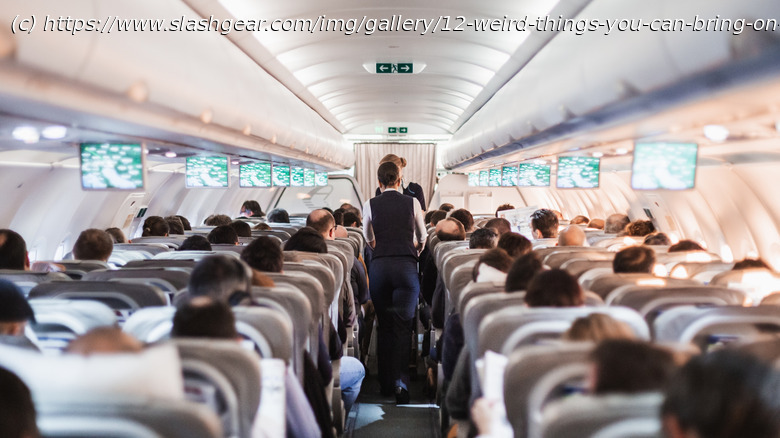
You’d think TSA rules are airtight, but nope. From antlers to embalmed specimens, here are 12 bizarre things you’re actually allowed to bring on a plane.
When the TSA somehow finds and confiscates that little pair of nail clippers you buried deep in your carry-on, it gives the impression that commercial airplanes are locked down tight, security-wise. They’re not. Just ask the passengers on a flight from Bangkok to Taiwan in 2023, whose trip was interrupted by the appearance of a rat and an otter — and later, it was discovered there was an entire menagerie of animals smuggled in via a suitcase. We’ve taken a look at some of the weirdest things ever confiscated by TSA officials, but even when security officers nab the not-okay stuff, there’s still a laundry list of bizarre things the x-ray technician lets right on through.
In most cases, the list of forbidden items makes sense. The electronics the TSA doesn’t allow in carry-on baggage, like tasers and nail guns, obviously present a security risk on a flight. But looking through the TSA’s long, long list of allowed and not-allowed items, there are a ton that the average person would probably assume are very not allowed. Here are 12 in particular that might surprise you, permitted either in a carry-on or in a checked bag.Antlers
That’s right, if the next time you’re putting your carry-on into the overhead bin and there’s a moose’s full rack next to it, it wasn’t because the TSA officer was too afraid to confront the burly owner in full camo. Antlers are allowed in both carry-on and checked bags and don’t appear to require any special permission or proof of where you got them, at least as far as the TSA is concerned. The only requirement is that they fit in the overhead bin if you’re bringing them on board. Airlines may have their own fees and policies. United Airlines, for example, charges $100 and asks that you wrap the antlers and protect the tips.
Having said that, there are obviously local regulations surrounding antlers that will come into play. Hunting rules aside, some states (Idaho, for example) require an antler-gathering certificate, which is free to obtain. There are further regulations that could land you in hot water if you’re not careful. For instance, a pair of antlers still connected to a skull is a big no-no. Buying antlers is a different matter altogether and usually requires another kind of certificate. We’ve only touched on one state’s regulations here; destination states or countries may have entirely different rules to contend with.
The point is, while the TSA may allow antlers, it assumes you’ve done your due diligence before and after the security checkpoint. There’s a good chance authorities could get involved if you bring a rack to the airport without proof you obtained it through proper channels. And don’t assume this applies to any and all trophy animal body parts; one man got busted big time in Delhi for trying to fly to Canada with a crocodile skull, thanks to local wildlife laws.Blenders (and other kitchen equipment)
If you really wanted to (and assuming you stay under a carry-on’s weight limits), you could bring a decent chunk of your kitchen with you on your flight. Not the knives, obviously, but other sharp objects (like blender blades) are a-okay. The TSA has a blanket requirement that any sharp objects permitted on the plane be « sheathed or securely wrapped to prevent injury to baggage handlers and inspectors. » After all, the first thing TSA officers ask before rifling through your bag is: « Will anything poke me? » A blender’s blades certainly might.
There’s a surprising amount of kitchen equipment on the allowed list. Maybe the TSA has gotten one too many calls from grandmas asking if their mixers are allowed. You can bring a coffee maker, tortilla press, bread machine, chopsticks, bottle opener, cutting board, and more. Most of the rules about bringing them are just common sense. With your coffee maker, for example, you need to make sure the cords are wrapped and the glass is packed properly to avoid breakage. One thing worth mentioning — and this applies to every item on this list — is that the TSA officer who inspects your stuff gets to make the final call. Even an item that’s technically allowed could still be confiscated if the officer says so.Human skeletons (and artificial ones)
It’s fairly well known that people can bring cremated remains on (most) airlines with them — although there is a chance your recently departed could get confiscated if you use the wrong container. What’s not as well known is that human skeletons are allowed, too. The TSA confirmed this on their X (formerly known as Twitter) account, clarifying that they need to be « properly packaged, labeled, and declared to your airline. » Your airline, however, will have its own regulations, so check with them too.
As proof that this is actually possible, Kristi Loyall, a woman who had her foot amputated due to cancer, brought the bones with her on her travels with surprisingly little hassle (via PBS). Again, TSA officers make the final call, and they are obviously going to pounce on anything that looks suspicious. Back in 2013, two women were stopped when bone fragments were found inside their ceramic pottery (via CBS). Your best bet at avoiding a very uncomfortable altercation with officials is to give full disclosure, properly package human remains, and label them clearly. And if you’re a medical student bringing your anatomical skeleton for study, fret not; it’s 100% allowed.A fully disassembled computer
Given how strict the TSA is about its electronics rules (airlines are increasingly banning power bank use on flights, for example), it might give the impression that a disassembled computer — motherboards, hard drives, power supplies — wouldn’t be allowed.