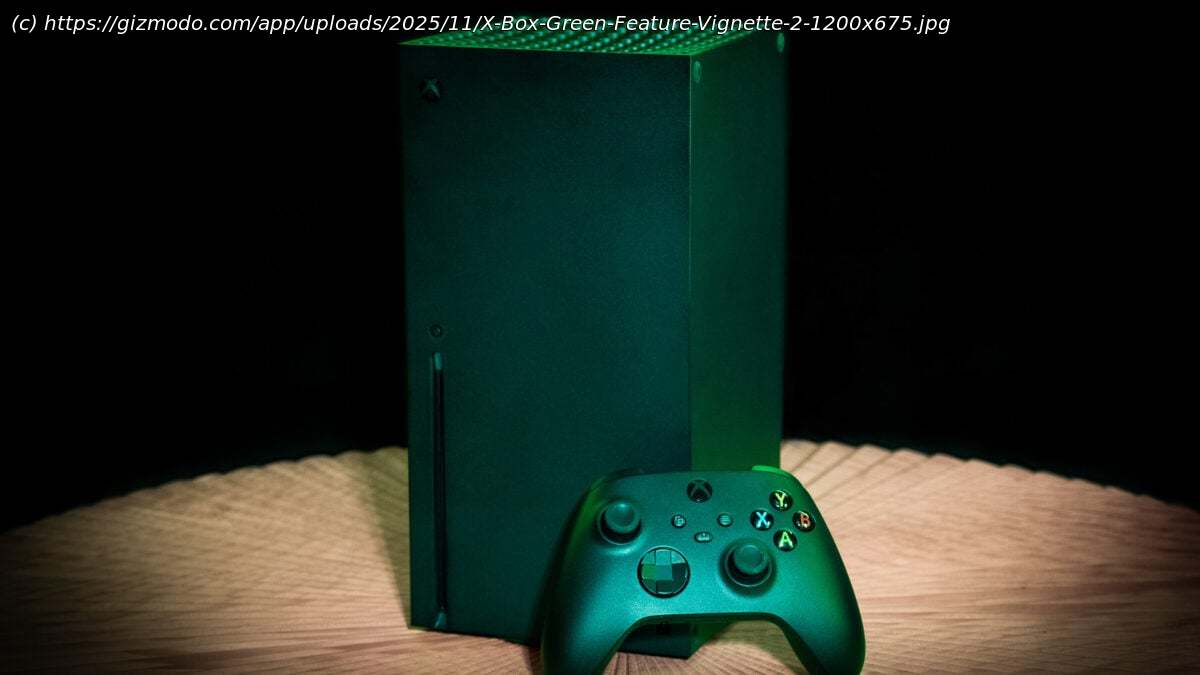
Xbox still needs console hardware, but it won’t look like anything you’ve seen before.
Five years ago today, the Xbox Series X sought to reimagine what the term “Xbox” even was. Back then, the big, black, boxy console promised players they could get peak performance for couch-based gaming for the low price of $500. In 2025, that console with the optical drive now costs $150 more than it did in 2020, and it has been eclipsed by the latest gaming-ready PC chips many times over.
Microsoft’s Game Pass model, which rose along with the Series X to become the best deal in gaming, now costs more than ever if you want the best features.
It all seems like grim tidings, but there’s more at stake than a brand. Xbox is trying to drag the entire games industry industry into a new identity, where exclusivity and first-party hardware like the Series X matter less than the games themselves.
Sure, Halo is coming to PlayStation 5 and Gears of War is already on the console, but Xbox isn’t going anywhere. It could still cut through the clamor and prove the naysayers wrong.
“What they’re attempting to do is blow up the traditional gaming framework,” Circana’s leading video game industry analyst Mat Piscatella told Gizmodo over email. “The key question is if players will be willing to go along with that change.”
When a trickle of bad news becomes a flood, it can seem near impossible to see any bright spot of hope. With the move toward a subscription-based gaming landscape, we own less and grow more dependent on digital platforms. We suffer at the whims of the platform holders, unable to do anything but roll our eyes at the inevitable process of enshittification. Then there’s the recent drama from Bloomberg’s report claiming Microsoft has placed a 30% profit margin mandate across its Xbox brand, which is way above the industry standard. The report puts the Xbox’s recent actions into perspective.
Harping on these pain points is less like beating a dead horse, and more like kicking the shins of a poor, hobbled creature who’s pushing itself harder than anybody else. The Xbox brand is still alive despite the crushingly dour outlook of the fanbase. Xbox could make the case that exclusivity has no place in our modern gaming landscape. While the majority of gamers would be fine streaming their titles from home, there will be a dedicated subset of gamers who would pay through the nose to get the absolute best gaming hardware there is without funneling thousands of dollars into a gaming PC.
Xbox needs a plan. Better yet, it needs to lift the lid on its plans if it wants players to get on board with its attempts to completely flip the script on gaming.How did we get here?
The Xbox is philosophically distinct from every other console on the market, and that informed what eventually became the Xbox Series X. The designers behind the original Xbox console back in 2001 wanted to take what was essentially a Windows PC and plug it into the living room. The system used Microsoft’s own DirectX technology and ran on equivalent computer parts. Eventually, that “DirectX Box” became, simply “Xbox.” Just a few years after launching its original console, the company found massive success with the Xbox 360. It was a console with a lifespan that lasted nearly 11 years, becoming the company’s best-selling device. Microsoft only killed off the Xbox 360 store in 2024.
Microsoft’s follow-up, the Xbox One, launched with a heavy focus on multimedia. In 2013, Microsoft emphasized the console as an “all-in-one home entertainment system” and kept bringing up Live TV as a killer feature. The console suffered from numerous controversies, like that infamous attempt to require an internet connection, limit players’ abilities to buy used games, and force users to hook up a Kinect. Former Xbox Senior Vice President Don Mattrick told players, “Fortunately, we have a product for people who aren’t able to get some form of connectivity. It’s called Xbox 360.”
After a large C-suite shakeup that saw the rise of Phil Spencer—now the CEO of Microsoft Gaming—Microsoft launched two consoles on Nov. 10, 2020. The Xbox Series S was a lower-end console built for playing Game Pass titles and modern games at 1440p resolution. The big daddy, the Series X, was the most “box-like” Xbox the company had ever devised. Microsoft promised it was designed for 4K gaming, packing in the both AI upscaling and ray tracing capabilities to make games play and look their best.
The thing we often forget about the Xbox Series X is how much it was a continuation of Microsoft’s original pitch way back in 2001. The console is full of PC guts, even if it doesn’t feel like any kind of Windows machine. And yet, it’s a powerful console for its price thanks to its custom 8-core, 3.8GHz AMD processor built on what was then the still-relatively new Zen 2 CPU and RDNA 2 microarchitecture. The console promised double the FLOPS (floating point operations per second) compared to the Xbox One. It came with 16GB of fast GDDR6 RAM for shorting loading times and a full 1TB SSD to hold the growing size of next-gen games. The storage was more than the 825GB SSD in the original (and most recent) PS5. The Xbox Series X internals are especially interesting—at least for hardware nerds like yours truly. In interviews, designers like Xbox’s Director of Mechanical Engineering Jim Wahl talked about how the console’s split motherboard design allowed it to direct cool air onto all components in a steady stream.
The Xbox Series X was a tall tower of gaming potential, though this console generation lacked many of the big-name titles that would get players to rush out for the latest hardware. Halo Infinite didn’t arrive until late 2021. The games that have come out since 2020 haven’t stuck around on Xbox’s own console, either. Titles like Forza Horizon 5 are now on PS5. More recent titles like Indiana Jones and the Great Circle hit Sony’s console in April this year.
Microsoft does not reveal the total number of console shipped or sold. Still, best estimates show the Xbox Series S and X has shipped around 30 million units total as of February 2024.