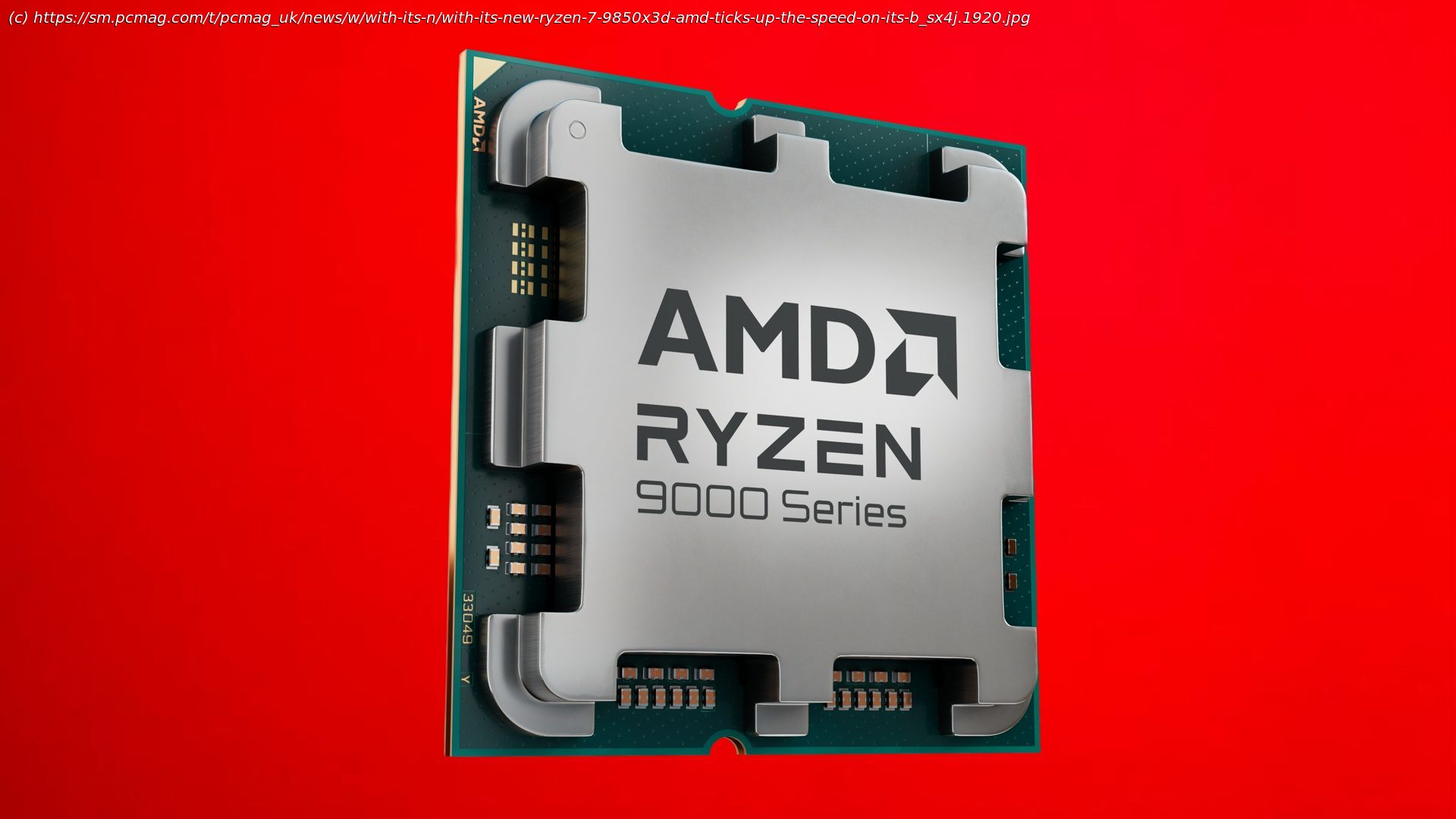
AMD’s new-for-2026 Ryzen 7 9850X3D processor kicks up the clocks and packs the same extra-fast cache in an effort to outpace the well-regarded Ryzen 7 9800X3D.
Serious PC gamers agree: AMD’s Ryzen 7 9800X3D has been one of AMD’s most successful processors in recent years, thanks to its game-boosting 3D V-Cache technology that layers in high-speed cache to enable the fastest frame rates possible with your given GPU.
Now, AMD is aiming to build on that momentum with the new AMD Ryzen 7 9850X3D, a higher-clocked variant of the 9800X3D that aims to deliver even better gaming performance, thanks to ticked-up clock speeds. AMD is declaring the Ryzen 7 9850X3D as the world’s new fastest gaming processor, as all signs point to it surpassing the Ryzen 7 9800X3D. A big question remains, though, whether it will be a better gaming CPU than AMD’s more robust Ryzen 9 9950X3D.The 9850X3D Difference
AMD hasn’t detailed all of the specs of the new AMD Ryzen 7 9850X3D, but so far, the only confirmed difference between it and the 9800X3D is a boost in the core clock speed. The AMD Ryzen 7 9800X3D tops out at 5.2GHz, while AMD pushes that to 5.6GHz with the Ryzen 7 9850X3D. The Ryzen 7 9800X3D and the 9850X3D both use the same chips at heart, so it’s possible you could overclock a particularly good sample of the Ryzen 7 9800X3D to match what you’ll get from a stock 9850X3D. But that’s just a theory.
Since they both stem from the same silicon, during manufacture, to determine which chips will become Ryzen 7 9850X3D processors and which will be 9800X3D processors, AMD employs a « binning » process that tests each chip’s capabilities and sorts them accordingly. The processors that go on to be 9850X3D chips prove to run stably at higher clock speeds than those chips destined to be 9800X3D chips. This is why the 9850X3D has a higher clock speed out of the box, but also why you might be able to push some samples of the 9800X3D to nearly those speeds.
Otherwise, both processors share similar specs, and both work on the AMD AM5 socket. Each is loaded with eight AMD « Zen 5 »-based CPU cores, which can work on two processing threads each, for a total of 16 threads. The processors also have 32MB of L3 cache, supplemented by a 64MB last-level cache (LLC); these caches help boost performance in certain workloads, most notably while gaming.
The increase in clock speed alone could enable a performance increase of around 8% over the Ryzen 7 9800X3D, in best-case scenarios. This appears to be roughly in line with AMD’s internal testing, which showed both processors performing relatively similarly, in many cases, with the 9850X3D generally slightly ahead in the slides AMD shared. In a few instances, AMD noted a performance gain of more than 8%, which is likely due to the increase in clock speed alleviating a bottleneck elsewhere in the system.