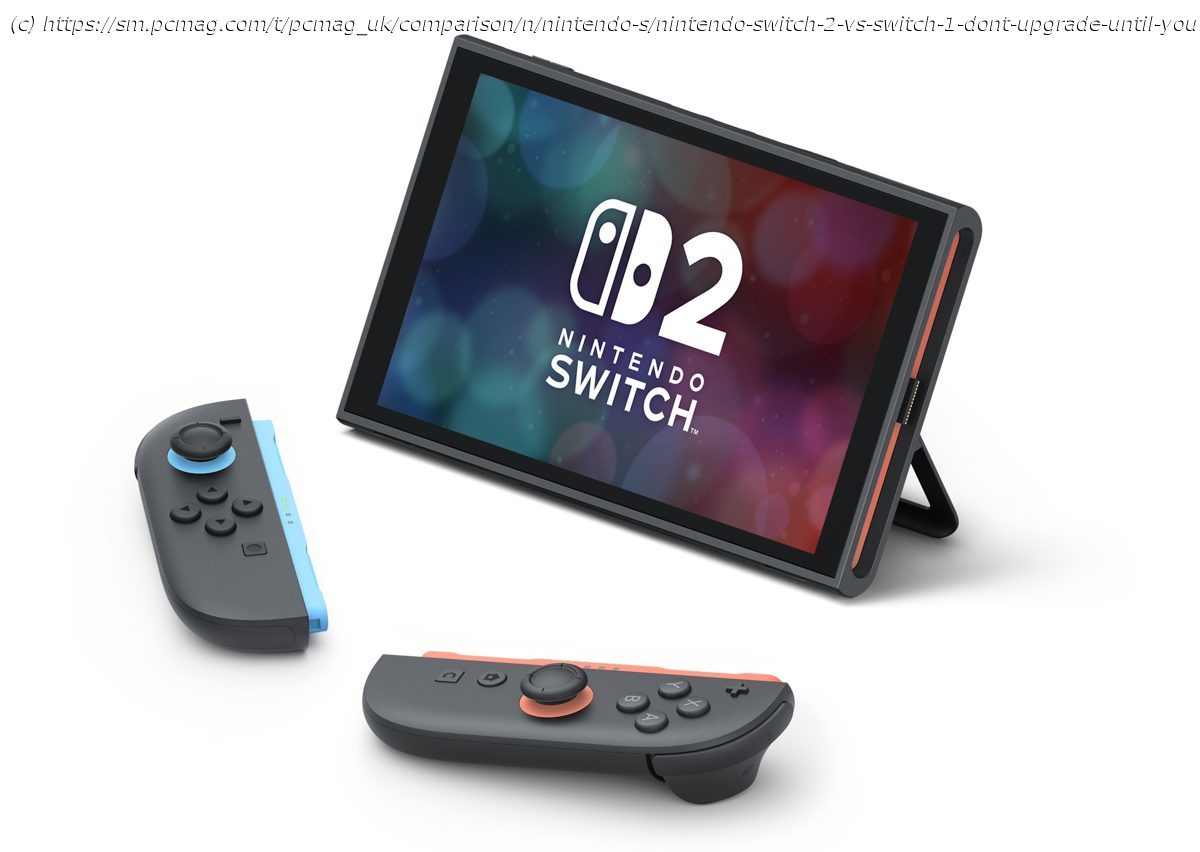
Nintendo’s Switch 2 is faster, sharper, and packed with new features—but it also costs more. Here’s how it compares with the original Switch, and what you gain (and lose) by upgrading.
Price: Newer Means More Expensive
Whether it’s the price of technology or tariffs, the Switch 2 is Nintendo’s most expensive system yet, at $449.99. That’s a big ask. The standard Switch ($339.99) and Switch OLED ($399.99) have increased in price by $40 and $50, respectively. Even the handheld-only Switch Lite is now $229.99, up from $199.99. The Switch 2 may also become more expensive; the sudden spike in RAM prices from AI investment and speculation could see that system hit $500 or more in 2026. That’ll put its price close to the PlayStation 5 and Xbox Series X.
Game prices are also moving upward, too. Mario Kart World is $79.99. That’s higher than the current $69.99 « normal » of many console games, after decades of the market settling around $59.99 for major releases. Accessories, such as the Switch 2 Pro Controller ($89.99) and Joy-Con 2 ($99.99 per pair), are also approximately $10 more expensive than their Switch counterparts.
Winner: SwitchDesign: Part-Handheld, Part-Console, All-Genius
The Switch 2 is the first Nintendo console to take its predecessor’s name and simply add a « 2 » to it. So, as you might expect, it isn’t all that fundamentally different. Both systems are tablets with detachable controllers and a dock that lets you play the device as a handheld or as a home console connected to a TV. It’s a great concept because you can play anywhere. I’m glad that Nintendo didn’t reinvent the wheel.
In terms of size and weight, the Switch 2 is slightly larger and heavier than its predecessor, measuring half an inch in height, just under an inch in width, and four ounces in weight (with the Joy-Cons attached). However, it doesn’t feel much bulkier or more cumbersome in my hands.
Winner: TieControllers: Now With Mouse Controls!
The Switch 2’s Joy-Con 2 controllers feel similar to the originals and have almost identical designs. They have an analog stick, four face buttons, two triggers, and two menu/capture/home buttons. They’re arranged so you can use a single Joy-Con sideways as a mini-gamepad or two for dual-analog gameplay. The Joy-Con 2 have slightly larger analog sticks, which is nice. However, the Joy-Con 2s have much more interesting tech.
Optical sensors on the connection rails of each Joy-Con 2 mean the controllers double as mice. This lets you play games like Fortnite and Metroid Prime 4: Beyond with a mouse-like aim, as you would in a PC game. It’s very accurate, but it makes my wrist sore after a while. That might not be an issue for everyone, and I might be able to mitigate the pressure by adjusting how I hold it.