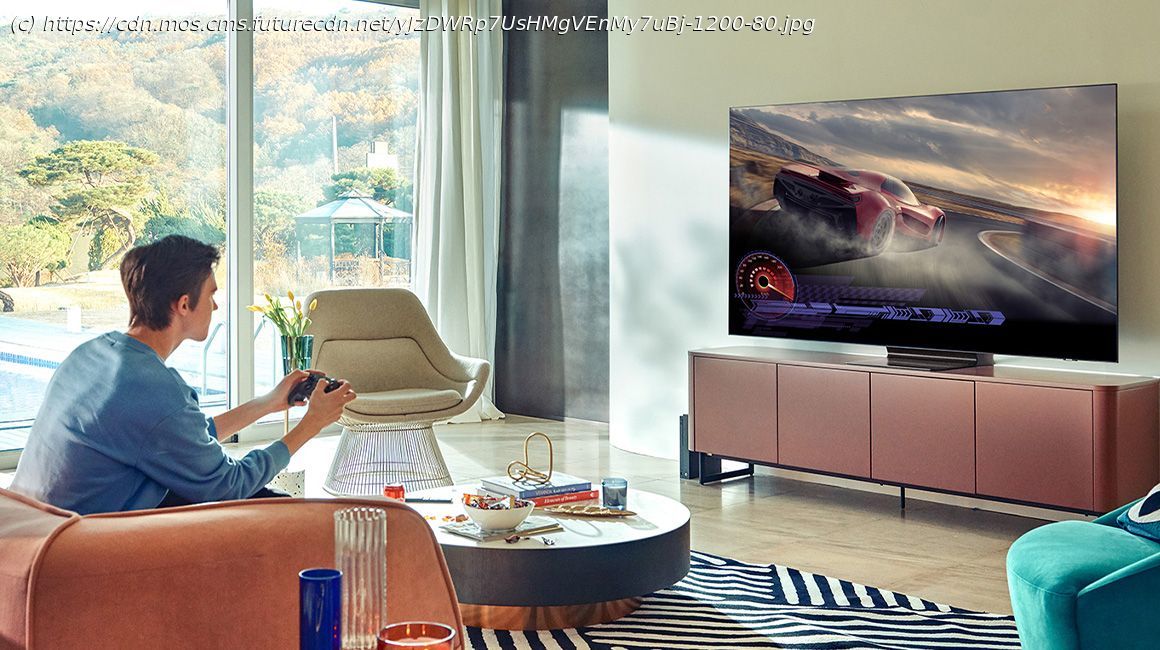
Need the best gaming TV? Here are the top-tier options to give you the edge on the competition in 2022.
The best gaming TVs can seem like they’re a dime a dozen, with tons of great models available at solid prices. No matter whether you’re after the best 4K TV for PS5, the best 4K TV for Xbox Series X /S, or a top-notch 1080p display for your Nintendo Switch or Switch OLED, we’ve got something in this guide to suit you. Even if you’re not a huge gamer, you might want to check out the models we’ve highlighted below. Wondering why? As is the case with the best gaming PCs, the best gaming TVs you can buy usually cover all fronts when it comes to the end user experience. They’re great for gaming, sure, but remember in most cases you’re getting features like 4K and HDR (high dynamic range), which serve to present a higher quality picture and a wider color gamut respectively. However, gaming specifications like HDMI 2.1 (for 4K/120 gameplay) or VRR (variable refresh rate) are on increasingly large numbers of TV screens, and they’ll be the difference between a perfectly-fine and truly-breathtaking experience with the likes of the PS5 or Xbox Series X. Whether you’re working with a console old or new, these are the best gaming TVs out there. The Sony X90J 4K TV sees the company behind the PS5 finally get its TVs in line. While last year’s Sony TV range was marred by inconsistent support for HDMI 2.1, this year’s range gets the input standard right, with two HDMI 2.1 ports for connecting next-gen games consoles. The X90J has a 120Hz panel with 4K resolution and two full-spec HDMI 2.1 ports for your PS5, with VRR (variable refresh rate) and ALLM (auto low latency mode, for sub-10ms lag) to really up your gaming experience. Just be sure to head into the picture settings and switch on ‘Enhanced format’ for your selected HDMI port, otherwise you won’t get the benefit of its 2.1 specification. There’s no VRR, though as the PS5 still doesn’t support it, that shouldn’t be an issue here either. It has excellent image quality, thanks in part to a new Cognitive XR processor rolled out to Sony’s top 2021 sets, making for excellent upscaling and contrast control. The X90J also sports the new Google TV smart platform, for easy setup and broad app support as well as the perks of Google Cast from Android devices. There are still a few lingering issues, including some middling off-axis viewing and struggles with direct daylight – and the X90J will no doubt be beaten by the capabilities of its step-up X95J model for a small uptick in cost. Still, the Sony X90J succeeds in delivering stellar performance for a reasonable price. Read the full review: Sony X90J 4K TV If you want the best gaming TV with a knockout OLED screen, then the LG C1 is your best bet. With a 4K OLED display, you can expect truly breathtaking black levels and an ‘infinite’ contrast ratio (the range between the darkest and brightest parts of the screen) to a level the gaming TV above can only dream of. You’re getting four dedicated HDMI 2.1 ports (ideal for plugging in multiple consoles) and even comes with a new Game Optimiser menu that gives you the option to quickly adjust brightness, contrast and VRR (variable refresh rate) on the fly. You can expect 4K/120fps support for any compatible games, too, as well as sub-1ms input lag. With Dolby Vision HDR and Atmos support, too, you’ll be able to make the most of out your Xbox Series X – given the PS5 doesn’t currently support these technologies. All in all, the LG C1 is a massively specified television, and LG’s work to attract gamer’s is very clear, especially with the addition of Nvidia FreeSync support last year for those hooking up a gaming PC to their television. You can always opt for last year’s LG CX too, which has largely the same specifications for a little less cost. If you have concerns around image retention, when static sections of a picture (say, a HUD) are looped so often that they permanently mark the panel, we wouldn’t worry. This isn’t a sizeable risk, especially since OLED TV makers have developed ‘screen shift’ technologies to regularly adjust the placement of onscreen pictures to help prevent this (via LG). Read the full review: LG C1 OLED Television sets like the U80G, U8G, U9DG and A6G have proven that Hisense can manufacture premium-like devices that won’t crush your bank account. While those sets offer a little something for everyone minus preferential differences in feature sets, the U7G sits in an interesting position amongst its siblings. Described by Hisense as a “TV that makes gaming smooth like butter,” the U7G focuses on improving gamers’ experiences in some meaningful ways. This includes a high 120Hz display, Game Mode Pro to help reduce input lag, an Auto Low Latency Mode, Variable Refresh Rate, Variable Refresh Rate and Freesync for PC gamers. All of those features should definitely help serious gaming enthusiasts or aspiring esports players looking to have the biggest advantage possible. Helps that the U7G features many standards to Hisense’s U Series line-up including Dolby Vision, IQ and Atmos alongside HDR10+. Long story short? PC Gamers or individuals lucky enough to get their hands on an Xbox Series X or PS5 will appreciate the U7G’s capabilities. On its own merit, the TV functions as a great general-use screen outside of gaming thanks to both great Android TV implementation and beautiful display. Read the full review: Hisense U7G Series ULED TV If you have deep pockets and a checkbook filled with blank checks, we’d tell you to reach deep and shell out for only the best 4K TVs on the market – or the pricier models listed above. But that’s not always realistic: for the vast, vast majority of us, our budget to spend on a 4K UHD TV is limited to somewhere under $1,000 – and often it’s even less than that. To that end, it’s absolutely fair to say that the TCL 6-Series is the best TV you can possibly get in this price range. Its performance per dollar is unmatched and its picture quality – despite a few minor flaws – will truly impress you for what you’re paying. Said simply, if there’s a better value 4K TV on the market, we’ve yet to see it. If you’re not based in the US, though, read on for other affordable gaming TVs worth considering. Read the full review: TCL 6-Series (R615, R617) The Samsung QN95A is the company’s new flagship Neo QLED 4K TV for 2021, and the first to embrace a Mini LED backlight. It’s a bit pricier than most models in this list – but if you have the cash, it could serve you well as a well-specified HDMI 2.1 TV. There’s a host of cutting-edge gaming features that’ll please next-gen console owners, all part of the new Slim One Connect box that ships with the QN95A. The box houses four HDMI inputs, one of which (HDMI 3) supports eARC. All of the HDMI inputs are capable of handling up to 40Gbps, which means they can accept 4K/120Hz, VRR and ALLM. While not full HDMI 2.1 connections, they offer sufficient bandwidth, making this TV a great choice for next-gen gamers who want to take full advantage of their new console. The results speak for themselves, with superb SDR and HDR images that benefit from deep blacks and brighter highlights, all of which are delivered without blooming or loss of shadow detail (thanks to the Mini LED backlight). The inclusion of quantum dot technology delivers saturated and nuanced colours, too. The OTS+ audio system packed into this 120Hz means you’re getting some impactful 4.2.2 channel sound from your games too. Read the full review: Samsung QN95A Neo QLED TV You may be wondering why you need a gaming-specific television. After all, won’t a regular TV do the job just fine? Sure, any old HD or 4K TV will be able to display the picture information sent through from a games console, as long as it has an HDMI 2.0 port. But there are a host of reasons worth getting a TV with dedicated gaming specification, to really elevate your play in how it looks, sounds, and feels. 4K resolution If you’re looking for one of the best TVs for gaming, the most basic requirement is 4K. The Xbox One S outputs all of its games in 4K, which is achieved via surprisingly good built-in upscaling, though the Xbox One X is required for native, game engine-integrated 4K support. The PS4 Pro also outputs games in 4K, using a mix of upscaling and in-game enhancement – while the Nintendo Switch only outputs at HD to a TV, though there’s chatter around a possible 4K refresh coming in 2021. Frame rate handling Now that the Xbox One X is almost here and promising native 4K resolution games running at 60 frames a second, make sure that whatever TV you buy has the latest specification HDMI sockets. If it doesn’t have at least one HDMI socket built to the v2.0a specification, it won’t be able to receive 4K resolution at anything higher than 30 frames a second. Fortunately far more of this year’s 4K TVs do feature HDMI 2.0a sockets than in previous years, but it’s still something that’s worth double checking – especially if you’re buying a particularly cheap TV. The new HDMI 2.1 standard will no doubt become the benchmark for high-end gaming in time, but we’re yet to see it really rolled out across commercially-available sets. High dynamic range (and high peak brightness) Sitting right alongside 4K in today’s video world is high dynamic range (HDR) technology. This delivers pictures with a much wider light range than the standard dynamic range pictures we’ve been living with for decades in a bid to get the pictures we’re seeing on our screens looking closer to the way our eyes see the real world. This is something the Xbox Series X has an advantage in, with an Auto HDR feature that applies some HDR magic even to SDR games that haven’t been purposefully remastered for high dynamic range. The PS5, as well as last-gen consoles like the PS4 and Xbox One, though, do display in HDR in games that support the format. The Xbox Series X also supports Dolby Vision – a dynamic HDR format with more precisely calibrated contrast – though currently only for streaming apps. You won’t find it supported on the built-in 4K Blu-ray player, or actually in any Xbox Series X games – though that latter point is expected to be amended before 2021 is out. Most people would say that HDR delivers more impact than 4K, especially on small TVs. The only problem is that HDR puts a lot of pressure on a TV, since it demands both much more brightness than SDR, and better contrast so that the extra brightness and deeper blacks can potentially share the screen simultaneously. Many movies and games target 1,000 nits or so for their brightest elements, so if you have a TV less bright than that it won’t unlock HDR’s full potential. That’s especially true in a video game environment, where graphics can be more stark in contrast terms than ‘real life’ tends to be. Bit depth When considering HDR, you might want to think about your gaming TV’s bit depth. too. The best HDR experience requires a 10-bit screen able to support 1024 values of each RGB colour – otherwise you’ll get an inferior colour performance, including, possibly, colour striping where you should see subtle blends. Most premium HDR TVs these days are 10-bit, but it’s far from a given at the affordable end of the TV market. Xbox and PlayStation consoles automatically assess the bit-depth of your TV and select the optimum HDR video output accordingly. Xbox models even provide a description of your TV’s capabilities under 4K TV Details in its Advanced Video Settings menu. To be clear, it’s entirely possible for an 8-bit TV to deliver a good HDR colour performance if they have a strong video processing engine – but 10-bit panels certainly have an immediate advantage. One other point to add here is that some TVs – including high-end Samsung models – actually support 12-bit colour management/processing, even though their panels are only natively 10-bit. Xbox consoles however do provide Colour Depth boxes in their Video Fidelity settings that let you select the maximum bit performance for your particular TV. Color purity Another advanced setting but important thing to consider for the ultimate gaming visuals is chroma subsampling. This video compression term refers to a TV’s colour purity, and is usually written in such terms as 4:4:4 and 4:2:0. These numbers reveal how many pixels colour is sampled from in the top and bottom rows for every two rows of four pixels. So with 4:2:0, for instance, colour is being sampled from two pixels in the top row and no pixels in the bottom row. From this it follows that the bigger the numbers are, the purer the colour performance will be, as there’s less ‘guesstimating’ of what colours should look like. The problem is, full 4:4:4 colour support requires a lot of extra image data, and so cannot be handled by the HDMI connections or processing of all TVs. In truth, the differences in picture quality between 4:4:4 and 4:2:2 and even 4:2:0 aren’t usually enormous. They can be more pronounced with gaming graphics than video, though, so it’s worth trying to check what a TV you’re thinking of buying can support – even though it’s not information regularly carried in TV spec lists. The latest consoles are pretty good at detecting the optimum chroma subsampling a TV can support, automatically adjusting their outputs according. It’s something that can cause annoying ‘handshaking’ issues with some TVs, though, and home consoles now tend to provide subsampling ‘limiter’ options in their video output menus (‘Enable 4:2:2’ on the Xbox One S, and 2160 YUV4:2:0 on the PS4 Pro). Surround sound Sound design has always played an integral part in a great gaming experience. It’s getting taken to another level these days, though, with the arrival of surround sound gaming. In fact, the Xbox Series S and Xbox Series X even support Dolby Atmos: Dolby’s most advanced sound system yet, which introduces a height channel and ‘object based’ precision to the soundstage. Things to pay attention to are whether speakers are facing forwards (as this will almost always give you a more direct, clean sound); rated power output; whether there’s a dedicated bass speaker (often found on a TV’s rear); built-in soundbars; and the number of individual speakers used. Sony is making much of the ‘3D Audio’ capability of the PS5, too, so expect good TV speakers to become even more crucial when the next-gen console launches. (There’s no Dolby Atmos support on the PS5, though.) You might also want to check out the capabilities of HDMI on PS5.