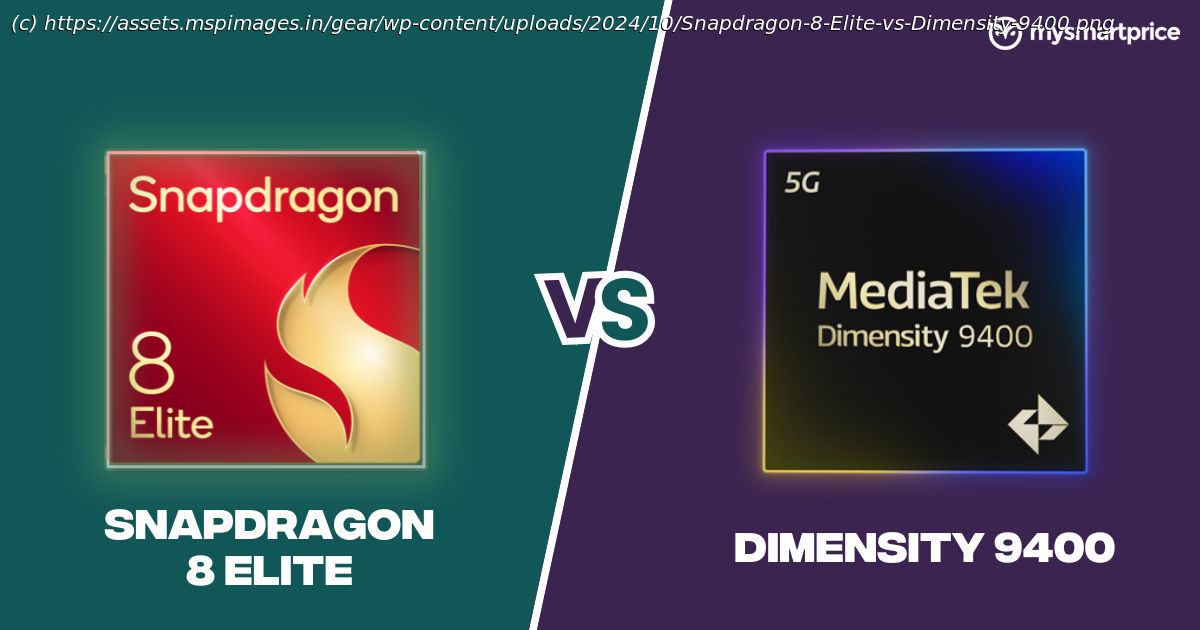
The Snapdragon 8 Elite and the Dimensity 9400 are based on TSMC’s 3nm architecture. Here’s a detailed comparison between the two flagship-grade processors from Qualcomm and MediaTek.
Qualcomm recently unveiled the Snapdragon 8 Elite processor as its latest flagship-grade processor for smartphones. It is the first chipset from the company based on TSMC’s advanced 3nm architecture, which also brings up to 45% faster performance than its predecessor, the Snapdragon 8 Gen 3.
The MediaTek Dimensity 9400 is the arch-rival of the Snapdragon 8 Elite, as it is based on a similar architecture and brings in huge performance upgrades. Both processors pack in industry-best gaming and on-device AI capabilities. Here’s a detailed comparison between the Qualcomm Snapdragon 8 Elite and the MediaTek Dimensity 9400.Qualcomm Snapdragon 8 Elite vs MediaTek Dimensity 9400: Specs ComparisonQualcomm Snapdragon 8 Elite vs MediaTek Dimensity 9400: The Differences
Qualcomm always had the upper hand over MediaTek in the flagship segment as their processors have been faster in top-end performance. However, the gap has narrowed this time, as both chips now use an all-performance core design on the same TSMC 3nm 3NE architecture. Here’s a breakdown of the key differences between the processors.CPU
The Snapdragon 8 Elite uses 2nd-gen Oryon cores, custom-made ARM cores in a 2+6 configuration. It supports maximum clock speeds of up to 4.32GHz. This provides a major boost in single-threaded and multi-threaded applications. It supports a 24MB L2 cache which is currently the highest on any mobile processor.
The MediaTek Dimensity 9400 uses an all-big core design, featuring stock ARM cores in 1+3+4 configuration. However, its maximum clock speed is limited to 3.62GHz, which is lower than its rival. Despite this, MediaTek says the Dimensity 9400 is capable of scoring over 3 million points, which is just as good as the performance claimed by Qualcomm for the Snapdragon 8 Elite.
Currently, we do not have the exact benchmarks as we have yet to see phones with these two processors. We will update this article after running in-depth benchmark testing.
Apart from the Oryon design on Qualcomm and the All-Big Core design by MediaTek, there are no major technical differences between the two processors on a CPU level. Both use the same 3nm TSMC 3NE node architecture, which brings them closer to each other in terms of performance.
GPU
The Snapdragon 8 Elite comes with the Adreno 830 GPU, again based on the Oryon design. It supports Unreal Engine 5.3, which can render 3D environments in real time. This GPU uses a sliced architecture, which also boosts the ray tracing performance by up to 35%. Qualcomm says the Snapdragon 8 Elite offers the best ray tracing performance on a mobile chip.
MediaTek has introduced a major overhaul in the gaming capabilities of the Dimensity 9400 using the Immortalis G925 GPU. It’s a 12-core graphics unit, which offers a 40% improved performance in ray tracing. This GPU also supports MediaTek HyperEngine Technology, co-developed by MediaTek and ARM. It also has OMM support which can process depths and 3D effects in games in real time, offering realistic rendering.
MediaTek Dimensity 9400
The Snapdragon 8 Elite and Dimensity 9400 are now capable of real-time 3D rendering and bring major improvements in ray tracing. Hence, it is possible that we could see fierce competition in real-world gaming experience. Our gaming test of the Snapdragon 8 Elite is expected by mid-November, and a detailed comparison between them should be live by mid-December; once phones start launching with the respective chipsets.
NPU
The Snapdragon 8 Elite comes with a new-generation Hexagon NPU, also known as the Hexagon AI Engine. It supports multimodal generative AI, which can process images, videos, text, and audio locally on the device. This NPU also pairs with the chipset’s ISP for processing images captured by the camera to get natural colours, HDR, bokeh, and other effects using AI-powered limitless segmentation.
The Dimensity 9400 is equipped with the 8th-generation MediaTek NPU 890. It supports LoRA training models, AI-powered video generation, and on-device AI. It also has the Dimensity Agentic AI Engine, which enables app developers to seamlessly integrate and utilize the power of the dedicated NPU in their applications.
Features-wise, both processors support on-device AI. Qualcomm and MediaTek are also partnering with Google and Meta to introduce support for Gemini AI and Meta AI models on their respective processors, using which phones can process these AI models locally on-device.
Modem (Connectivity)
The Snapdragon 8 Elite has the Snapdragon X80 5G modem. It supports peak download speeds of up to 10Gbps and upload speeds of up to 3.5Gbps. This modem is equipped with Wi-Fi 7 and Bluetooth 6.0 technology. It also supports NavIC, India’s self-developed navigation system.
The Dimensity 9400 features the 3GPP Release-17 5G modem. The download and upload speeds are the same as its Snapdragon counterpart. While it retains support for Wi-Fi 7, it is limited to Bluetooth 5.4. However, the difference between Bluetooth 5.4 and Bluetooth 6.0 is marginal, hence, it would not make a huge difference in real-world usage. The Dimensity 9400 supports NavIC as well.
The modems support the latest 5G technology and sub-6GHz and mmWave bands. However, the exact network reception and cellular performance will vary by device, as phone manufacturers can alter the support of specific bands and features by region.
Qualcomm Snapdragon 8 Elite vs MediaTek Dimensity 9400: Verdict
The Snapdragon 8 Elite and Dimensity 9400 compete very closely with each other and have minimal differences in the core configuration and architectural hardware. The upgraded GPUs on both chipsets also narrow down the performance gap between the two in gaming.
Qualcomm’s processors are known to be priced higher than MediaTek, and a similar trend is expected with the Snapdragon 8 Elite and the Dimensity 9400. Hence, we might see more brands leaning towards MediaTek for their flagships, at least in the flagship-killer segment.
Considering the fabrication similarities (based on TSMC’s 3nm architecture) for the two processors, the real-world performance will now depend on the software optimization of phone makers. We are excited to test phones with both processors, but until that happens, it’s difficult to pick a clear winner between the Qualcomm Snapdragon 8 Elite and the MediaTek Dimensity 9400.