Prepare to have your mind blown.
In 2025, NASA faced unprecedented uncertainty as it grappled with sweeping layoffs, looming budget cuts, and leadership switch-ups. Despite all of that, the agency somehow still managed to do some seriously astonishing science.
The insights we gained from NASA researchers, robots, telescopes, and spacecraft this year underscore the importance of protecting the agency’s core mission: to explore the unknown in air and space, innovate for the benefit of humanity, and inspire the world through discovery.
NASA will continue stretching the limits of our knowledge for years to come, but before we look ahead, it’s worth revisiting some of the agency’s most groundbreaking discoveries of the past year. Here are seven that truly stood out.A potential biosignature on Mars
While exploring Mars’s Jezero Crater in July 2024, NASA’s Perseverance rover stumbled upon an unusual rock. Its surface was peppered with spots resembling poppy seeds and leopard print. These distinctive features immediately caught the attention of scientists on Earth, as they suggested it may hold a potential biosignature.
Perseverance extracted a core and used its science instruments to investigate the surface chemistry and composition of the rock, now known as Chevaya Falls. A team of scientists led by Joel Hurowitz, an associate professor of planetary science at Stony Brook University, quickly got to work analyzing Perseverance’s data. In September of this year, the agency revealed their findings. Chevaya Falls may in fact be the clearest sign of past life ever found on Mars.
The rock not only contains ingredients for life (organic carbon, sulfur, oxidized iron (rust), and phosphorus) but also minerals that are often associated with microbial metabolism on Earth. These findings, published in the journal Nature, point to a possible biosignature, but to confirm this, scientists will need to retrieve the core and analyze it on Earth.
It’s unclear whether that will ever happen. The Mars Sample Return mission is currently in limbo as NASA reevaluates its architecture and schedule. Still, this discovery has reinvigorated the search for evidence of past life on the Red Planet.Interstellar object 3I/ATLAS
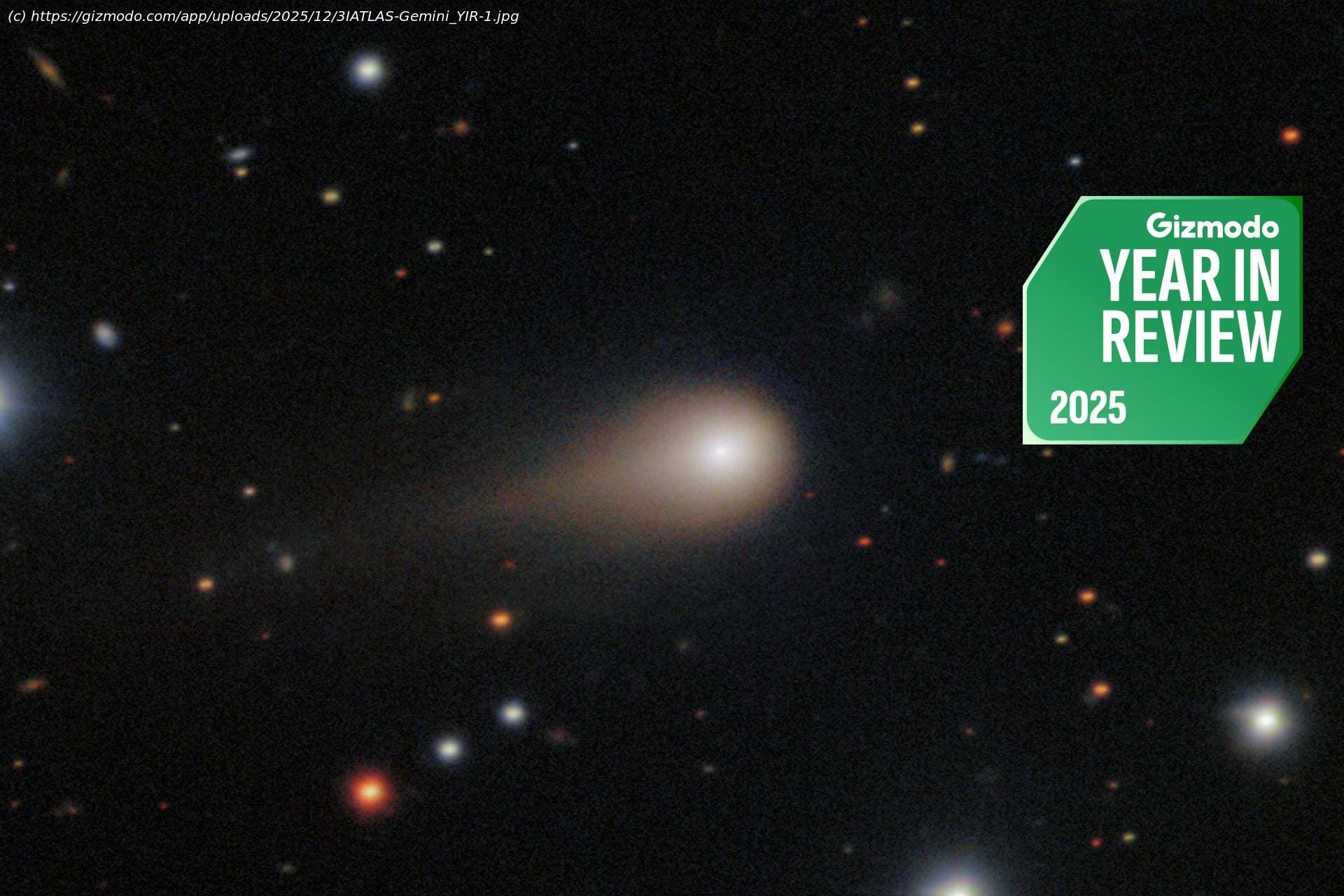
The vast majority of asteroids and comets astronomers detect are native to our solar system, but once in a great while, a celestial body from a far-off corner of the galaxy pays us a visit. Astronomers had only discovered two interstellar objects before the NASA-funded Asteroid Terrestrial-impact Last Alert System (ATLAS) spotted a third in June.
That object, named 3I/ATLAS, is a comet that hails from a distant star system. Astronomers around the world have been racing to gather as much data on it as possible before it vanishes, never to return. Interstellar objects offer exceptionally rare opportunities to study samples from other planetary systems, providing insight into the formation, evolution, and composition of distant worlds that spacecraft can’t reach.
Researchers have already uncovered fascinating details about 3I/ATLAS, such as its unusually high carbon dioxide content and incredible age. NASA has used several different spacecraft to observe the comet, gathering a wealth of data and imagery that the agency unveiled on November 19.