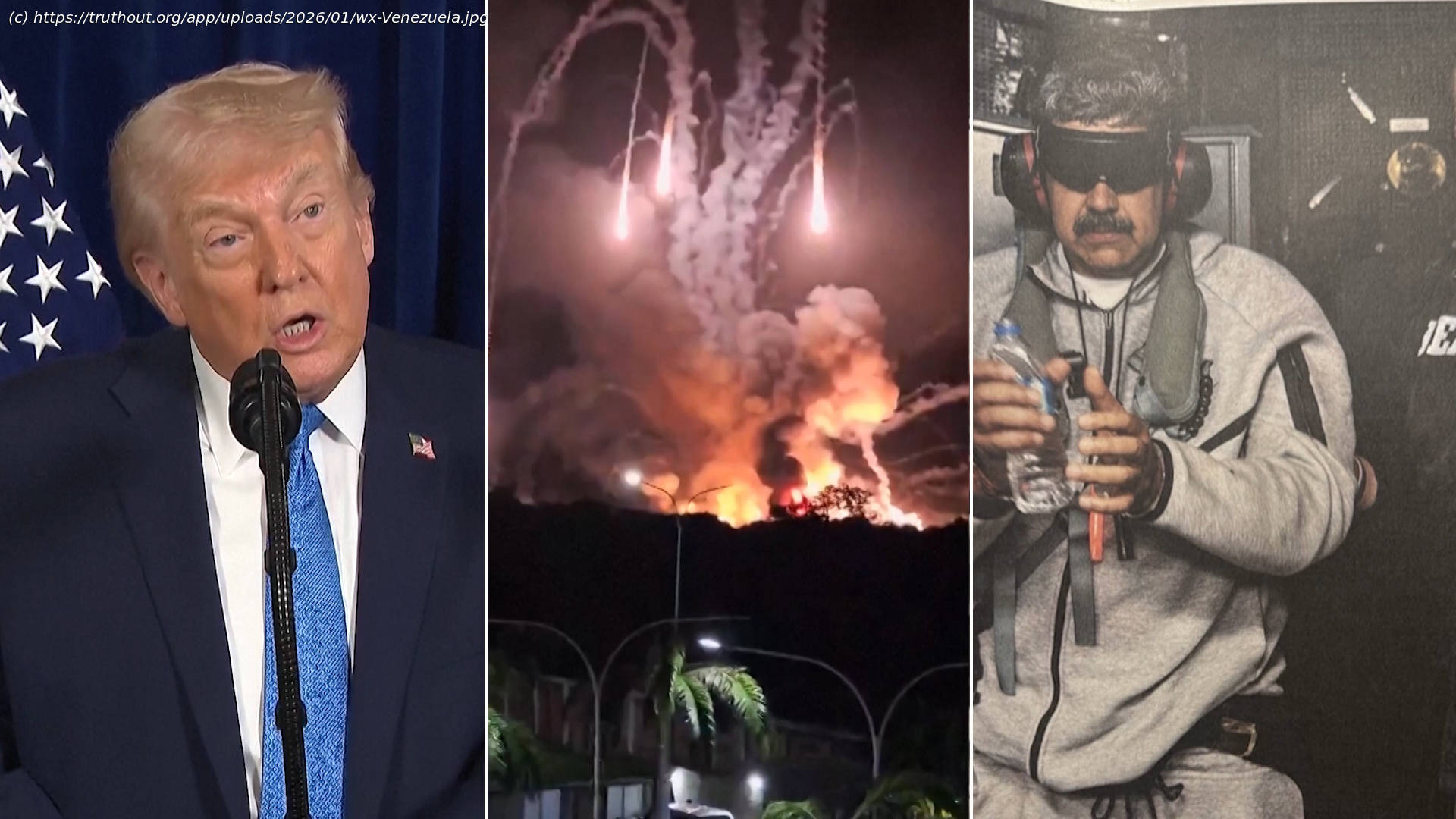
“It sounded like an earthquake, like the sky was falling down,” a journalist in Caracas said of the US strikes.
Amy Goodman and Juan González host breaking news coverage on U.S. forces attacking Venezuela and seizing Venezuelan President Nicolás Maduro. We speak to Venezuelan reporter Andreína Chávez in Caracas, as well as professors Miguel Tinker Salas and Alejandro Velasco.
AMY GOODMAN: This is Democracy Now!, democracynow.org. I’m Amy Goodman, with Juan González. We’re breaking in with this news.
The United States has seized Venezuelan President Nicolás Maduro after U.S. forces launched what President Trump called a “large-scale attack.” Maduro and his wife were flown out of Venezuela, expected to be brought to New York. They’ve been criminally charged.
Just before we recorded this, President Trump spoke, saying, “We are going to run the country until such time [as] we can do a safe, proper, and judicious transition.” In an interview with Fox, Trump said the U.S. will be “very strongly involved” in the Venezuelan oil industry. Venezuela has the world’s largest oil reserves.
It’s unclear how many Venezuelans were killed in the operation, which was carried out with the help of the CIA and U.S. Delta Force soldiers.
The U.S. attack has been widely criticized around the world. The Brazilian President Luiz Inácio Lula da Silva wrote on X, “The bombings on Venezuelan territory and the capture of its president [cross] an unacceptable line. These acts represent a grave affront to Venezuela’s sovereignty and yet another extremely dangerous precedent for the entire international community,” unquote.
Mexico’s Ministry of Foreign Affairs condemned the attack as a “clear violation of Article 2 of the Charter of the United Nations.”
Congressmember Greg Casar, chair of the Congressional Progressive Caucus, wrote, “Trump has no right to take us to war with Venezuela. This is reckless and illegal. Congress should vote immediately on a War Powers Resolution to stop him,” Congressmember Casar said.
We’re joined right now by Miguel Tinker Salas, emeritus professor of history at Pomona College in Claremont. He is the author of The Enduring Legacy: Oil, Culture, and Society in Venezuela, as well as Venezuela: What Everyone Needs to Know. We’re also joined on the ground in Caracas by Andreína Chávez, reporter there. Her piece earlier this week for Drop Site News, “’War of the entire people.’”
But before we go to our guests, Juan González, you were there in Panama. It was 35 [sic] years ago today that Manuel Noriega was seized by U.S. forces and brought to the United States. And it’s a month after President Trump pardoned a man who was convicted in this country of narcotrafficking, the former president of Honduras, Juan Orlando Hernández. Your thoughts?
JUAN GONZÁLEZ: Yes, Amy. Well, this is an extraordinary moment in what is clearly, by international law, a completely illegal military action by the United States. But in listening to the press conference that President Trump and his top aides held just a little while ago, a few things stand out to me.
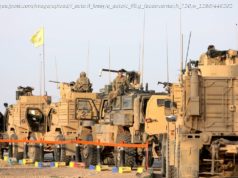
One is the size of this attack. And we didn’t really get a sense of that until General Dan Caine, the chairman of the Joint Chiefs of Staff, had an opportunity to talk, and he mentioned over 150 of the most advanced military aircraft of the United States participated in this, in this — basically, an Air Force invasion of Venezuela. And in addition to the Delta Force and CIA operatives that were on the ground, a blackout of Caracas that the United States triggered in order to be able to operate in complete darkness, and the admission by both the general and President Trump that there was a lot of opposition of Venezuelan forces on the ground to the U.S. attack. That’s one thing, the size of this attack.
The second, as you mentioned, is Trump’s claim that the United States is going to run Venezuela from now on, and that this was not just a question of extracting Maduro for supposed, alleged drug crimes, but also a regime change operation, that the United States is going to directly run Venezuela.
And I thought the most interesting thing of all was Trump’s claim late in the press conference that Marco Rubio has been in conversations with the current vice president, Delcy Rodríguez, and that, according to Trump, she told Rubio, quote, “We’ll do whatever you need,” as if implying that Delcy Rodríguez, the vice president and, clearly, the successor to Maduro, was in some way or other agreeing to this U.S. intervention, or at least acknowledging it.
So, I think that those are the three things that stuck out to me. We’ll have to see in the next few hours and days to what degree some of these claims of Trump are actually factual.
AMY GOODMAN: Well, these developments of the last hours have been stunning. We want to go first to Caracas to Andreína Chávez. If you can talk about how people are responding? What we have seen, the images of different cities of Venezuela being bombed, attacked, a “large-scale attack,” as President Trump put it, by the United States.
ANDREÍNA CHÁVEZ: Yes. First of all, I just want to say that President Nicolás Maduro, he wasn’t captured. He wasn’t seized. He wasn’t arrested. He was kidnapped. This is a kidnapping. The United States has just kidnapped a constitutionally elected president. So, this is something that it goes beyond our wildest imagination. This is something terribly against international law, against all principles of sovereignty, of self-determination of the people. So, this is something that we need to clarify.
Second, these comments that President Trump and his government are saying, that they are negotiating with the government of Venezuela, we should not believe those claims. None of that has been confirmed. Vice President Delcy Rodríguez, she has very clearly stated that the message right now is to resist. The message right now is to go to the streets, is to fight against this imperialist aggression, is to denounce this imperialist aggression. And there is no such thing, such transition or vacuum power happening right now. Right now we are fighting against this aggression. So, we need to treat these claims by the Trump administration mostly as psychological operations to try to debilitate even more the Venezuelan government, that is still standing, that is still here. We need to remember that we still have a Venezuelan government, even though President Maduro has just been kidnapped.
Second, as you said, we just experienced a quite horrifying night. We woke up around 2 a.m. to the sound of extremely loud explosions. Of course, at the moment, we didn’t know what was happening. Everybody knew it was something terrible, because it sounded like an earthquake, like the sky was falling down. I could hear the planes. I couldn’t see them, but I could hear the planes. I live very close to Miraflores, so I imagine that is why I could actually hear all this military operation happening around me. And we immediately got confirmation from the Venezuelan government that at least seven points of Caracas had been attacked, at least seven places, between civilian places and military complex. There were also attacks in places like Estado La Guaira, Aragua, Miranda. All these places were attacked.
After that, we got even more confirmation from the defense minister, Vladimir Padrino López, who said that, indeed, we were under an imperialist military aggression from the United States, and that the call right now for the Venezuelan people was to just remain calm, but also to remember that we need to fight back against this regime change, because at the end of the day, we need to remember that this is regime change. We have to remember that the U.S. has been peddling a lie about Venezuela, about the Venezuelan government being a drug cartel, about the Venezuelan government being involved in drug trafficking, using evidence that is not credible at all, using — not even using evidence. At the most, they’re just using a court in New York to say that President Maduro is involved in narcotrafficking, without actually presenting evidence that he is doing that. There is actually no credible evidence that there is a Venezuelan state that is involved in a high-structured drug-trafficking corporation. That is not true. They have been using that lie, first to kill people in small vessels in the Caribbean, and now to bomb Venezuela and to kidnap the Venezuelan president.
So, right now we’re facing a regime change. And I think that is something — that is the first thing that people need to have in mind, that Venezuela is being bombed. We are facing a regime change. President Trump just said it. He said that right now he’s going to run Venezuela. The United States has decided that they are going to control Venezuela from now on. They’re going to control Venezuela’s oil business from now on. So, if this was actually something about capturing a supposed narcotrafficking person, then why wouldn’t that just mean that the Venezuelan government continues? We have a vice president who constitutionally is mandated to now take power. But no, he’s not saying that. He is saying that anybody who remains loyal to the Bolivarian process is going to go down. He is saying that there might be more military operations. And he’s saying that now the United States is going to assign people to control the Venezuelan government, and the first thing that he’s going to do is take power over the Venezuelan oil industry. And remember that he says the Venezuelan oil industry wasn’t working right, that he was going to make it finally work right. We need to remember that the Venezuelan oil industry has been under U.S. sanctions for almost a decade.
AMY GOODMAN: Let us bring professor Tinker Salas into this conversation. You were born in Venezuela. Your books are about Venezuela. You woke up to this news, as well. You’re based right now in California. If you can respond to these points, and especially what Andreína is talking about? The U.S. will now run Venezuela, until such time as there is a just transition. Marco Rubio, the secretary of state, calling — saying that Maduro was given plenty of chances to step down, but, in fact, he’s a wild man, he said.
MIGUEL TINKER SALAS: Yeah, the spectacle of that press conference is amazing. It looked like something out of a Hollywood movie set, a B movie set. This is the Pirates of the Caribbean. This is Marco Rubio now the viceroy of Venezuela. This is an effort to run Venezuela with 15,000 troops.