The National Portrait Gallery removed key details from the caption under the president’s photograph. It still has a story to tell.
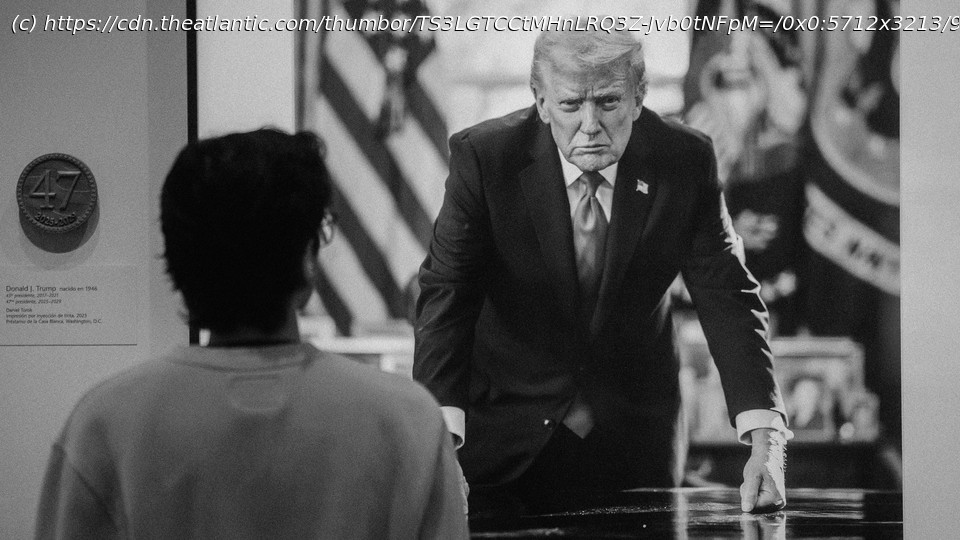
“Why does he look so angry?” one visitor to the National Portrait Gallery in Washington, D.C., asked our guide, as if that were a question with an answer. The docent had finally stopped before the black-and-white photograph of a looming, glaring President Trump that dominates the entrance to the final rooms of the “America’s Presidents” exhibit. We had managed not to talk about him for several minutes, swerving left toward the bright, kinetic John F. Kennedy painted by the abstract expressionist Elaine de Kooning and then crossing right to view Kehinde Wiley’s portrait of Barack Obama—a calm, floating, saintlike figure surrounded by leaves and flowers.
But the president with the gorilla posture, knuckles firmly planted on the presidential desk, had to be dealt with. Someone else in our group asked why the Smithsonian had capitulated to Trump. Two days earlier, The had broken the news that the National Portrait Gallery, which is overseen by the Smithsonian Institution, had swapped out an older portrait of Trump for the current one and put up a terse “tombstone” plaque that notes only the photographer’s name, Trump’s date of birth, and his years in office. All of the other presidential portraits in the gallery are accompanied by long assessments of each presidency, its successes and failures. They cite Andrew Johnson’s and Bill Clinton’s impeachments, and the label beside the previous Trump photograph mentioned Trump’s impeachments, too—but the new one, of course, does not. (That other photograph and caption can still be seen on the gallery website.)
Like some demonic trickster of folklore, Trump moves through the world robbing it of speech. The question about the Smithsonian’s capitulation left even our docent, a well-informed man, at a loss for words. He couldn’t address that, he said, but he could tell us a great deal about the desk in the Oval Office that Trump is leaning on: It is called the Resolute Desk because it was made from the oak timbers of the H.M.S. Resolute, a British Arctic-exploration ship.
The National Portrait Gallery spokesperson, noting that the museum had rotated in new Trump portraits before, dismissed the tweaks as routine. But when it comes to Trump and the preservation of historical memory, nothing is routine. The administration began pressuring the Smithsonian for changes almost as soon as Trump returned to office. In March, he signed an executive order demanding that the Smithsonian review its exhibitions for “improper ideology.” In May, Trump forced out the National Portrait Gallery’s director, Kim Sajet, on grounds of excessive partisanship.