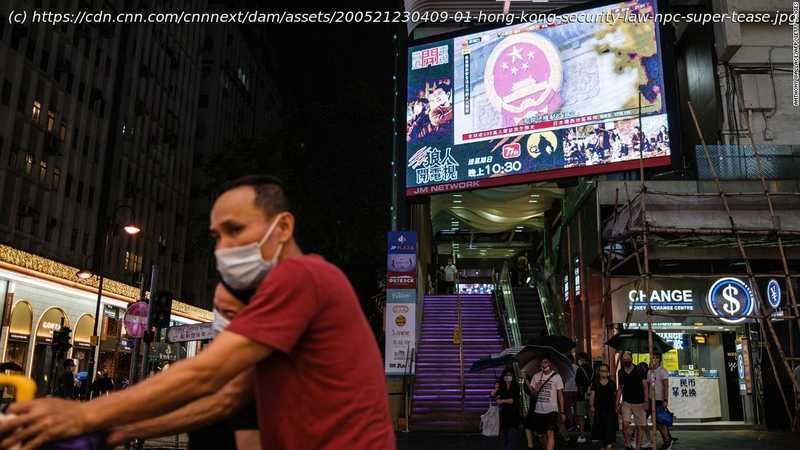
At issue is whether Hong Kong is governed by its own laws, under the semi-autonomous status that has made it an enclave of relative democracy and liberalism —or under China’s, writes Joy Park.
Joy Park is the legal counsel for Asia at the Human Rights Foundation (HRF) and leads HRF’s Hong Kong Desk project. As a member of HRF’s Center for Law and Democracy, Joy’s research focuses on legal issues related to freedom of expression and freedom of assembly in Asia. The views expressed in this commentary are her own. View more opinion at CNN.
For years, even as China has applied increasing pressure on Hong Kong’s pro-democracy movement, the framework of «One Country, Two Systems»—the dividing line that keeps Hong Kong relatively autonomous from the authoritarian mainland—has been respected by the Chinese Communist Party in theory.
The illusion of autonomy has now officially been shattered.
Shock waves reverberated around the world as a representative of China’s National People’s Congress, the largest gathering of the Chinese Communist Party (CCP) each year, announced that delegates at Friday’s session would consider a move to enact controversial national-security legislation in Hong Kong.
Should the Chinese government successfully impose its own national-security regulations on Hong Kong, it would open the door to any other law or regulation the Chinese government wishes to impose on Hong Kong in the future.
At issue is whether Hong Kong is governed by its own laws, under the semi-autonomous status that has made it an enclave of relative democracy and liberalism—and which has maintained Hong Kong’s status as an international hub of commerce—or under China’s.
Read More
Pompeo condemns China’s proposed Hong Kong national security law
The proposed measure is extremely concerning not just because the specifics are likely to be vague and overbroad in language, exposing pro-democracy activists in Hong Kong to increased and more severe persecution, but because Article 23 also calls for measures banning any «foreign political organization» from operating in Hong Kong. This could push out any remaining international observers, eliminating global attention on Hong Kong’s fight for freedom.
Governed by a mini constitution known as its Basic Law, Hong Kong has faced a looming legal controversy since it was handed over to China from British rule in 1997. Article 23 of that charter calls for Hong Kong’s local government—which is free of direct control from Beijing and is comprised of both pro-CCP and pro-democracy officials—to pass laws banning treason or sedition against the mainland government.