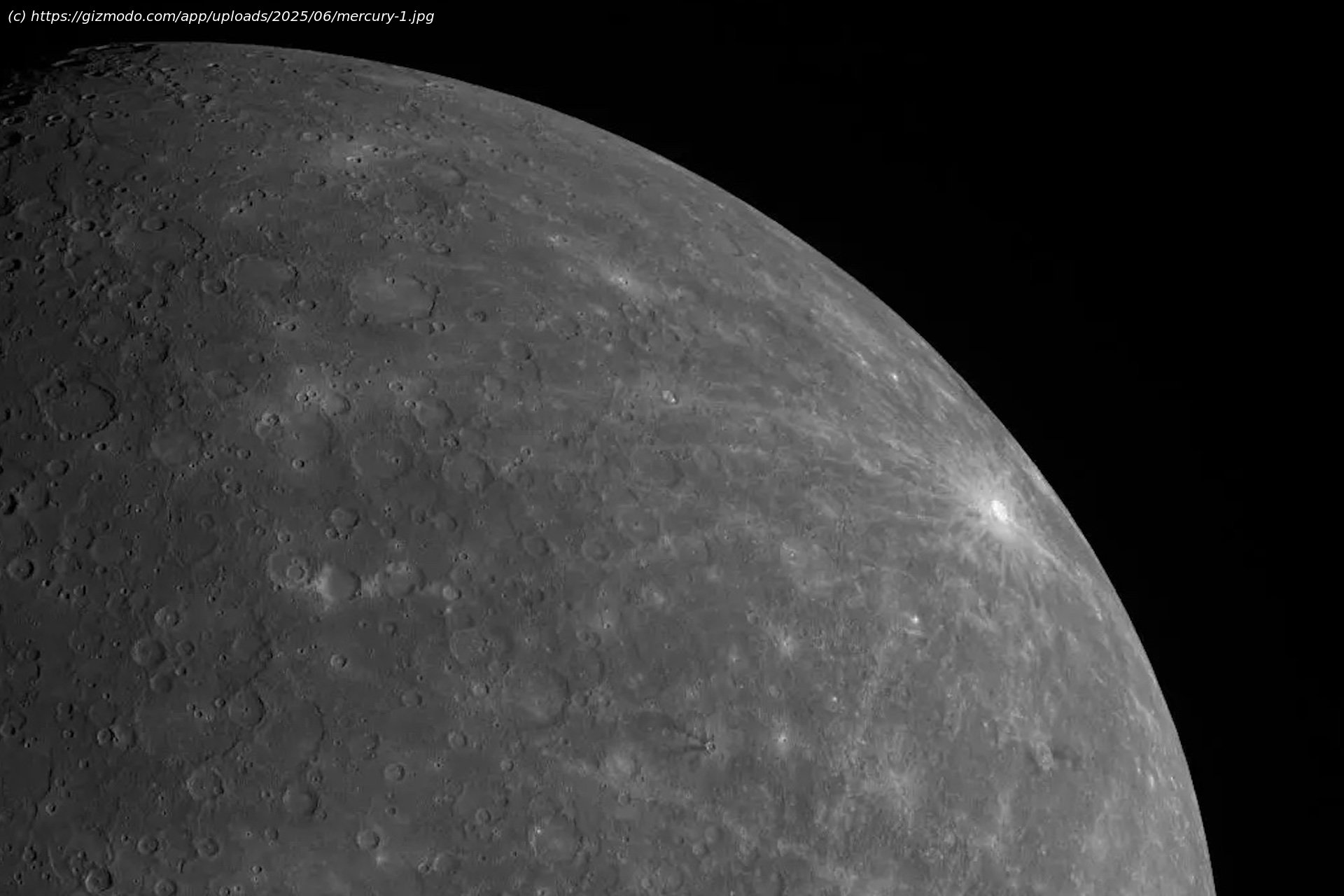
As the closest planet to the Sun, Mercury is exposed to the star’s enormous gravitational field. And it’s really stressful.
Mercury has it rough. Not only is it the smallest planet in the solar system, it’s also the closest to our Sun. This unfortunate position has caused Mercury to develop cracks and fractures across its surface, and generate stresses to its crust, a new study has found.
Mercury is dry, rugged, and heavily cratered; the planet appears deformed with towering cliffs and ridges, as well as fracture lines that run along its surface. The origin of Mercury’s scars has long been a mystery: How did the planet cool and contract in such an unusual way billions of years ago after it formed? Turns out, the answer may be due to its uncomfortable proximity to the Sun. A team of researchers from the University of Bern created physical models of Mercury to see how much of the Sun’s tidal forces affect the small planet, revealing that the star may have influenced the development and orientation of tectonic features on its surface over long periods of time. The results are detailed in a study published in the Journal of Geophysical Research: Planets.
Planets form from the hot, molten material left over from the birth of a star. Over time, these objects cool and their internal materials shrink, causing them to contract as their crusts wrinkle and crack.