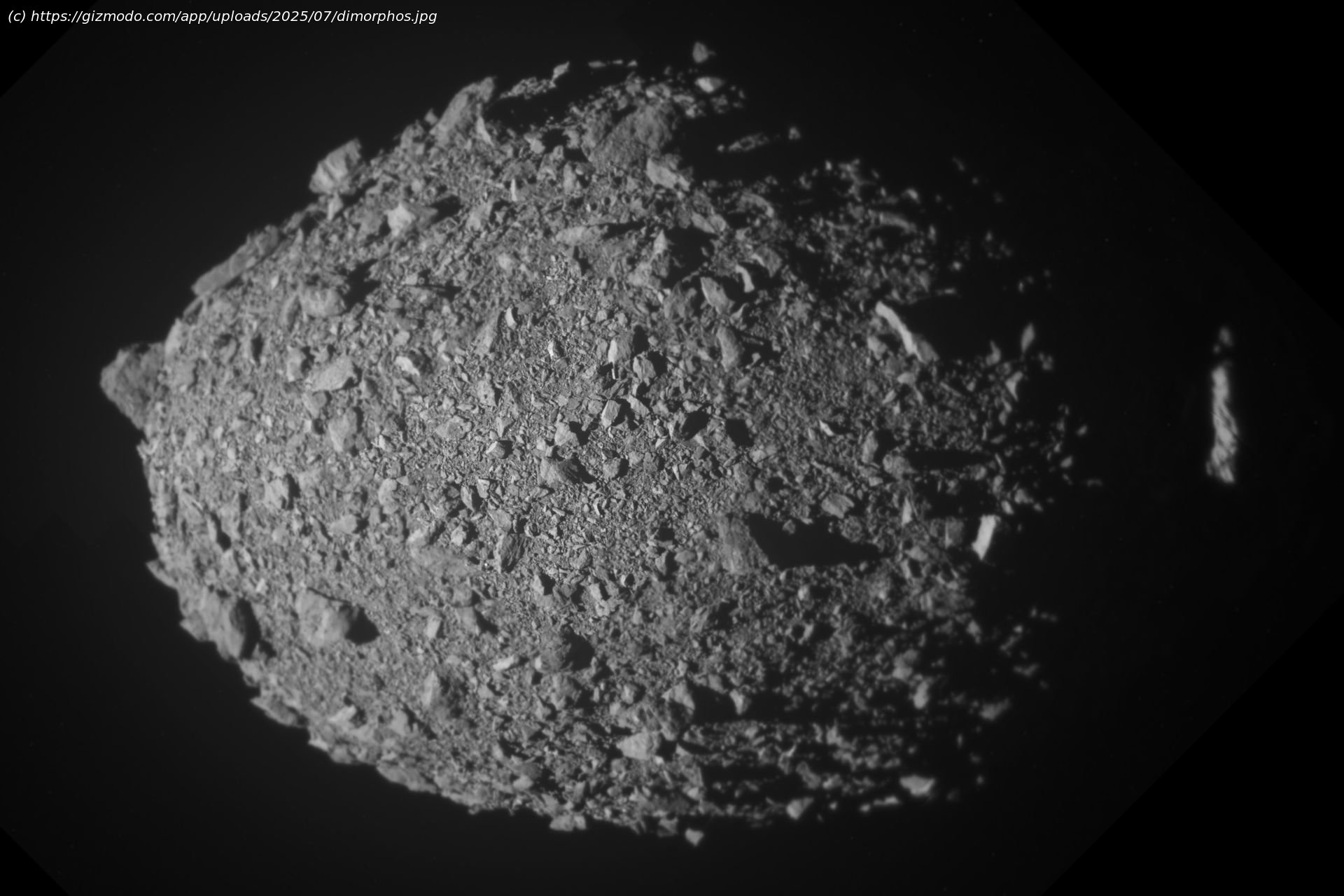
Scientists still have much to learn about the potentially life-saving «kinetic impactor technique.»
In 2022, NASA rammed a spacecraft into an asteroid to see if it could alter its orbital period around its parent asteroid. The mission, dubbed the Double Asteroid Redirection Test (DART), aimed to determine whether humanity could theoretically save itself from a catastrophic asteroid impact.
DART collided with Dimorphos, a small moonlet orbiting a larger asteroid called Didymos, on September 26, 2022. The results of the impact blew NASA’s expectations out of the water, shortening Dimorphos’s orbital period by 32 minutes. Such a change would be more than enough to deflect a dangerous asteroid away from Earth, indicating that this strategy—the kinetic impactor technique—could save us if necessary. New research, however, complicates this success story. An investigation into the debris DART left behind suggests this technique, when applied to planetary defense, isn’t as straightforward as scientists initially thought.
“We succeeded in deflecting an asteroid, moving it from its orbit,” said study lead author Tony Farnham, a research astronomer at the University of Maryland, in a statement. “Our research shows that while the direct impact of the DART spacecraft caused this change, the boulders ejected gave an additional kick that was almost as big. That additional factor changes the physics we need to consider when planning these types of missions.” Farnham and his colleagues published their findings in The Planetary Science Journal on July 4.
Dimorphos is a “rubble pile” asteroid, a loose conglomeration of material such as rocks, pebbles, and boulders held together by gravity. This study only applies to this type of asteroid. Had DART collided with a more coherent, solid body, the impact wouldn’t have produced these bizarre effects.