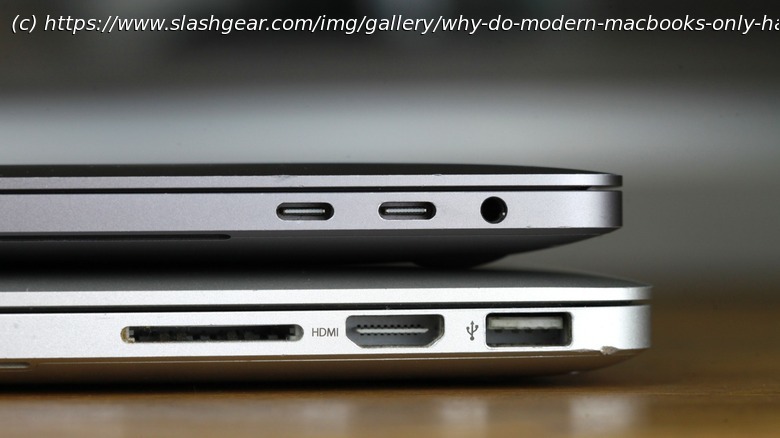
Apple shifted its MacBook lineup to USB-C ports to support faster charging, high-speed data transfer, and slimmer designs while phasing out legacy ports.
If you’ve owned a MacBook that was released between 2016 and 2020, you’ve probably noticed that there isn’t much variety when it comes to the port selection. There’s usually just a headphone jack, a couple of USB-C ports, and well, that’s it. Apple first introduced this approach to its major computers on the 2016 MacBook Pro. The 13-inch version had two USB-C ports, while the 15-inch version had four. With this, Apple welcomed a new era where one port could perform multiple functions.
Each USB-C port can handle power delivery, data transfer, video output, and more, all through a single reversible connector. They even support Thunderbolt connectivity. Apple’s vision was to create a simpler, sleeker, and more universal ecosystem that reduced clutter while offering maximum versatility.