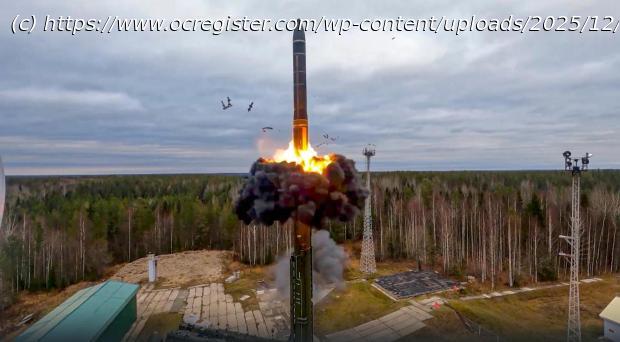
Experts say these threats from the Russia and the U.S., the world’s two largest nuclear powers, put pressure on nonproliferation efforts and endanger peace and security.
The United States and Russia have both recently threatened to resume nuclear testing, alarming the international community and jeopardizing a global norm against such tests.
Experts say these threats from the world’s two largest nuclear powers put pressure on nonproliferation efforts and endanger global peace and security.FILE – A mushroom cloud rises from a test blast at the Nevada Test Site on June 24, 1957. (U.S. Energy Department via AP, File)
“Because of other countries’ testing programs, I have instructed the Department of War to start testing our Nuclear Weapons on an equal basis,” U.S. President Donald Trump said in a post on his Truth Social site at the end of October. “That process will begin immediately.”
Moscow quickly responded.
Russian President Vladimir Putin told his Security Council that should the U.S. or any signatory to the Comprehensive Nuclear-Test-Ban Treaty conduct nuclear weapons tests, “Russia would be under obligation to take reciprocal measures.”
Here’s is a look at what a resumption of nuclear testing could mean.
Concerns about the negative effects of nuclear weapon tests grew in the 1950s when the U.S. and the Soviet Union carried out multiple powerful atomic tests in the atmosphere. As a result, a limited nuclear test ban treaty was negotiated that prohibited such tests but underground tests were still permitted.
Renewed international efforts to ban all nuclear tests resulted in the start of negotiations for a comprehensive treaty in 1994, culminating in its adoption by the U.N. General Assembly in 1996.
With 187 states having signed the treaty and 178 having ratified it, most experts believe the treaty has established a norm against atomic testing — even without formally entering into force.
For the treaty to officially take effect, 44 specific states — listed in an annex to the treaty — must ratify it. Nine of them have not yet done so.
China, Egypt, Iran, Israel and the U.