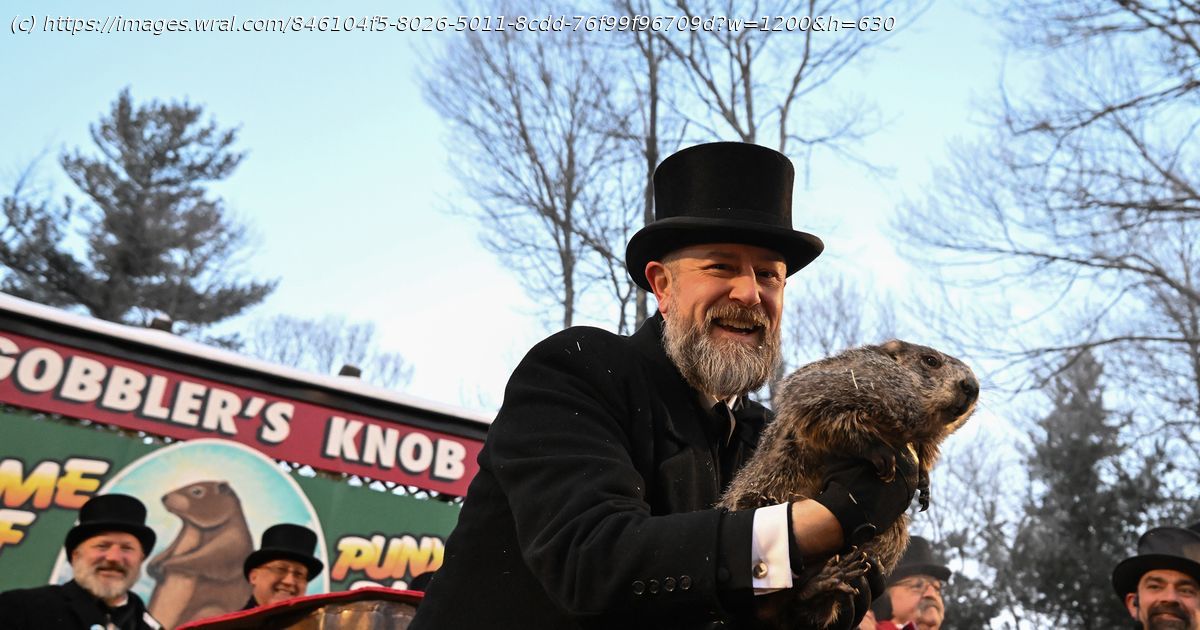
The handlers of a groundhog named Punxsutawney Phil at Gobbler’s Knob in western Pennsylvania announced that he saw his own shadow Monday morning, thereby predicting six more weeks of winter and not an early spring.
The handlers of a groundhog named Punxsutawney Phil at Gobbler’s Knob in western Pennsylvania announced that he saw his own shadow Monday morning, thereby predicting six more weeks of winter and not an early spring.
Thousands attended the annual event that exploded in popularity after the 1993 Bill Murray movie, “Groundhog Day.”
Other WRAL Top Stories
It’s part of a tradition rooted in European agricultural life, marking the midpoint between the shortest day of the year on the winter solstice and the spring equinox.
And in eastern and central Pennsylvania, where people of German descent have been watching the groundhog’s annual emergence from hibernation for centuries, there’s a tradition of groundhog clubs and celebrations that are independent of Phil.
Some dismiss the Punxsutawney event held every Feb. 2 as an unworthy rival to their own festivities, which they say forecast more accurate weather predictions. There have been weather-predicting groundhogs in many U.S. states and Canadian provinces, and less formal celebrations far and wide.
One thing it’s not: serious business.
“We know this is silly; we know this is fun,” said Marcy Galando, executive director of the Punxsutawney Groundhog Club. “We want people to come here with a sense of humor.”
Celtic people across Europe marked the four days that are midway between the winter solstice, the spring equinox, the summer solstice and the fall equinox. What the Celts called Imbolc is also around when Christians celebrate Candlemas, timed to Joseph and Mary’s presentation of Jesus at the Temple in Jerusalem.
Ancient people would watch the sun, stars and animal behavior to guide farming practices and other decisions, and the practice of watching an animal’s emergence from winter hibernation to forecast weather has roots in a similar German tradition involving badgers or bears.