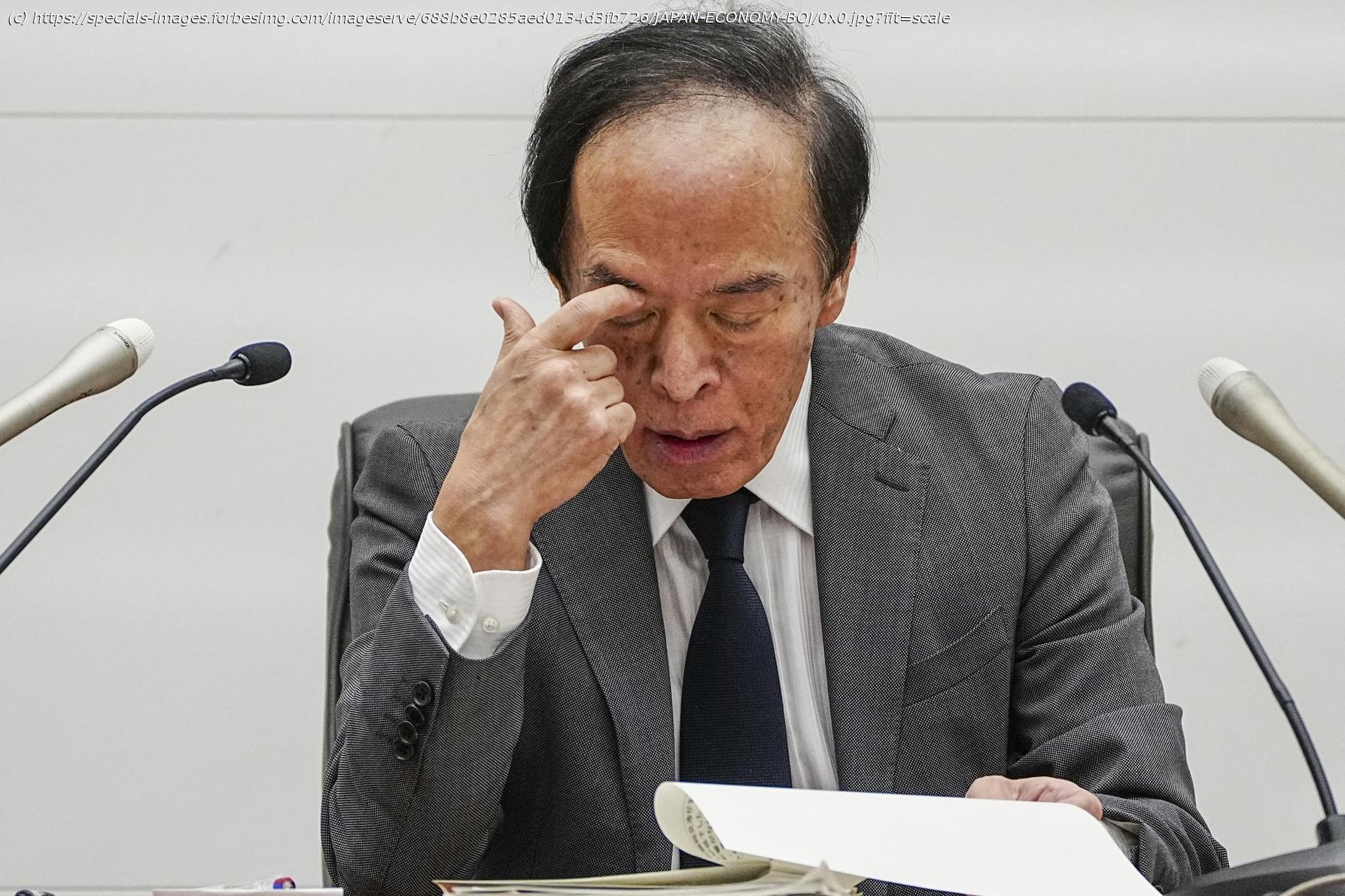
Poor Jerome Powell in Washington may be wearing the hard hat, but it’s Kazuo Ueda here in Tokyo who’s taking the real hits from Donald Trump.
Poor Jerome Powell in Washington may be wearing the hard hat, but it’s Kazuo Ueda here in Tokyo who’s taking the real hits from Donald Trump.
This week may be remembered as the moment when the Bank of Japan’s second effort since 1999 to normalize rates died. BOJ Governor Ueda said nothing of the sort on Thursday when he left the benchmark rate unchanged.
But Trump’s trade war has narrowed Ueda’s options to the point that BOJ watchers can barely see even a glimpse of a way forward.
Most Japan watchers are focusing on the wrong data point. For many, the issues is the 15% tariff that Prime Minister Shigeru Ishiba managed to score from Trump’s trade team.
Japan didn’t get off easy, exactly, but with Tokyo staring down the barrel of a possible 35% Trump tax and another 25% on autos, the outcome was fine by Tokyo. If Trump wants to quibble about the mechanics, financing methods and timeline of the $550 billion “signing bonus” fund he’s demanded, so be it. By the time anyone figures out what this entity is and how it works, the U.S. and Japan could both have new leaders.
The real issue is how the tariffs, and the chaos around them, have Japan barreling toward stagflation. As Ueda admitted on Thursday, inflation is accelerating. His team revised up its core consumer inflation forecast for fiscal year’s to 2.7% from 2.2% projected three months ago.
How to respond would be much clearer if Japanese growth wasn’t essentially flat, at best. Team Ueda’s forecast for real gross domestic product growth in fiscal 2025 is all 0.6%.
The BOJ is as risk-adverse as any monetary institution — more so, in fact. After all, 26 years should be enough time to get rates away from zero. And to switch off the quantitative easing machine that hums 24/7 in the background supporting Asia’s second-biggest economy.
Ueda has been trying, of course. Over the last year, he’s gotten the BOJ’s benchmark to 0.5%. That’s the highest since the BOJ last tried this in 2006 and 2007. By 2008, after Lehman Brothers collapsed, rates were headed back to zero. QE was back, too.
Trump’s trade war is proving to be just as devastating as the global crisis 17 years ago. Whereas Japan, China and South Korea avoided the worst of that crash, they’re now directly in the collateral damage zone.
The BOJ, especially. An argument can be made that Federal Reserve Chair Powell is having a worse 2025 than Ueda. Rarely does a day go by without Trump slamming Powell in ways investors have ever seen a president do. Ueda doesn’t have Japanese leaders stopping by the BOJ for photo opps in front of construction crews.
Yet the BOJ faces a near-impossible choice as Trump’s tariffs cloud Japan’s economic outlook. “BOJ policymakers face a delicate balancing act between competing policy dilemmas, including sticky inflation, lukewarm consumer demand, fiscal pressures, and tariff impacts,” says Yuxuan Tang, global market strategist at J.P. Morgan Private Bank.
One wildcard that really worries Tokyo: that China refuses to submit to the “grand bargain” trade deal of Trump’s dreams, triggering a whole new wave of Trump-driven tariff chaos. There’s always the risk, too, that Detroit’s complaints about Trump’s Japan deal prompts the White House to backtrack on the 15% auto tax level.
Japan’s preexisting conditions are their own problem. A quarter century of zero rates and a weak yen deadened the urgency to reduce bureaucracy, internationalize labor markets, rekindle innovation, increase productivity or empower women.
Now, as headwinds head Japan’s way, Ueda’s BOJ lacks the tools to save that day. And the BOJ’s latest effort to normalize rates is rapidly getting trumped.





