How often do you think of ancient Roman cement?
From the iconic Colosseum in Rome to Hadrian’s Wall all the way in England, there’s one question most people must ask themselves when gazing upon the enduring traces of one of the most beloved ancient civilizations: How the heck has it lasted so long?
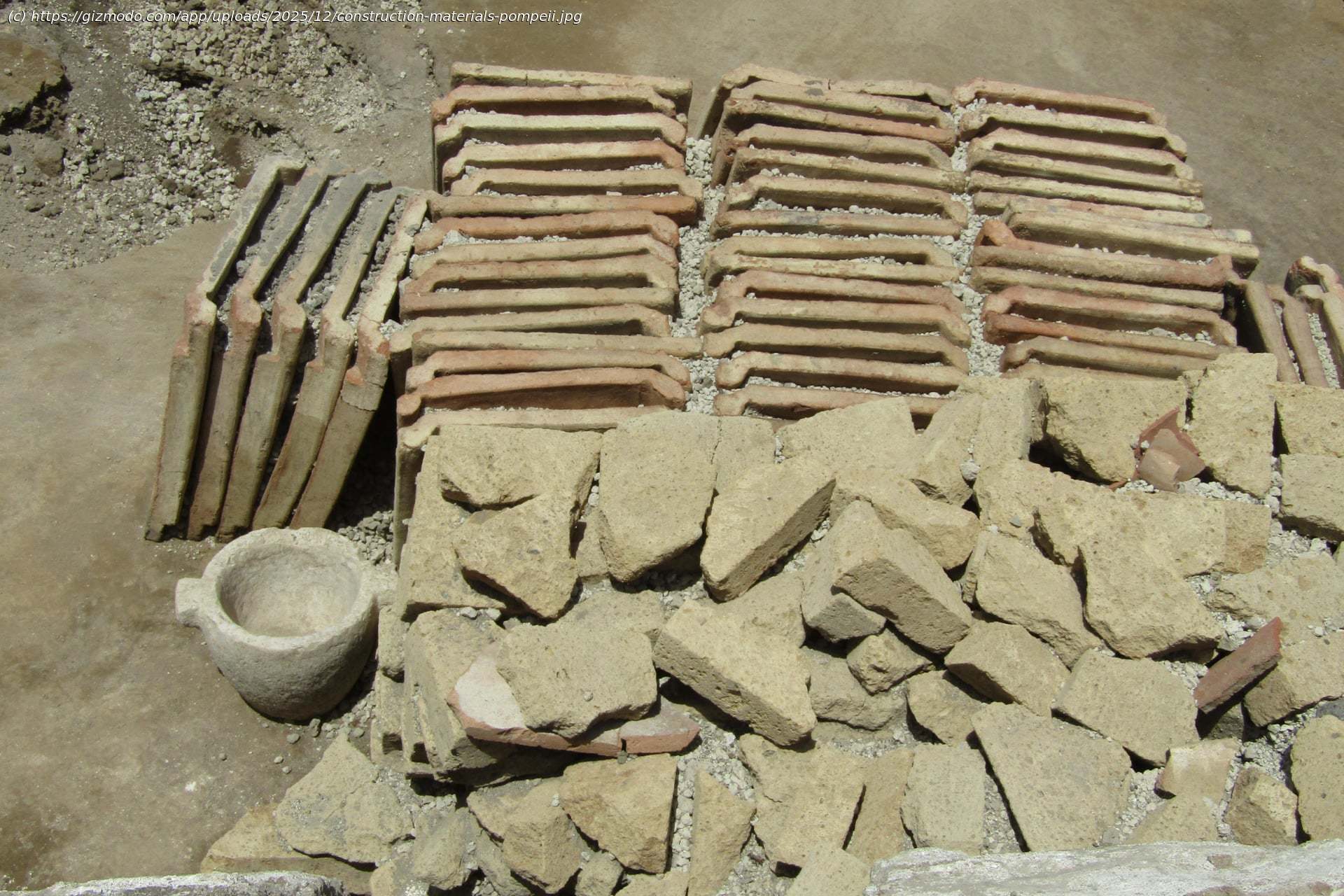
In Pompeii, researchers have investigated building materials in partially constructed rooms that shed light on this very question by providing insight into ancient Roman cement. A study published today in Nature Communications provides further evidence that they used “hot mixing”—mixing quicklime (dry, heated limestone) with volcanic rocks, volcanic ash, and water, triggering a chemical reaction that produces heat.
In 2023 Admir Masic, a physical chemist at the Massachusetts Institute of Technology (MIT), and colleagues published a paper describing how ancient Romans created such long-lasting cement, deducing the process of hot mixing from the cement’s chemical composition. As the hot mixture solidifies, it locks highly reactive lime into small gravel-like components. When the concrete cracks, these components, called lime clasts, dissolve again and fill in the cracks, essentially healing the damage.
However, their study used samples from a wall that might not be representative of other concrete structures throughout the Roman Empire. What’s more, it challenged the process described by the famous ancient Roman architect Vitruvius, who in the first century BCE authored “De architectura,” the first known book on architectural theory. Vitruvius wrote that Romans mixed water into lime to produce a paste-like material before adding other ingredients.