If your info appears on a people-search site, you can request its removal—but chances are, that’s just the tip of the iceberg. For broader data removal, services like Incogni or Optery can help. I compare both to determine which is best.
Pricing Options
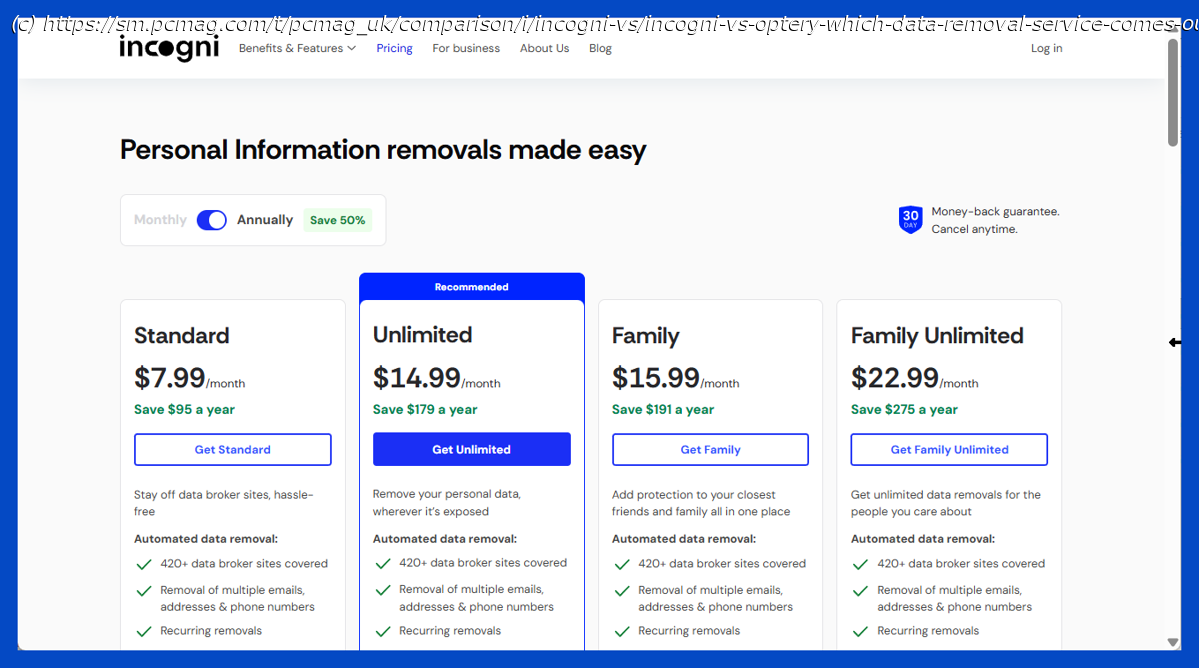
andard subscription to Incogni’s services costs $95.88, while the top-tier Unlimited subscription goes for $179.88. The Standard subscription gets you everything Incogni offers except for custom removals.
Optery subscriptions are available in three tiers: Core, Extended, and Ultimate, priced at $39, $149, and $249 per year, respectively. At the Ultimate tier, you get automated removal from every data broker site that Optery handles, with human intervention as needed. Extended subscribers also receive machine- and human-assisted removals for a large subset of the full site list. At the Core tier, you receive fully automated data removal from over 100 sites, eliminating the need for human intervention.
As with Incogni, Optery reserves custom removals for its top-tier customers. A Core subscription is subject to some limitations on available features.
Incogni’s Standard subscription is substantially less expensive than Optery Extended, and an Unlimited subscription with Incogni also undercuts the price of an Ultimate subscription with Optery. Yes, you can get started on the cheap with Optery Core, but in the pricing realm, Incogni edges out a win.
Winner: IncogniServices Available for Free
Optery includes a free Basic subscription as part of the main pricing lineup. You can sign up at no cost to get a free scan that reports which data brokers have profiled you. Optery supplies that report again every quarter.
In Optery’s reporting, details for each broker include an opt-out link, email for opt-out requests, or both. That’s to help with your homework—at the free level, opting out is a do-it-yourself project. Besides those links, Optery supplies detailed opt-out guides for nearly 200 popular data broker sites.
It’s not immediately obvious that you can get a free scan from Incogni. The default way to get started is with a paid subscription, which includes a 30-day money-back guarantee. It took me some digging to find Incogni’s Digital Footprint Checker scan. You supply the scanner with your name, email address, state of residence, and city, and it sends you a scan report by email.
The report includes links to the sites where Incogni found your data; however, these are only generic top-level links. It doesn’t link to an opt-out page or to the page containing your profile. It’s on you to dig into Incogni’s collection of opt-out guides (around seven dozen of them) and make DIY opt-out requests.
Winner: OpteryBreadth of Coverage
Numbers aren’t everything. Comparing the number of data brokers managed by different services becomes hazy, as some lists include multiple URLs that connect to the same broker. Even so, if I showed you one service that covered two dozen data brokers and another that managed two hundred, you’d surely be inclined to pick the latter. The difference between Optery and Incogni isn’t that stark.
Incogni’s list of covered brokers currently has over 400 entries, categorized by data sensitivity, including areas such as people search and marketing, and by geographic area. Most (approximately 60%) are people search sites, and all but a handful are based in the US. Another 1,000 or so are identified as sites where custom removal has succeeded.
As for Optery, its basic list of brokers beats Incogni by about 200. Optery can search for your profile on approximately 630 people-search sites and actively remove it, often providing proof in the form of clear before-and-after screenshots. But its abilities don’t stop there. If you enable the free Expanded Reach mode, it unlocks hundreds more data brokers, ones that don’t make their listings publicly available. Optery handles this by sending out “blind” requests, essentially stating that if you have this person’s data, you must remove it.
Optery also identifies nearly 600 sites where custom removal has been successful, totaling approximately 1,200 sites.