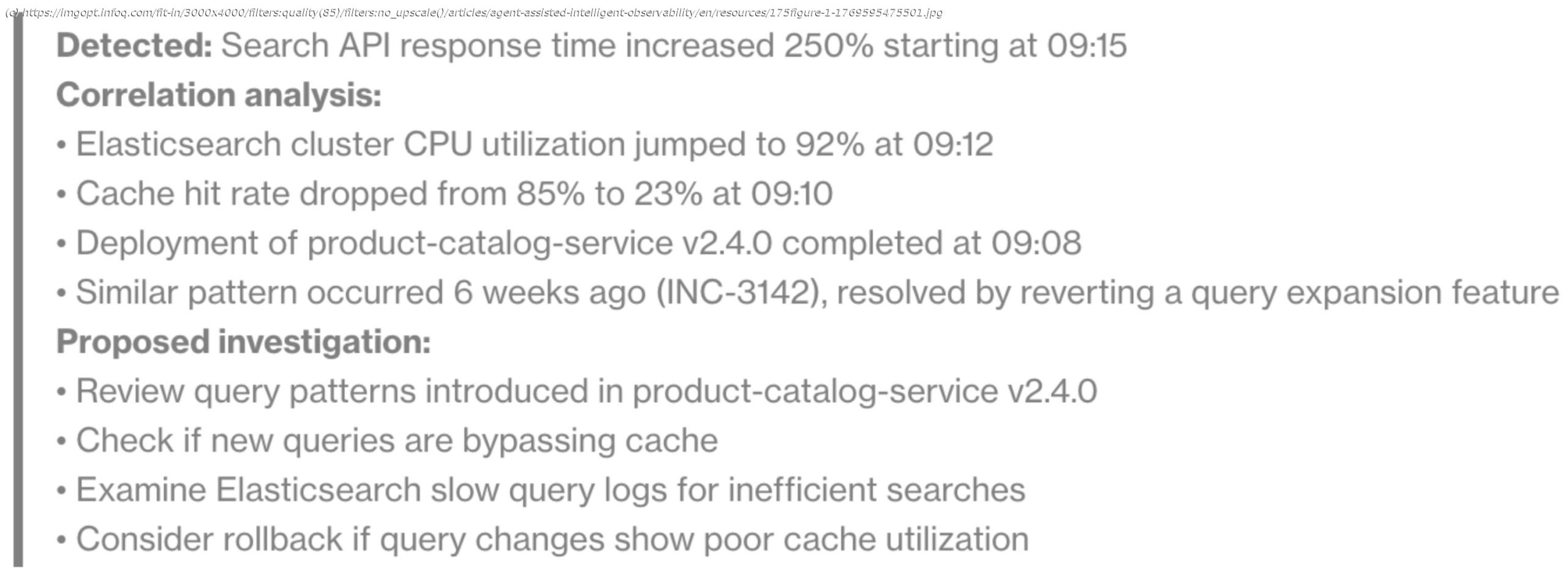
As systems grow, observability becomes harder to maintain and incidents harder to diagnose. Agentic observability layers AI on existing tools, starting in read-only mode to detect anomalies and summarize issues. Over time, agents add context, correlate signals, and automate low-risk tasks. This approach frees engineers to focus on analysis and judgment.
Key Takeaways
The monitoring maintenance burden grows with system complexity. As systems expand with new services and dependencies, teams spend significant time maintaining observability infrastructure and correlating signals during incidents.
Agentic observability does not require ripping and replacing your monitoring stack as agents integrate with existing monitoring and observability platforms.
Start with read-only mode and build trust gradually, beginning with anomaly detection and summarization. Then add operational context to enable intelligent correlation and investigation, before considering any automation.
After observing patterns from real incidents, identify repetitive, low-risk tasks as automation candidates and establish clear guardrails for when and how automation rules run.
AI agents shift engineering time from manual debugging to analysis and verification, improving operational efficiency rather than replacing human judgment.
If you have ever been on call, you know this ritual. The page arrives at 2:00 a.m. You jolt awake, grab your laptop, and start the investigation. You check the service dashboard. Then the dependency graph. Then the logs. Then, the metrics from three different monitoring tools. Thirty minutes later, you realize it’s a false alarm. The threshold was set too aggressively, a deployment canary triggered an alert that self-resolved, or a transient network blip caused a momentary spike.
But you can’t just go back to sleep. You wait. You watch. You make sure the alert window closes cleanly and nothing else fires. By the time you’re confident it’s truly resolved, you have lost an hour of sleep and most of your ability to fall back asleep.
This scenario plays out in operations teams everywhere. We keep tuning our alerts, trying to find that perfect balance. Make them too sensitive and you get buried in false positives. Make them too loose and you miss real incidents. This dynamic leads to alert fatigue, where engineers become overwhelmed by a high volume of alerts that do not require action. Over time, this reduces trust in alerts and slows response to real issues. Research on alert fatigue shows this slowing response is pervasive: In security monitoring, surveys have found that over half of all alerts are false positives, and similar patterns emerge across IT operations. That is not a configuration problem. That is a fundamental challenge of monitoring complex distributed systems.
Teams spend countless hours optimizing their alerting rules, and they should. But the underlying problem remains: The scope of what we need to monitor has outpaced our ability to manually maintain and interpret it all.The Monitoring Paradox We Don’t Talk About
The reality of modern systems is they never stop growing. Each new feature introduces more logs to parse, more metrics to track, more dashboards to maintain. What started as a clean architecture with straightforward monitoring becomes a sprawling ecosystem that requires constant attention.
The maintenance burden grows with the system. Teams spend significant time just keeping their observability infrastructure current. New services need instrumentation. Dashboards need updates. Alert thresholds need tuning as traffic patterns shift. Dependencies change and monitoring needs to adapt. It is routine, but necessary work, and it consumes hours that could be used building features or improving reliability.
A typical microservices architecture generates enormous volumes of telemetry data. Logs from dozens of services. Metrics from hundreds of containers. Traces spanning multiple systems. When an incident happens, engineers face a correlation problem. Which of these signals matters? How do they connect? What changed recently that might explain this behavior?Enter the AI Teammate
When I first encountered the concept of AI agents for observability, I was skeptical. It sounded like vendor hype meets buzzword bingo. But as the technology has matured and early implementations have emerged, the potential is becoming clearer.
The key shift is to think of these systems not as replacements but as teammates. Specifically, teammates who are really good at the parts of incident response that humans find tedious: pattern matching across massive datasets, remembering every previous incident, and staying alert at 2:00 a.m. on a Tuesday.
Agentic observability means your monitoring system doesn’t just collect metrics and fire alerts. It actually understands what it’s seeing. It can:
Notice things that don’t fit patterns: not just threshold breaches, but subtle shifts in behavior that suggest something’s wrong before it becomes critical.
Connect dots across your stack, correlating that spike in database latency with those authentication errors and that deployment from six hours ago.