The recently released Token-Oriented Object Notation (TOON) aims to be a schema-aware alternative to JSON that significantly reduces token consumption at a similar level of accuracy. While the existence and importance of token saved depend on the data shape. some benchmarks show TOON may use in some cases 40% fewer tokens than JSON, possibly resulting in LLM and inference cost savings.
The recently released Token-Oriented Object Notation (TOON) aims to be a schema-aware alternative to JSON that significantly reduces token consumption at a similar level of accuracy. While the existence and quantity of saved tokens depend on the data shape, some benchmarks show that TOON may use 40% fewer tokens in some cases than JSON, potentially resulting in LLM and inference cost savings.
TOON self-describes as a compact, human-readable encoding of the JSON data model for LLM prompts.
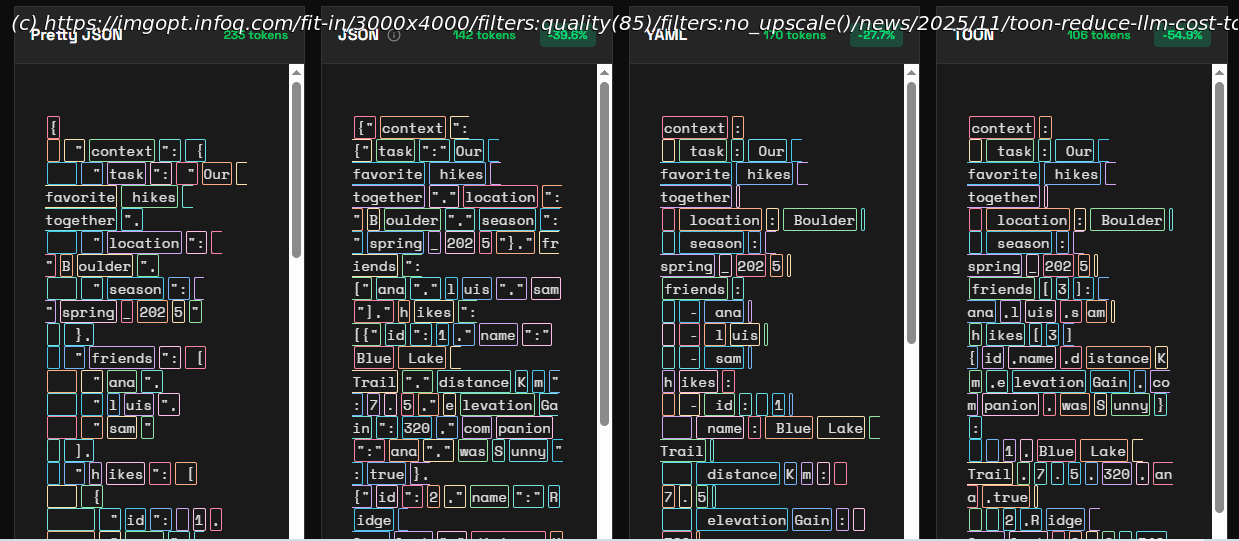
Consider the following JSON: { « context »: { « task »: « Our favorite hikes together », « location »: « Boulder », « season »: « spring_2025 » }, « friends »: [« ana », « luis », « sam »], « hikes »: [ { « id »: 1, « name »: « Blue Lake Trail », « distanceKm »: 7.5, « elevationGain »: 320, « companion »: « ana », « wasSunny »: true }, { « id »: 2, « name »: « Ridge Overlook », « distanceKm »: 9.2, « elevationGain »: 540, « companion »: « luis », « wasSunny »: false }, { « id »: 3, « name »: « Wildflower Loop », « distanceKm »: 5.1, « elevationGain »: 180, « companion »: « sam », « wasSunny »: true } ] }
In the TOON format, the same data becomes: context:
task: Our favorite hikes together
location: Boulder
season: spring_2025
friends[3]: ana,luis,sam
hikes[3]{id,name,distanceKm,elevationGain,companion,wasSunny}:
1,Blue Lake Trail,7.5,320,ana,true
2,Ridge Overlook,9.2,540,luis,false
3,Wildflower Loop,5.1,180,sam,true
Running this example in an online playground will show a 55% reduction in tokens vs. pretty-printed JSON, 25% vs. compact JSON, and 38% vs. YAML.
As the previous example showcases, TOON combines YAML (for nested objects) and CSV (for uniform arrays) layouts to save tokens. However, for non-uniform data, JSON may be more efficient. For deeply nested objects, YAML may be more token-efficient. For flat datasets, CSV remains the most compact format. TOON adds a small overhead (~5%) with field headers and array declarations, in order to improve LLM accuracy.
Johann Schopplich explained on X:
“Does token efficiency hurt accuracy?”
No 🙂 TOON hits 99.4% accuracy on GPT 5 Nano while using 46% fewer tokens.
Tested across ~160 questions and 3 LLMs with semantic validation.
I think explicit lengths + field lists = fewer mistakes.
Readers may review TOON’s specifications, documentation, online playgrounds, and run their own efficiency and accuracy benchmarks. In latency-critical applications, developers should compare Time To First Token and tokens per second in both formats.
The reference implementation in TypeScript/JavaScript is maintained at github.com/toon-format/toon. The reference implementation includes a complete encoder and decoder, CLI tools for JSON-to-TOON conversion, and performance benchmarks. TOON 1.0 was released under the MIT license two weeks ago.