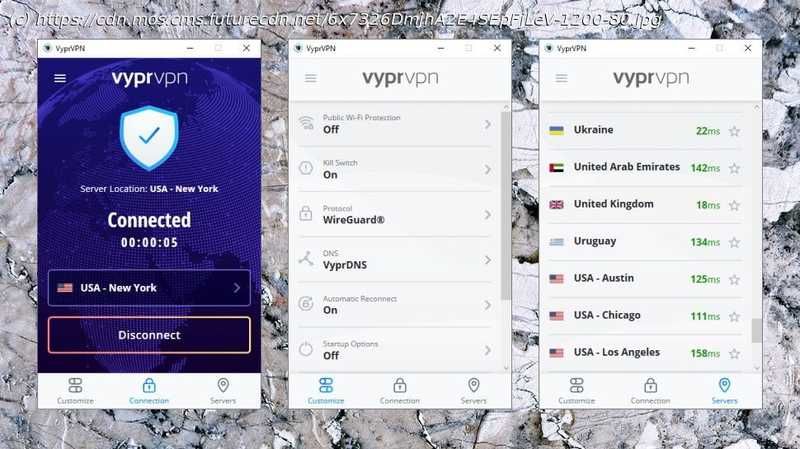
This is an impressively feature-packed VPN – but there are a few small issues to be aware of.
A popular Swiss-based VPN from the same corporate group as Usenet provider Giganews, VyprVPN has a decent-sized network with 700+ servers in 70+ locations across 60+ countries. These aren’t solely focused on Europe and North America, as we often see – VyprVPN has 14 locations in Asia,5 in the Middle East,7 in Central and South America,2 in Africa and 5 in Oceania. Even better, these servers are owned and managed by the company. That means there’s no reliance on third-party web hosts, unlike most of the competition. Welcome features include a zero-knowledge DNS service, a customized Chameleon protocol to help bypass VPN blocking, P2P support across the network, and 24/7/365 customer support to keep the service running smoothly. Wide platform support includes apps for Windows, Mac, iOS, Android, Tomato-based routers, QNAP, Anonabox, Smart TVs and Blackphone. If that’s not enough, the website has 30 tutorials to help you set up the service on Chromebooks, Linux, Blackberry, Synology NAS, OpenELEC, Android TV, Apple TV, and via DD-WRT, AsusWRT, OpenWRT and more. It’s a lengthy list, but there’s still something missing: VyprVPN doesn’t have any browser extensions. Whatever hardware you’re using, VyprVPN supports connecting up to five devices simultaneously. That’s still the industry standard, but many providers now offer more: Private Internet Access and IPVanish support up to 10 simultaneous connections, StrongVPN handles 12, while Windscribe and Surfshark have no limits at all. The website has the usual ‘no logging’ claims, but unlike most of the competition, you don’t have to take these on trust. In 2018, VyprVPN had an independent audit to verify that it doesn’t log or share anything about what you’re doing online, including session logs, and you can read the report for yourself. Recent improvements are mostly about performance and protocols. You can now make speedy WireGuard connections on Windows, Mac, iOS, Android and Android TV. The company’s Chameleon obfuscation protocol has been reengineered to do an even better job of getting around VPN blocking, and the VyprVPN iOS app now supports both Chameleon and OpenVPN. There’s good news on the unblocking front, too, with VyprVPN now claiming to support 35 streaming catalogs, including Netflix, Amazon Prime Video, BBC iPlayer, Hulu, HBO Go and more. Does it deliver all this? Keep reading. VyprVPN pricing starts at $12.95 billed monthly, towards the high end of the $10-$13 industry average. The annual plan is cheap at just $3.75 a month (paid upfront), though, and it plummets to only $2.50 a month on the two-year plan. This isn’t just a special introductory deal, either, where the price doubles on renewal (like at Surfshark). There are no marketing tricks, no uncomfortable surprises later on – just surprisingly low standard prices. Sign up and although you’ll be asked for payment details (card and PayPal are supported), the company won’t bill you for three days. Cancel from your web console before the time is up and you won’t be charged anything, so this is effectively a short free trial. Three free days isn’t long, but it’s three days longer than most providers offer, so we’re not about to complain. If you decide to carry on after the trial is up, and you run into any major issues, you’re also protected by a 30-day money-back guarantee. A few companies give you more – Hotspot Shield and CyberGhost allow 45 days, for example – but 30 days should be long enough to identify any problems. VyprVPN protects your privacy with well-chosen protocols and industrial-strength encryption. It supports AES-256-GCM and SHA384 HMAC by default for OpenVPN, with TLS-ECDHE-RSA-2048 to provide Perfect Forward Secrecy. (The latter is a smart technique which ensures that a different key is used for every connection, so that even if an attacker obtains a private key, they would only be able to access data in that particular session.) WireGuard is now supported across all platforms, along with OpenVPN and IKEv2. VyprVPN’s custom Chameleon 2.0 protocol has been improved to do an even better job of bypassing aggressive VPN blocking (it’s a new option on the iOS app, too, which is good to see). We don’t attempt to test access from China, but VyprVPN is far more upfront about issues with its service than most providers, publishing details of any current problems on its Service Status page. If you’re having difficulties connecting to the service, unblocking particular streaming sites or anything else, the Service Status page usually has more info available. We can’t say whether it includes every problem the company is experiencing, but it seems to be regularly updated with a lot of useful details, and the fact that it exists at all is a major credit to VyprVPN. We wish other providers would be as upfront about their service difficulties. Back to privacy: VyprVPN provides an encrypted zero-knowledge DNS service, a handy way to avoid ‘man-in-the-middle’ attacks, DNS filtering and other snooping strategies. Works for us, although if you’re less happy with the idea, the apps also allow you to switch to any third-party service (just enter whatever IP addresses you need). Individual apps have their own privacy-protecting technologies, too, including options to defend against DNS leaks and bundled kill switches to reduce the chance of data leaks if the VPN connection drops. We’ll look at these in more detail later. Figuring out a VPN’s real logging procedures can require spending an age digging through the privacy policy, terms of service, support documents and more, before trying to decide how much you can trust whatever the provider has said. VyprVPN improves on this immediately with a privacy policy which gets straight to the point, explaining that there’s no logging of source or destination IP addresses, connection start or stop times, user traffic or DNS requests. Even better, you don’t have to take VyprVPN’s word for this, as in September 2018 the company hired Leviathan Security Group to audit the platform and produce a public report on its logging practices. The results [PDF] are available to all on the VyprVPN website, and make an interesting read. Experts will find a huge amount of detail on how VyprVPN works, and the in-depth testing performed by the auditors (logging in to servers, inspecting running processes, examining source code, and more). Everyone else can simply check the executive summary, which explains that the audit initially found a few limited issues (‘from inadvertent configuration mistakes’), but these were ‘quickly fixed’, and ‘as a result, [the audit] can provide VyprVPN users with the assurance that the company is not logging their VPN activity.’ While that’s great news, and still much more than the majority of VPN providers have done, we hope VyprVPN doesn’t stop there. It’s been more than two years since this audit; plenty of time for new problems to have cropped up. TunnelBear has had three annual security audits of its service, and we’d like to see other providers do repeat runs like so.