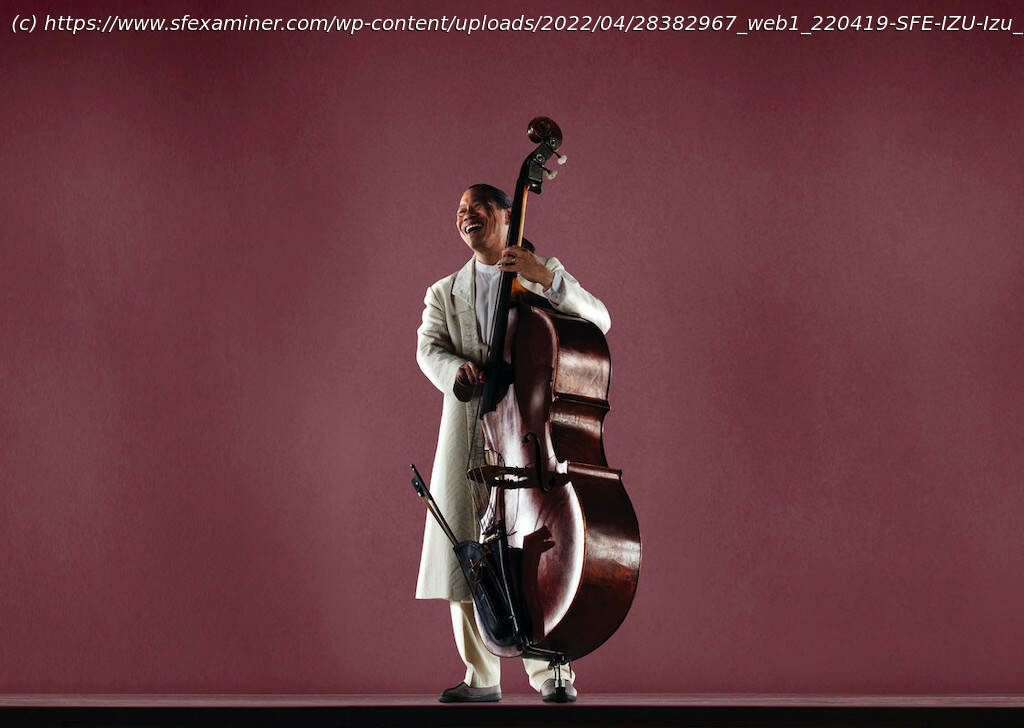
World Premiere of Mark Izu’s ‘Songs for J-Town’ at Presidio Theatre
An epiphany often can occur at the most inopportune moment. Local jazz bassist Mark Izu’s struck him, of all dates, on September 11,2001, as Americans reeled from the World Trade Center disaster. His band had a Yerba Buena Gardens show booked, and its musicians had already flown in before airports shut down nationwide, so the high-road choice seemed obvious: Cancel the gig. But following the wise teachings of his Los Angeles-based sensei, the late Togi Suenobu, Izu picked the road less traveled. “My sensei always said, ‘Don’t think so much about life — you really have to experience it,’ says the musician and composer,67, who this weekend will be premiering his 90-minute “Songs for J-Town” at the Presidio Theatre. The work is inspired by the history of San Francisco’s Japantown and the pandemic-era transformations it’s undergoing. Every venue was dark on 9/11, Izu recalls, but his ensemble agreed to perform anyway, with or without pay. “It was literally the only thing open that night, and it was packed, because people really wanted to be with other people,” he says. Complementing the ethereal music was a blessing by a Konku minister, plus a rousing singalong of the Hawaiian folk song “Aloha Oe,” complete with English translation. “And it just made me cry,” he adds. “Because that was the essence of why I do what I do — we’re here to entertain people, but we’re also here to bring people together for a deeper connection.” Inspired by Japan’s traditional Gagaku music and its nature-revering Shinto and Konko religions, Izu — who was artistic director of The City’s Asian American Jazz Festival for 15 years — does stand on ceremony. And he seeks the spiritual in every creative undertaking, be it collaborations with his theater-artist wife Brenda Wong Aoki (like their breakthrough 1997 play “Mermaid” and a more recent “MU”), or solo commissions like scoring the soundtrack to Sessue Hayakawa’s 1919 silent film “The Dragon Painter,” leading to an upcoming assignment composing soundtracks for recently unearthed reels of Japanese- and Chinese-American home movies from the ‘30s. During lockdown, while reconsidering the thematic focus of “J-Town,” he switched from his customary acoustic bass to the sho to stream 10-minute “ Sho Meditations ” daily at 10 a.m. “The sho is a Japanese mouth organ with 17 bamboo pipes, and it sounds like a harmonica-bagpipe with these vibrating reeds,” says the multi-instrumentalist who has also mastered the Chinese sheng. “So I’d play these meditations, and I had these loyal followers, who said, ‘This is exactly what we need right now — everyone’s so worried, no one can sleep, and none of us know what’s going to happen in the future.’” Izu has compiled more than enough for a future album. Initially, Izu imagined “J-Town” as more cherry-blossom fragrant and verdant. “But after the pandemic, everything feels different — the malls have been sold, and there’s so much vacancy there,” he says of the neighborhood, which no longer houses as many Japanese-descended folks as it used to. So he returned to the mixed-media impulses he acquired through Lewis Jordan, his old bandmate in the ’80s SF free-jazz outfit United Front. His theater scores have been performed at Lincoln Center, the Kennedy Center and Sundance, and his film soundtrack for “Bolinao 52” even won a 2009 Northern California Regional Emmy, so conjuring music for images — and vice-versa — has become improvisational second nature. His art, he assesses, is a lot like life itself: “If you look straight at something, you don’t really see it, but if you look slightly left of center? I’ve realized it’s so much better to get the big picture and understand how the audience sees it — it’s just a different way of looking at things, a way of understanding the world of music through different mediums.” The “J-Town” performance will center on his bass-generated music, on poetry and on conducive mood lighting, with a closing reception featuring tea and Japanese candies. The only visuals? A commemorative stage photograph of his senseiand an introductory short film by Izu’s wife, “Return of the Sun,” which retells the legend of the Japanese Sun Goddess Amaterasu, who becomes so distressed by the warring state of humanity that she disappears into a cave. It’s a timely metaphor for our current Ukraine-bedeviled state. “The world was suddenly dark, and everyone realized they needed to coax her out of her cave, so they danced and sang until she finally peeked out and people were happy again. World War starts incrementally, so reading the news is just so depressing,” says Izu. But the fable also reflects he and his wife’s optimistic belief system: “We have to celebrate our life to make the sun shine, to continue to bring life to the world.” IF YOU GO: “Songs for J-Town” Where: Presidio Theatre,99 Moraga Ave., S.F. When: 7:30 p.m. Saturday, April 23 Tickets: Starting at $25 Contact: (415) 960-3969, www.presidiotheatre.org