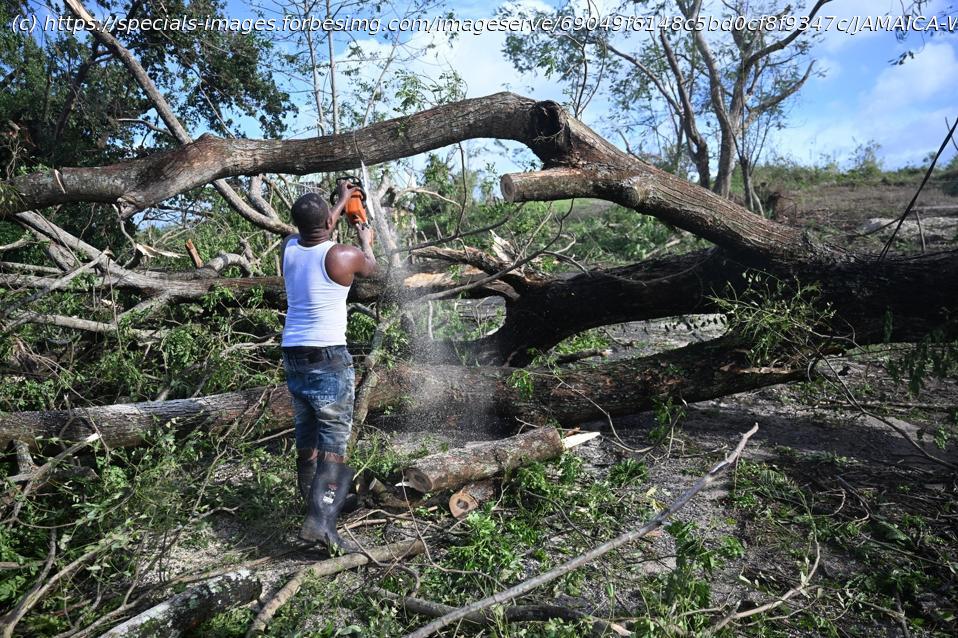
As Hurricane Melissa tests Jamaica’s strength, a global network of Jamaicans rallies to rebuild — revealing what climate resilience truly looks like
In 1965, upon receiving the keys to the Jamaican capital city of Kingston, Rev. Dr. Martin Luther King Jr. reflected on his visit, saying, “In Jamaica, I feel like a human being.” He went on to share that he was proud to be among “brothers and sisters on this wonderful island.”
Sixty years later, that same island — the place that once offered refuge to a weary civil rights leader — is again testing the limits of its humanity and resilience. Hurricane Melissa, a monstrous Category Five storm, roared across Jamaica this week with sustained winds topping 252 miles per hour at low altitudes. Though the entire island felt its fury, the storm made landfall along the island’s southwest coast, in the parish of St. Elizabeth — a region too often left out of glossy tourism brochures but rich in culture, farmland, and working-class grit.
While outside the resort belt, St. Elizabeth’s role in Jamaica’s economy benefits the entire island. Known as the “breadbasket” of the island, St. Elizabeth and the other southwestern parishes are home to the farmers, fishermen and families who anchor the nation’s food supply and keep the economy resilient. Now those crops are flattened, those homes are flooded, the grids providing power have failed, and those parishes remain isolated due to Melissa’s devastation.
So far, at least 19 people have been confirmed dead, according to the Jamaica Embassy in Washington, DC, as the country begins to assess the full scope of Hurricane Melissa’s destruction. Much of the western half of the island has suffered severe damage to roads, bridges, and communications networks.
Four public hospitals have reported significant structural damage or power loss, and roughly 70 percent of the island remains without electricity, leaving hundreds of thousands in the dark as crews work around the clock to restore basic services.
“The entire infrastructure and everything needed for the convenience of modern living is destroyed here,” Jamaican Prime Minister Dr. Andrew Holness said on a visit to St. Elizabeth following the storm.“But, from what I have seen and the interaction, the people here are strong, resilient and positive in outlook.”
It’s that enduring positivity that makes Jamaica more than a geographic landmass in the Caribbean sea; it’s a people bound by connection, love, and faith that radiate far beyond the island’s shores. Whether through its music, its cuisine, or its unshakable belief in equality and the human spirit, Jamaica has long sown the seeds of resilience.
Those same seeds now drive a recovery effort that could become a model for climate resilience across the Caribbean and beyond.
This resilient spirit is easy to romanticize from afar, but in St. Elizabeth, it’s gritty, wet and real. The parish that feeds much of Jamaica is now blanketed in mud and silence, broken only by the sound of hammers, radios, and neighbors calling out for one another. This is where the country’s celebrated optimism and push to “keep the faith” meet their most challenging test: not on a concert stage, but in fields once flooded and houses now collapsed.
You don’t have to look far to find small miracles of progress. In a recent post on social media, reggae icon Beenie Man, born and still residing in Kingston, was seen shoulder to shoulder with other Kingstonians, packaging rice and preparing meals for fellow Jamaicans in the hardest-hit parishes. As part of his “Beenie Man Rescue Teams,” the artist — whose real name is Anthony Moses Davis — has mobilized volunteers across the island to deliver food and supplies to hospitals, schools, and communities fighting to recover.
And he isn’t alone. Just hours before the storm made landfall, hundreds of concerned Jamaicans, members of the diaspora, and allies joined a virtual town hall with Ambassador Antony Anderson, Jamaica’s envoy to the United States. The conversation quickly turned from fear to action — how to move money, supplies, and manpower to the island in the storm’s aftermath.
“In these types of disasters is when you see the true humanity of everyday people come out,” said Anderson, following the storm at a press conference he hosted at the embassy.
“There are 1.5 million Jamaicans integrated into U.S. society, and they have rallied quickly and ramped up their support to assist their homeland in this time of crisis,” he stated.
In the aftermath of Melissa, Jamaicans abroad have mobilized, transforming community centers, churches, restaurants, and cultural hubs into drop-off sites for relief supplies across Washington, D.C., Broward County, Florida, New York City, Atlanta, and Chicago. Volunteers are collecting bottled water, nonperishable foods, lightweight clothing, children’s items, medical kits, and recovery essentials such as flashlights, power banks, and PPE. Many of these parcels are already en route to Jamaica, bound for Norman Manley International Airport in Kingston and Ian Fleming International Airport in St. Mary Parish. On Saturday, November 1st, Montego Bay’s Sangster International Airport will reopen.
“We are strong and resilient people, and as this recovery and relief effort gets into high gear, the world will see that resilience play itself out,” said the Ambassador. “Our diaspora is here in the U.S. Many have one foot here and one foot in Jamaica, and now is the time for the diaspora to come together.”
Jamaica, like other islands across the Caribbean, counts among some of the world’s smallest carbon emitters. Its devastation stands as a living, breathing example of the climate crisis: rising sea levels, the loss of biodiversity, and dangerously warming ocean temperatures that fuel some of the most powerful storms humanity has ever faced.
As former United Nations Secretary-General António Guterres warned during a 2022 CARICOM Heads of Government meeting, “The Caribbean is ground zero for the global climate emergency.”
Those harms have forced Jamaica to innovate financially as well. Years before Hurricane Melissa, the government established a catastrophe bond, a first-of-its-kind financial safety net that provides rapid disaster funding. The island is now expected to receive a $150 million payout, which will help offset—but not nearly cover—the estimated $5 billion to $10 billion in damage caused by the storm nationwide.
This is a storm that has also caused considerable damage to the Caribbean nations of Cuba, Haiti and the Bahamas.
The remaining amount will come from foreign humanitarian assistance and, of course, from the generosity of the Jamaican people themselves, both on the island and abroad. And that generosity and grassroots spirit have already started. Far too many images and stories have emerged of neighbors helping neighbors, and community members clearing roads, assisting churches and physically carrying the elderly, sick and disabled to shelters and medical assistance.
“To see people, communities and livelihoods just destroyed in an instant is heartbreaking, but it has not taken away our faith in what is possible,” Glenroy Murray, executive director of the Equality for All Foundation Jamaica, said.
In the wake of the storm, Murray’s foundation has launched an unprecedented effort to assist LGBTQIA Jamaicans who are especially vulnerable, as one in three has experienced some form of homelessness or displacement. Working to erase stigma and fear, the foundation’s Rustin Fund is working to raise awareness and resources for many LGBTQIA Jamaicans who might be afraid to access public services.
“This is a moment for everyone to come together. Those of us in Kingston who weren’t hit as badly are already starting drives and fundraising to support our family and loved ones across the island,” Murray said. “Collective action on a national, regional and global scale will be what gets us through this difficult time. Collective action not just in response to this tragedy but to do the necessary climate action to prevent future tragedies.”
That kind of collective action is, honestly, the Jamaican way. Fueled by humor that’s played out across social media, anchored in music, and grounded in faith, the Jamaican people have once again deployed their secret weapon — “likkle but wi tallawah” — small but mighty. It’s a force that stretches far beyond the island’s borders, uniting an entire diaspora — Jamaicans abroad, their children, and their children’s children — all working to help build the island back stronger than ever.
In 1965, Rev. Dr. King described that same spirit when he said of Jamaica’s people:
“Here you have people from many national backgrounds — Chinese, Indians, so-called Negroes — and you can just go down the line, Europeans and people from many, many nations,” King said. “Do you know they all live there, and they have a motto in Jamaica: Out of Many, One People. And they say, ‘Here in Jamaica, we are not Chinese, we are not Japanese, we are not Indians, we are not Negroes, we are not Englishmen, we are not Canadians — but we are all one big family of Jamaicans.’”
It was a dream Rev. Dr. King hoped would one day be realized in America — and a reality that still beats at the heart of the Jamaican people. It’s a truth on full display in this moment of recovery, a reminder that Jamaica’s most significant export has always been its people: resilient, creative, and unbreakable.
And as Jamaica rebuilds, that resilience is real, lasting and might be missed by mainstream media. In the early days after the storm, children will return to school, and churchgoers will return to their houses of worship. Flying above the debris will be the black, green, and gold flag — and on the sacred ground where a church once stood, you’ll hear the echoes of gospel songs reminding the living, and their ancestors, of the road they’ve already traveled and the trials they will overcome.
Because even in ruin, Jamaica insists on being seen — not as a victim of the storm, but as a model of human endurance.
As the island rebuilds, the story of Jamaica’s resilience continues, one act of generosity, one shipment, one song at a time. But rebuilding a nation takes more than spirit; it takes solidarity and resources.
Those moved by Jamaica’s courage and ready to lend a hand can contribute to trusted recovery partners, including supportjamaica.gov.jm, Food for the Poor, the American Friends of Jamaica, and the Rustin Fund for Global Equality. Together, they are helping ensure that the black, green, and gold fly high once more over homes rebuilt and hope restored.