It’s literally dizzying to contemplate.
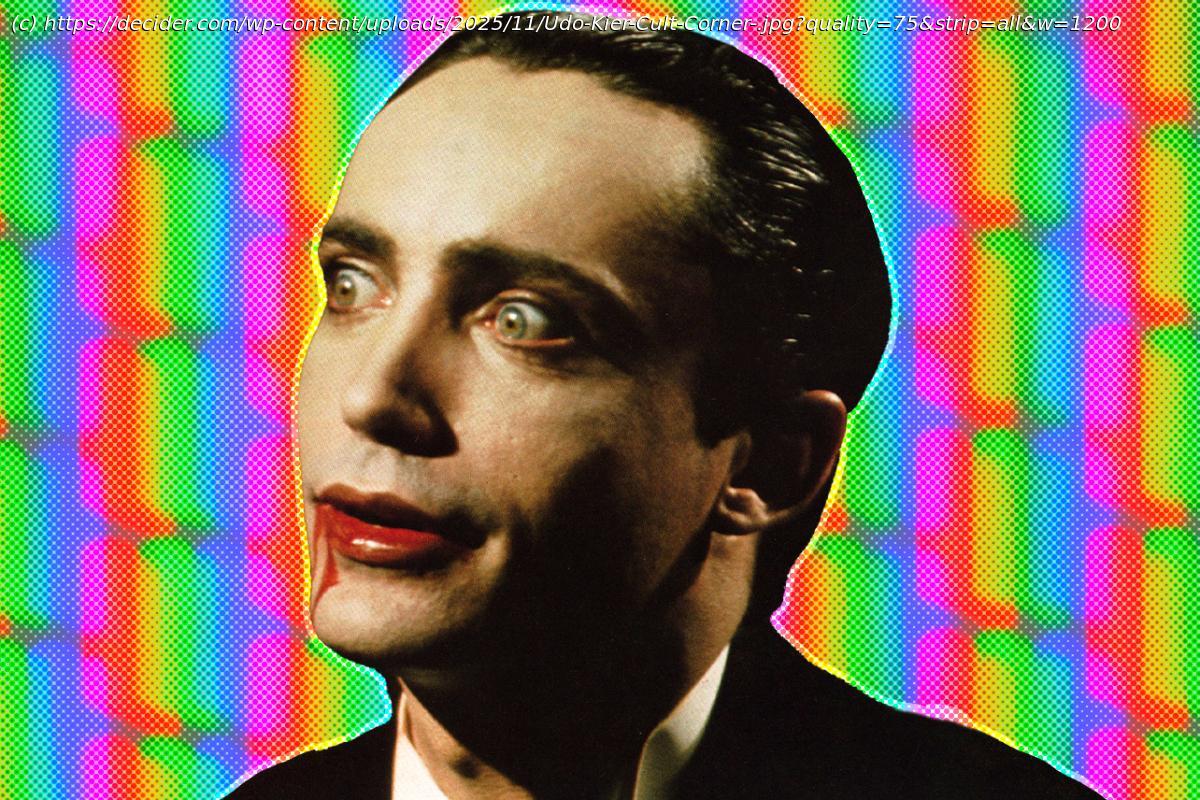
One reckons that very few actors nowadays would even consent to pronounce a line of dialogue like “To know death, Otto, you have to fuck life…in the gall bladder!” And even those who would deign to say those words could never match the enthusiastic delivery achieved by the German born actor Udo Kier in the 1973 Andy Warhol-produced, horror comedy masterpiece Flesh for Frankenstein, co-directed by Paul Morrissey and Antonio Margheriti.
The ever busy Kier, who died in his adopted home of Palm Springs, has more than 250 film appearances to his credit, and the range of directors with whom he works literally goes from A to Z. He played a helpful psychiatrist in Dario Argento’s lurid, multicolored horror masterpiece Suspiria in 1977, and a mobster and police informant — also helpful! — in S. Craig Zahler’s equally lurid (but in a different way) Dragged Across Concrete in 2018. Slight of build, with hypnotic eyes and high cheekbones, there was something about him that made him too exotic to be a conventional leading man. He gravitated toward unconventional material his whole career. In the same year as Concrete, he appeared in Rick Alvreson’s highly alienating psychiatric horror film The Mountain, and a year after that he was in the bloody, mutated Western Bacarau. And then a harrowing adaptation of Jerzy Kosinski’s harrowing World War II novel The Painted Bird. Always in a supporting role, always somehow sinister. But he never phoned in the weirdness. While his presence alone was enough to assure a certain atmosphere, Kier was invariably thoughtful.
He was an exemplary product of post-World War II Germany, in a particularly mordant way: he came into the world in 1944 in Cologne hospital that was being bombed by Allied forces — he and his mother had to be dug out of the rubble. A born survivor, you could say. In his teens he befriended the genius German director Rainer Werner Fassbinder (at one post-screening Q&A, Kier — who, like Fassbinder, was gay — was asked about his relationship with the filmmaker and said something along the lines of, “Oh, sure, we were ‘roommates!’”), and they worked together on several greats, including 1977’s The Stationmaster’s Wife and the epic miniseries Berlin Alexanderplatz in 1980.