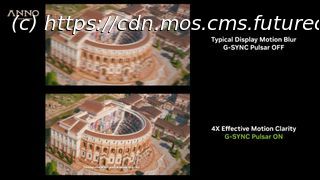
«With Pulsar, you get the motion clarity of a theoretical 1,000 Hz monitor as if you’re rendering at 1,000 fps.»
Nvidia showed off its original version of G-Sync Pulsar motion blur reduction technology two years ago at CES 2024. At first it was only going to be available for monitors with the proprietary G-Sync module installed, but this later opened up to all G-Sync monitors using one of MediaTek’s scaler chips.
Now, two years after its initial announcement, Nvidia has announced an update to the tech which should mean more blur reduction. Oh, and there are actually monitors supporting the tech, now.
Perceived motion blur on a monitor, to simplify a little, is essentially caused by the perception that pixels are still hanging around in their previous position after they’ve moved on to their new spot. That’s not really what’s happening, of course. This can either be caused by a a slow pixel transition to a new value, or it can be caused by our eyes still holding on to the previous frame for a little too long after the image has changed.